
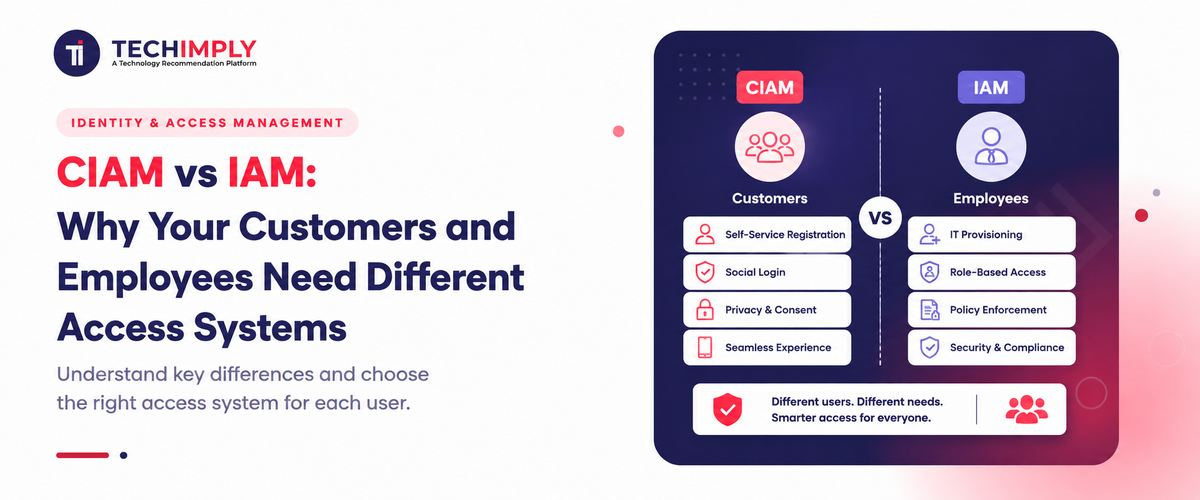
A company may have thousands of employees and millions of customers, yet both groups still need to authenticate before accessing digital services. It can therefore seem efficient to manage them through the same identity system. The problem is that employees and customers have fundamentally different relationships with the business, which means their identity lifecycles, access requirements, and login experiences are different too.
IAM and CIAM address different identity populations and business requirements. IAM is mostly intended for staff and other workforce members; CIAM is developed for consumers and other outside users. The difference has an impact on everything from user experience to scalability, security rules, account creation, and authentication. Understanding these differences helps businesses choose an identity architecture that fits each user group instead of forcing fundamentally different users into the same system..
What Is IAM?
Organizations use Identity and Access Management (IAM) software to control system access permissions, which determine what users can perform within their systems. A standard business environment includes IAM, which protects the access rights of employees, contractors, and administrators, and occasionally trusted business partners.
Users can access email and HR software and internal databases, collaboration tools, and financial systems through their IAM system access. The basic question is:
Who is this person, and what should they be allowed to access?
IAM typically supports authentication, role-based access control, multi-factor authentication, password policies, and user provisioning and deprovisioning
While marketing team members do not need these rights, the new finance team member has to have access to financial reports and accounting software. The system establishes a direct connection between business operations and security guidelines that companies implement internally.
What Is CIAM?
Customer Identity and Access Management (CIAM) software applies similar identity concepts to people outside the organization. These users could be customers, subscribers, patients, members, consumers, or users of a digital product.
A customer identity management platform typically handles activities such as customer registration, login and authentication, password or account recovery, profile management, social or passwordless login, and consent or preference management.
The focus is not only on keeping an account secure. The login experience also forms part of the customer's interaction with the business. That makes customer experience an important consideration when comparing CIAM vs IAM.
Why Customers and Employees Need Different Login Experiences
A login screen appears the same regardless of who is using it. Underneath, an employee logging in and a customer logging in are essentially different interactions. An employee's account exists because the company created it, tied to a job that has defined boundaries and an expected end date. A customer's account is usually created because the customer chooses to use a product or service, although some accounts may be created through invitations or other business processes.
Identity and access management, or IAM, grew up around the first relationship. Customer identity and access management, or CIAM, grew up around the second. Treating them as interchangeable is where the friction starts.
For Example:
Imagine a company with employees and a much larger customer base.
An employee may be required to complete stronger authentication steps before accessing an internal financial system. That extra step may be reasonable because the employee is accessing sensitive company resources. A customer signing into an online store may only want to check an order or update an address. Applying the same experience to both groups can create unnecessary friction.
This is one reason CIAM solutions tend to place more attention on flexible registration, authentication choices, account recovery, and the overall customer journey. The goal is not to make security weaker. It is to make security fit the context.
Do You Know?
A digital identity does not always mean that a service knows a person's real-world identity; digital identity can represent a user within the context of a particular digital service.
CIAM vs IAM: What Is the Actual Difference?
The easiest way to understand CIAM vs IAM is to look at the person using the system and the business relationship behind that identity.
|
Area |
IAM |
CIAM |
|
Main users |
Employees and internal users |
Customers and external users |
|
Main focus |
Internal security and access |
Customer access and experience |
|
Account creation |
Often managed by IT or HR |
Usually customer-driven |
|
Access |
Business applications and resources |
Products, apps, portals, and services |
|
User experience |
Important, but usually secondary to policy |
A major consideration |
|
Identity data |
Often linked to employee records |
Often connected to customer profiles |
|
Lifecycle |
Joiner, mover, leaver |
Sign-up, account changes, inactivity, deletion |
|
Common business teams |
IT and security |
Product, marketing, customer experience, security |
This does not mean that CIAM ignores security or that IAM ignores user experience. The priorities are simply different.
Where Do Partners and Other External Users Fit?
Not every external user is a normal consumer. A business may also need to give access to distributors, resellers, agencies, suppliers, or other business partners. This creates an overlap between CIAM, IAM, and areas such as partner management and channel management.
For example, a manufacturer may have employees using internal applications, retail customers using an online portal, distributors accessing partner resources, and sales representatives working with channel partners. These users do not necessarily need identical access policies. A business may therefore need to think about its identity architecture based on the different groups it serves rather than trying to place every person into one system.
When Should a Business Consider CIAM?
A dedicated CIAM approach may make sense when a business has a large or growing population of external users. For smaller applications with limited external access, a separate customer identity management solution may not always be necessary. Existing application authentication may be enough.
Some common signs include:
- Customers create their own accounts
- Users access several customer-facing applications
- The business wants consistent login across products
- Account recovery creates frequent support requests
- Customer data is spread across different systems
- Product teams need more control over registration and authentication
- The company operates customer or partner portals
- Customer preferences and consent need to be managed alongside identity
A Practical Way to Sort Out Which System Owns Which Group
- If the account is created by your business for someone who works for you, that is IAM territory
- If the account represents an external customer or consumer who interacts directly with your products or services, it is generally CIAM territory.
- If the account belongs to an external business partner, such as a distributor, reseller, agency, or supplier, the organization may need a B2B or partner-focused identity approach. Depending on the platform and requirements, this can overlap with IAM or CIAM rather than fitting neatly into either category.
This sorting exercise is worth doing even for a smaller company. It is far easier to plan for this distinction, including where channel management, partner management, and referral management programs sit, while identity infrastructure is still simple than to untangle it later once thousands of the wrong kind of account are already sitting inside the wrong system.
Keeping IAM and CIAM Connected Without Merging Them
None of this means IAM and CIAM need to run as completely isolated systems with no communication between them. Usually, a customer support agent who is an employee must look up a customer's account to assist them; hence, the two systems have to communicate with one another even as they stay structurally apart.
The goal is not complete isolation. The right internal teams should be able to access the information they need across both systems, subject to appropriate authorization and security controls.

Quick Insight
External business ties are occasionally referred to as B2B IAM, partner IAM, and partner identity management. Although the words differ across companies, the fundamental need is normally the same: controlling identities and access for users who work for another firm.
Conclusion
Often compared as both controlling digital identities and access, CIAM and IAM, however, satisfy different people and maximize different corporate needs. While CIAM concentrates on customer-facing authentication, scalability, account management, and user experience, IAM is meant mostly for workforce security, government, and regulated access. Businesses should look at staffing and client identity needs independently, even if they do not always need totally different items. This becomes even more crucial when partners, distributors, or other outside groups also need access. Early identification of these user groups allows companies to develop an identity architecture that can grow without causing needless security or customer-experience issues.
Related Reads :
- Best Identity vs Access Management: Key Differences
- Best Identity Management Software Cost in India
- Best Identity Management for Employee Lifecycle Explained
- How Does Identity Lifecycle Management Reduce Security and Access Risks?
- Best Identity Management Guide for Indian Businesses
- What Is CIAM and Why Every Indian D2C and Fintech Brand Needs It
- How CIAM Helps Indian Businesses Stay DPDP-Compliant While Keeping Logins Simple
- CIAM vs IAM: Why Your Customers and Employees Need Different Access Systems