On a D2C site, a shopper adds three items to the cart, then clicks the sign-up screen and views a form requesting a password with eight linked guidelines before closing the tab. A few kilometers away, a fintech app sends an SMS OTP to verify a login, but two days ago the SIM was changed, and the person logging in is not the account owner. Two completely different businesses, two completely different outcomes, and the same underlying gap: neither company had a real system for managing customer identity separate from how it manages employee identity.

Looking for Customer Identity and Access Management Software?
Check out Techimply's List of the Best Customer Identity and Access Management Software in India for your business.
That system has a name. CIAM, short for customer identity and access management, is built specifically for this problem, and for Indian D2C and fintech brands operating at consumer scale, it has quietly become less of a nice-to-have and more of a condition for staying in business. Understanding what CIAM software actually does, and why it is different from the identity tools built for employees, is the first step to fixing either problem.
What is Customer Identity and Access Management?
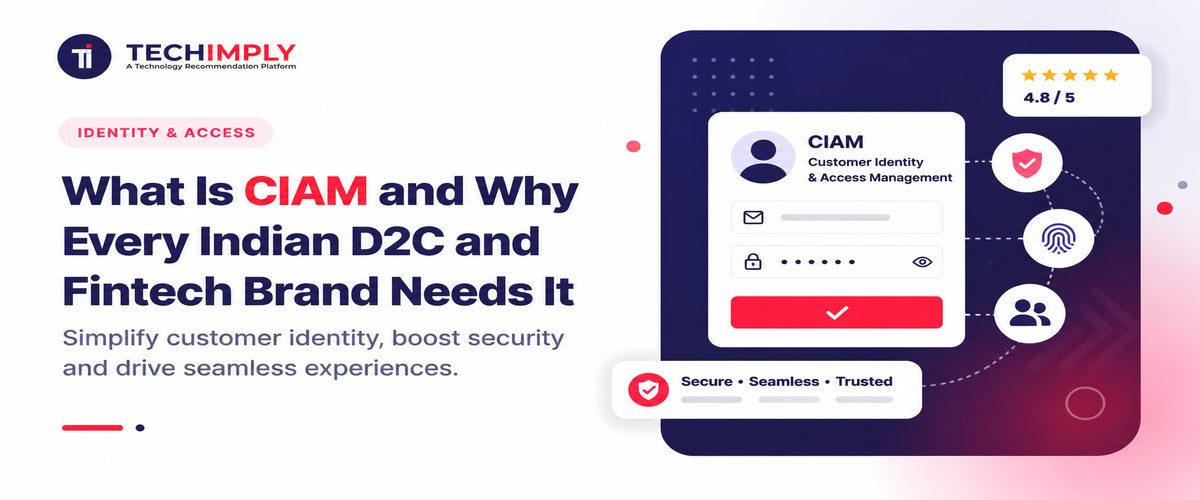
Customer identity and access management (CIAM) is the technological layer that controls how a customer signs up, logs in, resets a forgotten password, and administers their profile across a brand's website, app, and any linked service. It is at the junction of security, which wants excellent verification, and growth or product, which wants signup to take fifteen seconds rather than five minutes- two teams that normally don't share a roadmap.
Customer identity and access management is designed for an ever-growing audience of external users who arrive on their own terms, usually via a mobile app, expecting seamless authentication that supports smooth customer service; workforce identity tools, by contrast, are developed to manage a known, finite group of staff members.
Do You Know?
CIAM is increasingly designed to support millions or even billions of customer identities, because consumer applications can experience massive registration and login spikes that traditional employee-focused identity systems were not designed to handle.
The Growth Problem: Why Indian D2C Brands Lose Customers Before the First Purchase
Baymard Institute research has consistently identified forced account creation as a significant checkout-abandonment reason, with roughly one in five shoppers in its research reporting that they abandoned an order because the site required account creation. Every further field on a signup form, every password rule, and every OTP that takes ten seconds too long to arrive creates friction in the customer experience and acts as a tax on conversion; D2C companies managing paid acquisition are paying twice for every one of these drop-offs: once in ad spend and once in lost revenue.
Social login can reduce signup friction by eliminating the need to create and remember another password, and some industry studies have reported substantial improvements in registration completion. Customer identity and access management platforms are what make this kind of frictionless registration possible without the brand losing visibility into who its customers actually are.
The Security Problem: Why Fintech Apps Are a Favorite Target in India
Indian financial technology companies may encounter threats like phishing attacks, SIM swap frauds, credential theft, account takeovers, and many other kinds of digital threats. Because customer login is often an important security boundary, fintech companies need authentication and risk controls that can respond to suspicious activity. SIM swaps, phishing attacks, and SMS OTP can provide useful authentication, but they should not be treated as universally sufficient for high-risk customer actions.
Though identity verification using Aadhaar can be used to confirm the identity of a customer at onboarding, it is not enough to protect the account during login and password management processes. Customer Identity and Access Management connects these two processes: convenient registration and insecure logins by using adaptive checks.
CIAM vs Workforce IAM: Why the Same Tool Cannot Do Both
It is tempting to assume that an identity and access management tool already deployed for employees could simply be extended to customers. In practice, the two solve different problems at a different scale, and the table below shows where they diverge:
|
|
Workforce IAM |
CIAM |
|
Who it manages |
Employees and contractors |
Customers, app users, sometimes millions of them |
|
Account creation |
Provisioned by IT or HR |
Self-registration by the user |
|
Priority |
Control and least privilege |
Low friction plus fraud prevention |
|
Scale |
Hundreds to a few thousand identities |
Can spike to millions during a sale or campaign |
A workforce identity tool built for a few hundred employees, provisioned manually by IT, will not hold up against a flash sale that brings ten thousand new signups in an hour. CIAM software is purpose-built for that spike.
What a CIAM Platform Actually Does
- Let clients register using email, phone number, or a current social account, therefore lowering signup friction.
- It only asks for step-up authentication when a login seems dangerous, like when someone uses a new device or logs in from an odd place.
- Centralizes consumer profile and permission information such that product, support, and marketing teams view one correct record.
- Before they become account takeovers, it finds and reduces bot-driven login attempts and credential stuffing.
- Scales automatically during traffic spikes without manual provisioning.
Why Fintech Companies Have an Even Bigger Reason
For fintech companies, the conversation changes from convenience alone to trust plus security. A fintech customer may interact with:
- Mobile banking or financial apps
- Payment services
- Investment platforms
- Credit products
- Insurance products
- Customer support portals
- Web dashboards
Every additional digital service creates another identity and authentication touchpoint. That increases the importance of consistent identity controls. RBI's digital payment security framework already places significant emphasis on authentication, security controls, monitoring, financial risk management, and protection of customer information. Its directions for regulated entities include multifactor authentication for electronic payments and risk-based authentication considerations.
For non-bank payment system operators, RBI's 2024 Master Directions on Cyber Resilience and Digital Payment Security Controls also introduced phased implementation requirements, with timelines varying by the size of the operator. CIAM does not replace these regulatory controls. Instead, it can provide part of the identity infrastructure needed to build secure customer-facing journeys.
Where CIAM Meets India's Data Privacy Rules
The Digital Personal Data Protection framework places requirements around how organizations collect and process personal data, including requirements related to consent where consent is the applicable basis for processing. It also gives individuals rights around withdrawing consent and exercising certain controls over their personal data.
This is a need for consumer identification, not employee identification, and it is exactly what a platform for consumer identity and access management is meant to handle: supporting data governance by keeping permission records linked to each identity, updated in real time, and accessible should a regulator or auditor ask for evidence.

Pro-tip
Just check how many mandatory fields your current registration process has and whether it includes a social login option. If a customer has to provide more than three fields or a password to register, then this friction costs you more registrations than you could pay for CIAM.
Why Indian D2C Brands Need CIAM
A D2C brand operates in an ecosystem that consists of customers hopping across Instagram, marketplaces, websites, mobile apps, WhatsApp, customer loyalty programs, and even physical stores. The customer may not think about these as separate systems. They simply see one brand.
If the website recognizes the customer but the mobile app does not, or the loyalty program keeps another profile for the customer, then the company misses out on the opportunity of having a connected relationship with its customer.
A CIAM platform can create a consistent identity across these touchpoints. For example, imagine an Indian skincare brand with:
- A website
- Android and iOS apps
- A loyalty programme
- Subscription orders
- A customer support portal
- Promotional campaigns
Without a connected customer identity layer, each system can end up storing pieces of the same person's information. With customer identity management solutions, the business can create a seamless customer experience by working toward a unified identity, all while controlling what information is collected and how it is used.
Fewer Login Interruptions
Customers can use familiar authentication methods such as OTP, social login, passkeys, or other supported methods rather than repeatedly creating credentials.
Better Account Recovery
A customer who forgets a password should not have to navigate a complicated support process for a relatively simple account problem.
More Consistent Experiences
The same customer can move between web and mobile experiences without feeling as though they are dealing with completely separate accounts.
Better First-Party Data
A centralized identity layer can help connect customer-provided information and preferences across digital touchpoints, subject to the company's privacy and consent practices.
Modern CIAM platforms increasingly combine identity with consent and customer data management for this reason. SAP, for example, describes CIAM as a way to centralize first-party data, customer consent, identity, and access across digital experiences.
Conclusion
For an Indian D2C brand, CIAM shows up as more completed signups and fewer abandoned carts. For a fintech app, it shows up as fraud caught before it becomes a customer complaint or a regulatory finding. Different businesses, same underlying decision: customer identity is not something to bolt on later once growth or a breach forces the question. Many Indian brands can start by adding capabilities such as social login and adaptive authentication to their existing signup flows, then expand into consent management and centralized profile management as their customer identity requirements grow.