An employee resigns on a Friday. By Monday, payroll shows them as inactive, and their name is off the internal directory. But their VPN login still works. Their access to the customer database hasn't been touched. Nobody remembers that they were also added to three separate SaaS tools during a project six months earlier, using a personal email as the recovery contact.
This isn't a rare mistake. It's the default outcome when identity is managed manually, one ticket at a time, across systems that don't talk to each other. Identity lifecycle management exists specifically to close this gap. Understanding how it does so is the difference between treating access control as a routine IT chore and treating it as a core part of your security posture.
What Identity Lifecycle Management Actually Covers
Identity lifecycle management, frequently abbreviated as ILM, represents the segment of identity management responsible for governing a digital persona from its initial creation through to its final permanent deletion. This scope encompasses staff members, independent contractors, and external suppliers, while also extending progressively toward non-personal identifiers including API credentials and service accounts utilized to link separate systems together.
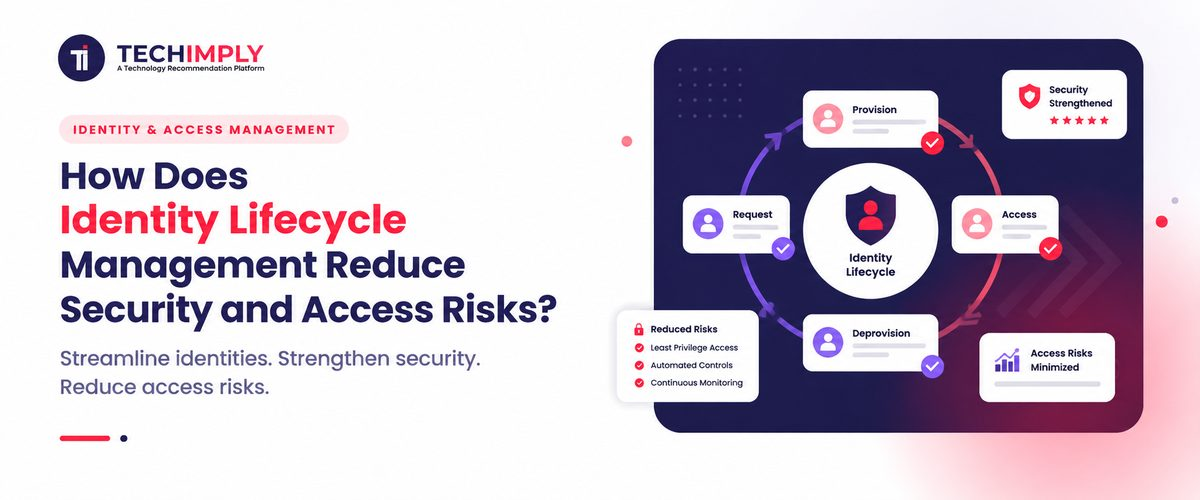
Most identity lifecycle management systems generally revolve around three linked phases, occasionally referred to by the abbreviated terms joiner, mover, leaver:
- Provisioning: When a person joins, creating an identity and granting that access to a role are required.
- Modification: Modifying permissions when an individual's job function, division, or assignment shifts.
- Deprovisioning: Taking away entry totally once someone departs, or a setup becomes obsolete.
A fourth activity, periodic access review or certification, runs alongside these stages to confirm that current access still matches current need, rather than what was appropriate a year ago.
It's worth separating identity lifecycle management from two terms it often gets grouped with. Authentication, single sign-on, and lifecycle management form the wider scope known as identity and access management (IAM). Policy enforcement and compliance reporting are then layered onto these lifecycle procedures within identity governance and administration (IGA).
Privileged access control (PAC) remains even more limited, targeting specifically those administrator and service user profiles presenting significant risk. Managing identity throughout its life cycle serves as the functional core operating beneath each layer; it is the segment responsible for establishing, modifying, and decommissioning accounts according to decisions made by the remainder of the system architecture.
Do You Know?
Every one of those is a separate place an identity can be created, forgotten, and left active long after anyone remembers granting access to it, which is a big part of why manual, spreadsheet-based identity tracking breaks down once a company grows past a certain size.
Where Access Risk Comes From
Before looking at solutions, it helps to be specific about what access risk actually means in practice, since vague warnings about cyberattacks don't help anyone prioritize a budget or a project.
- Orphaned Accounts: These represent credentials staying enabled once the user or device requiring them has ceased usage. A 2025 study involving over 850 experts from security, IT, and HR sectors conducted by Tools. Ever revealed that 42% of companies lack visibility into the total number of orphaned accounts within their networks, with 30% requiring more than three days to cut off access following employee departure, while 12% extend this process beyond one month.
- Privilege Access: Rights pile up quicker than they vanish. A person shifts from help desks to sales, grabs admin permissions for a six-week task, then switches groups once more, retaining everything throughout. No one consciously chose this as fine; it just lacked review entirely.
- Manual, Delayed Offboarding: When provisioning and deprovisioning depend on someone remembering to file a ticket in every connected system, delays are inevitable, especially across contractors, seasonal staff, or teams with frequent turnover.
- Unmanaged Non-Human Identities: Service accounts, API keys, and integration tokens often outlive the project or employee that created them, and they rarely show up in a standard access review because no single person is listed as their owner.
How Identity Lifecycle Management Closes These Gaps
Identity lifecycle management tackles every one of those specific patterns straight away, doing so without layering yet another security software above current workflows; instead, it alters the very manner in which access gets established and subsequently taken away initially.
Automated Provisioning Enforces Least Privilege From Day One
When identities are set up based on a specific role instead of being hand-copied from another person's current profile (a frequent quick fix that silently causes too much permission throughout a company), they begin with just the access that said role truly needs. Rules for roles or attributes manage this process by themselves, taking away the guessing involved, which creates extra access right at the start.
Continuous Access Reviews Catch Privilege Creep Before It Compounds
Instead of depending on a person to recall yearly audits, developed identity lifecycle management connects reviews to distinct events: a shift in position, a move between divisions, or a set quarterly timetable. Permissions that no longer align with an individual's present function are marked for deletion automatically, rather than awaiting the following planned review to discover them several months down the line.
Immediate Deprovisioning Closes the Offboarding Window
Here is where lifecycle management gets its title. By linking the HR platform straight into each app and directory where someone holds entry, an exit action inside HR causes removal actions all simultaneously, rather than relying upon IT staff to go through a list by hand over many systems. The time span between "person departs" and "rights deleted" drops from several days down to mere minutes, matching precisely the opening that the orphaned-account figures previously displayed reveals firms face currently.
Extending Coverage to Machine and Non-Human Identities
Verizon's 2026 Data Breach Investigations Report determined that exploiting vulnerabilities surpassed credential misuse as the primary driver of incidents, yet external entities accounted for 48% of verified cases, representing a significant jump compared to the prior year. A large portion of this risk stems from service accounts, API credentials, and supplier connections instead of personal staff access points.
The Business Case Extends Beyond Security
Security is the headline reason to invest in identity lifecycle management, but two other pressures make it increasingly hard to postpone for businesses operating in India specifically. The first is regulatory. Once the DPDP Rules were officially announced on 13 November 2025, India's Digital Personal Data Protection Act, 2023, transitioned from being merely a law into active operation, featuring compliance duties that will roll out gradually across about eighteen months before total enforcement is expected around May 2027.
Among its primary duties lie sensible protections for information safety and quick notification of incidents, tasks made much simpler if a company can clearly identify precisely which individuals accessed private details at specific moments, and verify that such access ceased immediately upon becoming unnecessary.
Lifecycle records essentially become audit evidence, which matters during a data protection Board inquiry as much as during a routine security review. The second is workforce turnover. India's information technology and technical support industry keeps recording very high turnover numbers compared with other big sectors, usually mentioned between twenty and twenty-five percent while total staff loss in Indian companies drops near the middle teens.
For a group of two hundred tech workers, that speed creates many joining and leaving actions annually. Treating every single case by hand does not merely drag HR and IT operations back; it increases the precise moments when forgotten user profiles and security dangers build up without being seen.
Choosing the Right Approach for Your Organization
Not all enterprises require a specialized identity lifecycle management system immediately upon inception. A compact workforce comprising fifteen to twenty individuals utilizing several common applications may frequently handle user onboarding and removal effectively by employing a rigorous exit verification list alongside one administrator tasked with ensuring its application.
That shifts when a firm possesses several divisions, frequent vendor rotation, over a few linked cloud security software, or manages controlled types of information. At that point, manual tracking stops scaling, and the gap between headcount changes and access changes starts showing up in audit findings rather than internal reviews.
When assessing identity lifecycle management tools, certain factors outweigh promotional material:
- Seamless connection to your HR platform ensures that lifecycle occurrences initiate permission modifications automatically rather than relying upon an additional manual action.
- Support for role-based or attribute-based rules on access, not merely static account setup.
- Built-in logging detailing which individuals accessed specific items, and precisely when modifications occurred.
- Coverage for non-human identities alongside employee accounts.
- Realistic implementation effort: these tools are only as accurate as the HR and IT data feeding them, and a messy source system will produce messy access decisions no matter how capable the software is.
If you're comparing platforms for your organization. Most identity management software sold to Indian businesses today bundles lifecycle automation with single sign-on and identity governance reporting, so you're rarely buying lifecycle capability as a completely standalone purchase.

Pro-tip
Before evaluating any software, run a manual check on your five most sensitive systems: email, VPN, your finance or ERP platform, your cloud admin console, and your CRM. Compare every active account against your current employee list. This single exercise usually surfaces the most urgent orphaned accounts immediately, and gives you a concrete baseline to measure improvement against once you do adopt a proper identity lifecycle management process.
Conclusion
Identity lifecycle management does not wipe out all security threats, nor was it designed to. Its function is to apply least privilege rules steadily, taking away the most frequent, easiest-to-stop cause of access problems: user records staying active past their time, holding extra rights they no longer require, ignored by those tasked with oversight. When used uniformly over each identity within the firm, both person and machine, that one adjustment fixes more security holes than many separate security applications handle alone. For most growing businesses, the question isn't whether to eventually address this. It's how many orphaned accounts accumulate before they do.