Ask three vendors for a quote on identity management software, and you will likely get three completely different numbers: one at a few dollars a user, one buried in a custom enterprise contract, and one that claims to be free. None of these numbers are wrong exactly; they are just answering different questions, and that is usually where Indian businesses get stuck while budgeting for identity management software.

Looking for Identity Management Software?
Check out Techimply's List of the Best Identity Management Software in India for your business.
This article breaks down identity management software cost in India, why the pricing swings so widely, and where the real spend hides once you go beyond the number on the pricing page. We will also touch on how privileged access management, or PAM software, is priced differently, since the two are often confused during budgeting even though they solve different problems.
Why Identity Management Software Cost Varies So Much
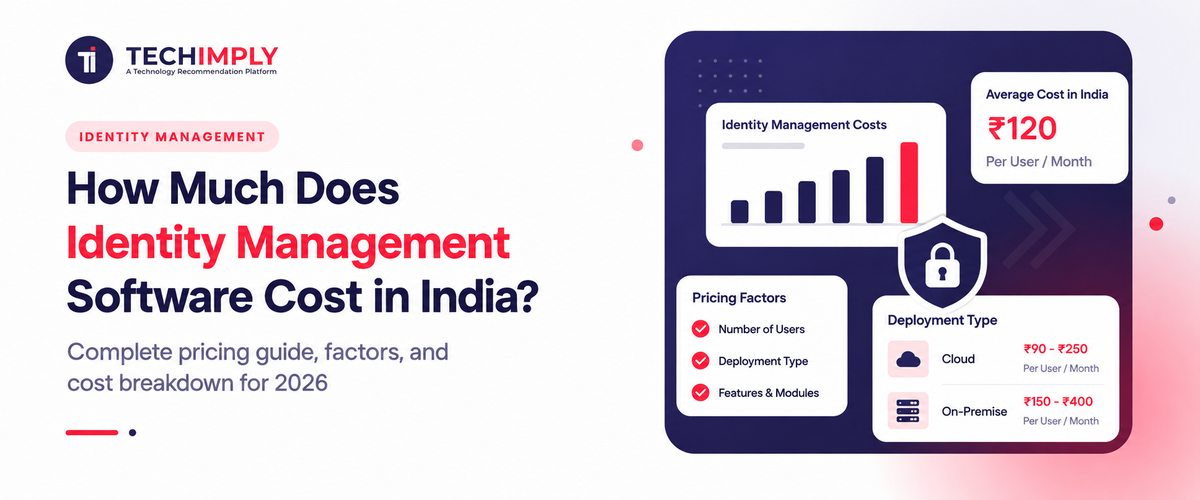
Identity management software cost depends almost entirely on the pricing model a vendor uses, and there are three common ones in the Indian market. Mastering these models is the initial step to interpreting any quote accurately.
- Per-user, per-month: there is a flat fee per active identity, so even if you add many more users, there is no additional charge.
- Alternative commercial options, e.g., unit- or feature-based pricing, with authentication being cheaper than advanced governance or risk-based access controls.
- Flat annual licensing, common with enterprise IAM software, where the contract is negotiated rather than published
A ten-person startup and a two-thousand-employee enterprise are rarely comparing the same product even when both call it identity management software, which is why publicly listed identity management software pricing can look inconsistent at first glance.
[Total Identity Software Cost] = [Base License Fees] + [Implementation & Add-ons] + [GST & Support Tiers]
Do You Know?
Over 40% of corporate cloud software budgets in growing businesses are wasted on ghost accounts, active licenses assigned to former employees or inactive contractors that were never properly deprovisioned.
Typical Identity Management Software Cost in India
Based on current vendor pricing pages and Indian resellers, here is roughly what businesses are paying in identity management software costs across different tiers:
|
Tier |
Typical Vendor Example |
Price Range (per user/month) |
Best Fit |
|
Bundled / low-cost |
Zoho Directory |
Free plan available; paid plans vary by plan |
Small teams already on Zoho |
|
Entry-level IAM |
miniOrange |
Request a Quote |
Startups and SMEs |
|
Microsoft ecosystem |
Microsoft Entra ID P1 / P2 |
Custom Pricing |
Businesses already on Microsoft 365 |
|
Global enterprise IAM |
Okta |
Custom Pricing |
Large or regulated enterprises |
|
Self-hosted / open source |
Keycloak |
No license fee (Costs depend on hosting, cloud infra, and DevOps setup) |
Teams with in-house DevOps capacity |
Pricing Disclaimer:
The prices listed above are indicative estimates based on published rates and market averages in India.
Actual cost may vary depending on local tax regulations, custom enterprise plan, volume discount, regional currency fluctuations for USD-denominated products, or regional vendor promos. For precise and up-to-date quotes, visit the website.
What Free or Open Source Identity Management Software Really Costs
Open source identity management software such as Keycloak carries no licensing fee, which makes it look like the obvious way to avoid identity management software cost altogether. In practice, the long-term total cost of ownership reveals a different picture. Multiple independent estimates suggest that costs for a self-hosted Keycloak server over 3 years would be somewhere between approximately $199,200 and approximately $211,200, taking into consideration infrastructure, DevOps time, and the engineering skill set of someone who would operate it in production.
That cost is not licensing. It is labor: someone has to handle clustering, patching, uptime, and security hardening constantly. For a company with an existing team already comfortable with DevOps tools and identity protocols, this can still work out cheaper than a subscription. For a smaller Indian business without dedicated infrastructure staff, a managed identity management software subscription is usually the more predictable and, ultimately, cheaper option than treating open source as free.

Pro-tip
Before comparing prices across vendors, list every connected app, your total user count, and whether you need privileged account coverage separately. Most pricing confusion comes from comparing quotes that were never scoped to the same requirements.
Cost Factors Beyond the Sticker Price
The quoted per-user rate is rarely the full identity management software cost. A few line items tend to show up only after a business has already shortlisted a vendor:
- Implementation and setup fees, varying from a few thousand dollars to twenty-five thousand dollars US for larger implementations.
- Per-connection charges for linking additional identity providers or applications.
- SMS or OTP charges for multi-factor authentication, billed separately in many pricing models.
- Premium support tiers, since basic support is often limited to email or ticket-based response.
- Data residency requirements, which can push a business toward vendors with Indian data centers at a different price point.
Asking for an all-in quote covering these items, rather than just the base subscription, is usually the difference between an accurate budget and a number that grows a few months into the contract.
Identity Management Software Cost vs PAM Software Cost
Identity management software cost and PAM software cost often get bundled into the same budgeting conversation, but they are priced differently because they cover different risk. Identity management software handles everyday access for every employee. More recently, development of privileged access management, which protects a much smaller subset of high-risk accounts, such as system or database administrators, and usually includes password vaulting, session recording, and just-in-time access authorization.
Because PAM software protects fewer accounts with far more sensitive access, it is usually priced per privileged account rather than per general user, and the per-account cost tends to run higher than standard identity management software. A company might pay a modest per-user rate for identity management software across its entire workforce, then a separate, higher rate for PAM software covering only its 15 or 20 privileged accounts. Budgeting for both under one line item is a common mistake, since the two solve different problems and rarely come from the same pricing sheet.
How to Estimate Your Own Identity Management Software Cost
A simple way to estimate your first-year of running a quick calculation of identity management software cost is to take the per-user cost of each of the plans you've shortlisted, multiply that across your total number of employees, and then add 15-20% to cover set-up costs, additional connected applications, and any modules that you may find yourself needing in your first year.
For businesses already on Microsoft 365, Entra ID pricing will normally be near a marginal cost rather than a new line item. Businesses on other stacks should also plan for the full per-user price as a separate line item.
Again, Single sign-on (SSO) and basic provisioning are typically included at the entry level under normal per-user prices, while more advanced identity governance, risk-based authentication, and detailed compliance reporting are more likely to be offered in higher tiers.
Keeping Identity Management Software Costs Down Without Cutting Corners
Integrating software licensing into your overall cloud cost management strategy helps prevent unnecessary IT overspending. You can keep expenses low by following a few practical steps:
- Use the identity management software contained in your current productivity suite (Zoho One, Microsoft 365, etc), if it provides this free service.
- Negotiate annual billing where possible, since most vendors discount against monthly pricing.
- Confirm whether MFA and SMS OTP costs are bundled or billed separately before signing.
Identity management software for small business does not need to match enterprise feature sets. For a ten- or twenty-person company considering identity management solutions, a bundled or entry-level package should be given priority, with a move to a dedicated IAM platform only once the volume of linked apps or compliance needs really exceeds it.
Quick Note:
Once infrastructure and DevOps time are considered, a three-year total cost of ownership for self-hosted, license-free identity management software like Keycloak can approach 199,000 US dollars, usually making a paid subscription more affordable for smaller teams.
Conclusion
By examining beyond simple monthly subscription costs to include implementation costs, currency factors, and feature tiers, Indian companies can select solutions that scale with their operations without exceeding their budgets. To get a precise count, you must ask vendors for the complete picture rather than just the headline per-user rate, and you must list PAM software as a distinct line item rather than integrating it into the same budget.