
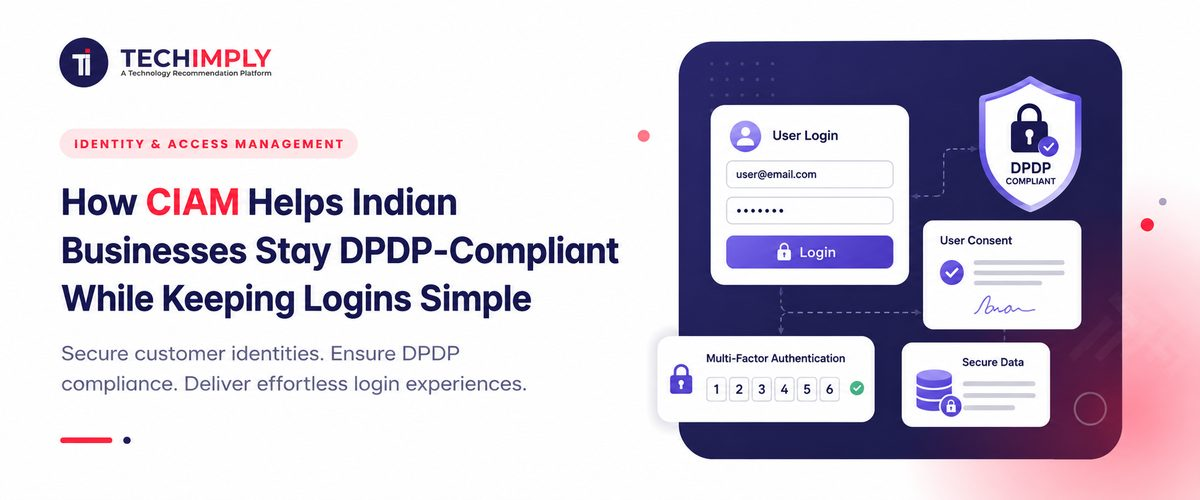
The majority of commercial entities encounter the Digital Personal Data Protection Act and envision a repetitive solution. They add a checkbox to the registration form or a window that asks users to accept agreements - that reaction is common, but it is an incorrect strategy. The Digital Personal Data Protection Act, 2023 is not a requirement for additional obstacles during the entry process. It is a requirement for a system where administrators log authorizations, allow users to cancel them easily, and manage data with backend tools.

Looking for Customer Identity and Access Management Software?
Check out Techimply's List of the Best Customer Identity and Access Management Software in India for your business.
Adding more pages to the payment or authentication steps does not meet those legal standards. It is a factor that causes users to stop using the application. Customer identity and access management is a technology that manages this conflict. It maintains compliance with the Act while ensuring that the entry process remains efficient. The method is not to create more delays. It is to move the administration of authorizations away from the entry interface and into the underlying technical architecture.
What DPDP Actually Asks For at the Point of Login
The Act is not a mandate for a company to block every authentication attempt with a fresh authorization request. Rather, it sets clear rules for compliance management, requiring a standalone document written in plain language before any personal data is collected. To maintain proper compliance management under the law, organizations must audit these authorizations and provide a revocation process that requires no more effort from the user than the initial consent.
Data principals are the legal term for users whose information a company processes. They have the right to see, change, or delete their information. With this law, they can also name a representative or submit a formal complaint. None of these rights require a customer to see a new screen every time they log in. They require the business to have built the infrastructure to honor them when asked, which is a very different engineering problem than a bigger consent banner.

Pro-tip
Test your current consent withdrawal flow yourself before an auditor does. If withdrawing consent takes more clicks or more time than giving it did, that gap alone is enough to fail the DPDP Act's as-easy-as-giving standard.
The Two DPDP Deadlines Every Business Should Be Building Toward
The Digital Personal Data Protection Rules 2025, which came out on November 13, 2025, are being implemented in three phases; the gaps between them are exactly the window firms have to get their identity and consent infrastructure ready.
|
Phase |
Date |
What Changes |
|
Phase 1 |
13 November 2025 |
Data Protection Board of India established, definitions become operative |
|
Phase 2 |
13 November 2026 |
Consent Manager registration opens, penalty framework becomes enforceable |
|
Phase 3 |
13 May 2027 |
Full compliance due: notice, consent, data principal rights, breach reporting |
The Consent Manager framework under Rule 4 is the first hard, date-bound obligation on this list, and the penalty framework tied to it becomes enforceable the same day. Waiting until early 2027 to start is, by most compliance timelines being published this year, already too late to be ready for the May deadline.
Where Businesses Get This Wrong: Bolting Compliance Onto the Login Screen
The most common DPDP mistake is architectural, not legal. A business treats consent as a checkbox stored in a database that gets checked once, updated occasionally, and rarely synced with every system that actually uses that customer's data. When a customer withdraws consent, the change might reach the marketing platform within a day, but the login and personalization systems keep using stale permissions for weeks.
Because consent is supposed to be applied in real time, not caught up finally, this kind of batch-synchronized consent handling generates precisely the compliance hole the withdrawal criteria of the DPDP Act is meant to seal.
Meanwhile, the friction consumers really notice results from the wrong fix: an additional consent re-confirmation screen affixed to login since a compliance checklist demanded one, not from the underlying consent system needing it.
How CIAM Separates Consent Management From the Login Experience
A well-configured CIAM system guarantees permission at the authorization layer, the same layer determining what a logged-in consumer can view, rather than at the login form itself. This means consent status is checked in real-time whenever it is applicable, therefore saving the customer from having to re-confirm anything at each sign-in. Withdrawing consent becomes a one-click action inside account settings, not a support ticket or a re-registration flow, satisfying the as-easy-as-giving standard the Act sets out.
This is the practical answer to the trade-off businesses assume they are making. Customer identity and access management software does not choose between DPDP compliance and a simple login; it separates the two problems so that solving one does not slow down the other.
Operationalizing Data Principal Rights Through Self-Service
The rights to access, correction, erasure, nomination, and grievance redressal are far easier to satisfy when a customer identity management platform already gives customers a self-service account portal. A customer requesting their data, correcting an outdated phone number, or nominating someone to manage their account after they are unable to does not need to file a request that a support team manually processes days later.
CIAM software that centralizes profile and consent data can expose these as account settings a customer manages directly, which is both faster for the customer and far less operationally expensive for the business handling the request.
Meeting the 72-Hour Breach Notification Standard
Rule 7 of the DPDP Rules sets out a two-stage breach process: immediate notification to the Data Protection Board the moment a breach is discovered, followed by a full report within 72 hours, with affected customers notified in plain language at the same time.
Meeting that window depends on already having visibility into who was affected and what data was touched, which is exactly the kind of audit trail a CIAM platform's session and access logs are built to provide. Businesses trying to reconstruct this manually after an incident, rather than pulling it from an existing identity system, are the ones most likely to miss the 72-hour mark.
Do You Know?
Under Rule 7 of the DPDP Rules 2025, a breach must be reported to the Data Protection Board immediately upon discovery, with a full written report following within 72 hours, and there is no materiality threshold that lets a business skip notifying affected customers, unlike some other global privacy laws.
Where This Connects to Identity and Access Management Overall
DPDP obligations do not stop at customer-facing systems. The same principles of consent, access rights, and breach accountability apply to identity management for employee data too, which is why businesses evaluating CIAM often end up reviewing their broader identity and access management setup at the same time.
The two serve different populations, customers versus employees, but a business trying to build one coherent DPDP compliance story usually finds it easier to align both under the same governance approach rather than treating customer identity and workforce identity management as entirely separate compliance projects.
Getting DPDP-Ready Without Redesigning Your Login
Comparing CIAM vendors on this specific question is different from browsing a generic features list. The market includes everything from lightweight customer identity software meant for smaller D2C catalogs to full customer identity management solutions built for regulated sectors, and the right CIAM solutions for a DPDP-focused rollout are the ones that treat consent as infrastructure rather than a checkbox add-on.
- Shift consent enforcement to the permission level rather than just at registration.
- Give consumers self-service access to erase, export, or correct their personal data.
- Make one-click setting of consent withdrawal rather than a help ticket.
- Maintain audit-ready records of access events and consent modifications for breach reporting.
Conclusion
DPDP compliance and a basic login are not truly at odds; they only seem that way because permission is added to the login page instead of integrated into the identification architecture behind it. The November 2026 and May 2027 deadlines are met by a company using consumer identity and access management software that manages consent, rights, and breach readiness in the background without asking consumers to sit through yet another screen.
Note: This article is intended for general informational purposes and explains how CIAM can support businesses in managing identity, consent, and data privacy processes. DPDP requirements may vary based on the nature of the business, the data being handled, and applicable regulations. The examples and timelines mentioned are provided for general understanding and may change as regulations evolve. Businesses should review the latest official guidance before making compliance decisions. This article should not be considered legal advice.