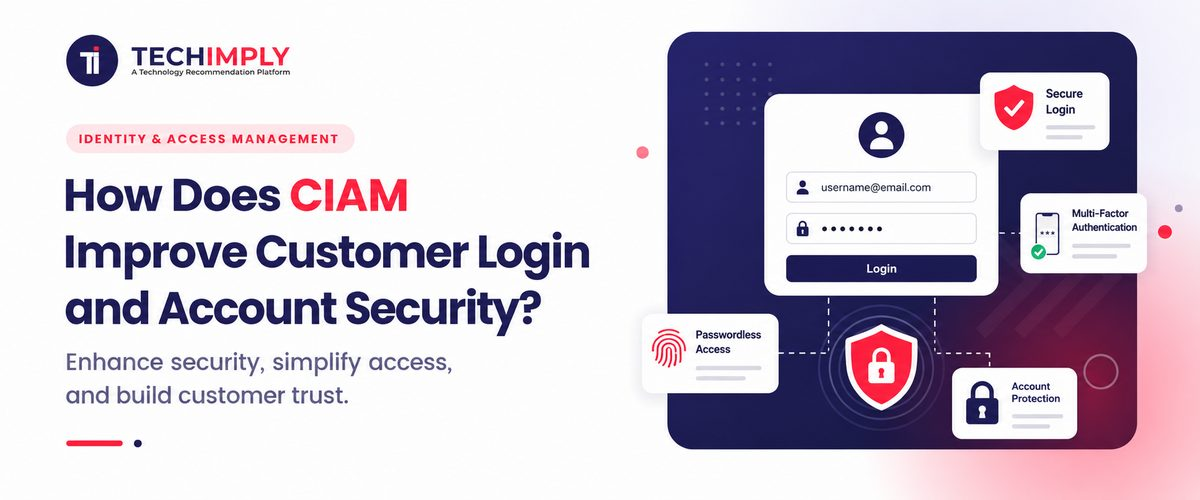
Every login screen looks identical whether the person typing the password is your actual customer or someone testing a list of stolen credentials obtained from a data breach. A login page with no way to distinguish between these situations is exactly the gap that customer identity and access management, or CIAM, is designed to address.

Looking for Customer Identity and Access Management Software?
Check out Techimply's List of the Best Customer Identity and Access Management Software in India for your business.
Customer Identity and Access Management, or CIAM, is designed to close that gap. The practical question is not simply what CIAM means. It is what happens inside customer identity and access management software that makes legitimate login easier, suspicious access harder, and account takeover less likely.
What Is CIAM and What Does It Actually Control?
Customer Identity and Access Management is what CIAM stands for. It seeks to manage those outside of a company's staff who utilize websites, portal systems, digital services, and customer-facing apps.
- Customer registration
- Login and authentication
- Multi-factor authentication
- Passwordless authentication
- Social or federated login
- Account recovery
- Customer profiles
- Consent and preferences
- Authorization
- Session management
- Identity monitoring
- Suspicious activity detection
Microsoft's current Entra External ID documentation similarly describes customer-focused identity capabilities around self-service registration, personalized sign-in, account management, and secure access. This makes CIAM different from simply adding a login form to a website. The login is only one part of the identity journey.
Do You Know?
Verizon's 2025 Data Breach Investigations Report found that credential stuffing accounted for a median of 19% of all daily authentication attempts across the SSO logs it analyzed, meaning roughly one in five logins on an average platform could be an automated attack rather than a real customer.
How CIAM Improves Customer Login
The first noticeable benefit of CIAM is usually the login experience. Customers want security, but they rarely want to think about security while shopping, checking an investment account, booking a service, or using a mobile application. A CIAM platform can support several authentication methods and allow businesses to design different login journeys for different situations.
1. Self-Service Registration Reduces Friction
Instead of asking a customer to rely on customer support or complete a lengthy registration process, CIAM allows customers to create and manage their own accounts. This matters for high-volume consumer businesses. An Indian D2C brand running a festive sale may receive a large number of new visitors within a short period. A slow or complicated registration flow can create unnecessary abandonment.
Modern CIAM platforms support self-service registration as a core customer identity capability. Microsoft specifically includes self-service sign-up and customized sign-in experiences in its current customer identity architecture.
2. Multiple Authentication Options Give Customers Flexibility
Different customers prefer different ways to sign in. Depending on the application and risk level, CIAM can support options such as:
- Password-based login
- OTP authentication
- MFA
- Social login
- Single sign-on
- Passkeys
- Federated identity
Auth0 identifies SSO, passkeys, MFA, OAuth, OpenID Connect, and other identity standards as important components of modern customer identity architecture. The goal is not to offer every possible method simply because it exists. The goal is to provide authentication that matches the customers, application, and security requirements.
How CIAM Improves Account Security
Convenient login is only half the equation. The more valuable question is what happens when someone tries to access an account they should not be accessing.
1. MFA Adds Another Verification Layer
A password can be taken, used again, guessed, or made public via a compromised service. Multi-factor authentication introduces another layer of authentication that reduces the value of a stolen password on its own to an attacker.
A customer could, for instance, input their password, then verify the login using another factor. CIAM platforms can incorporate MFA into customer authentication flows and apply stronger verification where appropriate. Microsoft and Okta both identify MFA and adaptive security as important parts of customer identity architectures.
2. Risk-Based Authentication Can Reduce Unnecessary Friction
Not all logins merit the same degree of attention. Imagine a consumer who routinely connects from the same device and area. An unknown device with strange activity may call for more confirmation. This is where adaptive or risk-based authentication becomes useful.
Instead of forcing every customer through the most restrictive security process, the system can respond differently based on available signals and configured policies. That can create a better balance between customer experience and security.
3. CIAM Helps Address Account Takeover
An attacker takes control of a real customer's account during an account takeover. Credential stuffing, phishing, stolen passwords, and social engineering all add to account takeover efforts. Okta specifically identifies these threats as key concerns in CIAM security.
A modern CIAM architecture can combine authentication controls, anomaly detection, MFA, identity verification, fraud signals, and monitoring to reduce exposure. Importantly, protection should not stop after a successful login. Auth0's current CIAM guidance describes controls before login, at the login layer, and after authentication, including session and authorization controls.
Stopping Credential Stuffing Before It Reaches a Real Account
Since 94% of exposed passwords appear duplicated elsewhere, a major portion of login attempts on any consumer-facing platform are not people at all; they are automated bots going through breach lists. CIAM solutions tackle this through proactive password management, implementing bot detection that highlights unusual login speed, several failed tries across several user accounts, and traffic patterns that no actual user would generate.
Less apparent, a second layer works earlier in the process: breached-password screening. A strong CIAM system examines a password a customer sets or resets against databases of already compromised credentials and rejects the try if a match is discovered, therefore closing the door before a weak password is even put into use.
CIAM Protects More Than the Login Screen
This is one of the most important points for anyone researching customer identity software. Imagine a customer successfully logs into an investment application. Authentication has succeeded.
But the customer is now trying to:
- Change their registered mobile number
- Add a new beneficiary
- Change security settings
- Access sensitive financial information
- Initiate a high-value transaction
A CIAM strategy should not assume that successful login means every action should receive identical treatment. Authorization and session controls can determine what the authenticated customer can do and under which conditions. That is why modern customer identity management solutions extend beyond authentication into authorization and ongoing identity security.
What Happens After Login Matters Just as Much
Account security is ongoing, not just at entrance. After login, device intelligence keeps an eye out for an abrupt shift in behavior mid-session, a device switch, or a surge in strange activity, and can automatically prompt re-authentication or close the session. This fills a hole that password-only systems leave wide open: a session stolen after a successful login and no more authentication as long as the token is valid.
|
Attack It Targets |
Weak Point Without CIAM |
How CIAM Responds |
|
Credential stuffing |
Every login is treated the same, no matter how it behaves |
Bot detection and rate limiting flag abnormal login speed and volume |
|
Reused, breached passwords |
Passwords never checked against known leak databases |
Breached-password screening blocks known-compromised credentials at signup or reset |
|
Session hijacking |
A session stays valid indefinitely once login succeeds |
Continuous device and session risk checks can force re-verification mid-session |
|
Phishing |
A stolen password alone is enough to get in |
Passwordless and step-up MFA reduce what a stolen password can actually unlock |
CIAM Creates a More Consistent Customer Experience
Security is important, but customer identity also affects how a person experiences the brand. Consider a business with:
- A website
- Mobile application
- Customer Loyalty programme
- Customer support portal
- Subscription service
If every channel maintains a separate identity, customers may end up creating multiple accounts or repeatedly proving who they are. A consistent experience across channels is made possible by a unified identification layer. Channel management especially benefits from this since companies have to coordinate customer experiences across many digital touchpoints.
The benefit is not simply convenience. A consistent identity can help a business understand that the person using its mobile application is the same customer interacting with its website or loyalty service, subject to appropriate privacy and data-use practices.
What This Looks Like for an Indian Business
For a fintech app, this combination means a stolen SIM-swapped OTP alone is no longer enough, since a new device and unusual location would still trigger a risk-based challenge on top of it. For a D2C brand, it means the checkout page stays fast for regular customers while credential-stuffing bots get filtered out before they can attempt account takeover during a high-traffic sale.
The best CIAM solutions, and the best identity management solutions more broadly, apply this logic without customers noticing it most of the time, since the extra friction only shows up when something genuinely looks wrong.

Pro-tip
If you manage your own login system today, start with breached-password screening at signup and password reset. It is one of the lowest-effort additions and directly blocks the most common way stolen credentials turn into account takeover.
Choosing Among CIAM Vendors for Login Security
Not all identity and access management solutions weigh these mechanisms the same way, and evaluating CIAM vendors on this specific question, login and account security, means asking pointed questions rather than reading a features list.
The market for customer identity software ranges from lightweight social login add-ons to full customer identity management solutions built for banking-grade risk assessment, and the right fit depends entirely on how much of your risk sits at the login stage.
- Does the CIAM software support real breached-password screening, not just password complexity rules
- Can multi-factor authentication step up automatically based on risk, or is it always-on or always-off
- Is session risk monitored continuously, or only checked once at the point of login
- Does the customer identity management platform give end users visibility into their own active sessions and devices?
Reading through vendor comparison pages for customer identity software can get repetitive fast, since most CIAM solutions list the same feature checklist. Usually what distinguishes a truly safe configuration from one that just sounds so is asking how each of the four questions above is actually implemented instead of whether the feature shows on paper.
Conclusion
Though most login pages appear that basic on the surface, customer login security stopped being a simple password check a long time ago. What actually protects an account now happens underneath that form, in the risk scoring, the breached-credential checks, and the session monitoring that customer identity and access management software runs quietly in the background. Judging a CIAM platform on how well it does exactly that is a more useful test than judging it on features that never touch the login itself.