
A staff member is being accused of misconduct. Do you think you should do what? Warning, Show Cause notice, enquiry or termination of the employee?
It is not advisable to assume the final punishment immediately. Typical procedures for discipline at work involve a fair process, a thorough documentation, and a chance to respond on the employee's part. The actual sequence may vary depending on the nature of the employees, their contract, company policy, relevant standing orders and legislation. .
A practical way to understand the process is:
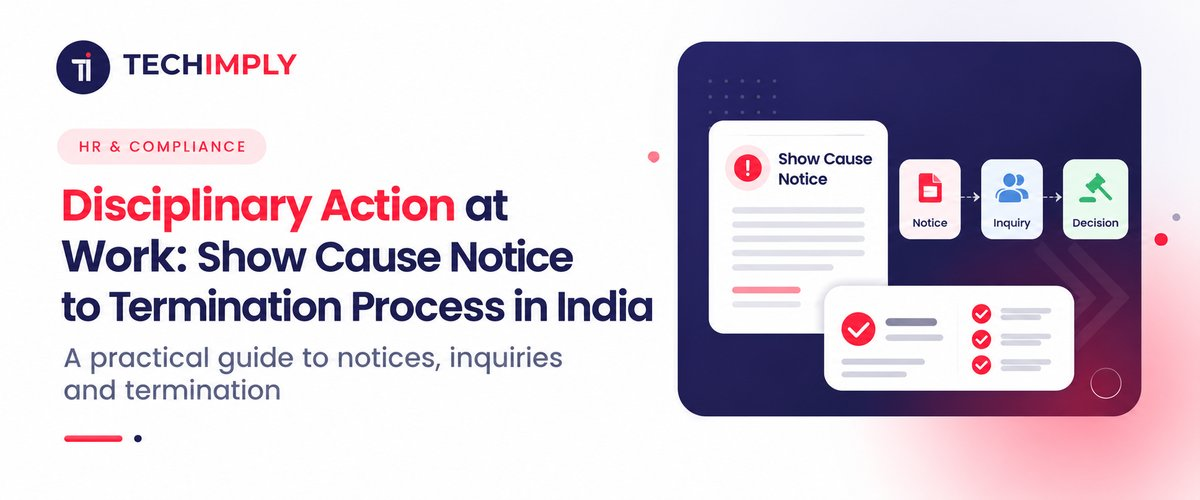
Allegation → preliminary fact-finding → show cause notice or charge sheet, where applicable → employee response → domestic enquiry, where required → findings → disciplinary action → termination, where justified.
Key Takeaways
- A show cause notice is not a termination letter. It provides a staff member an opportunity to clarify an allegation prior to taking further action.
- A charge sheet and a show cause notice are two different documents and may be issued in different order in the workplace and as per the rules.
- A domestic enquiry provides an opportunity for an employee to respond to formal allegations of misconduct and make a defence.
- Natural justice requires that you be aware of what you're being accused of and have a fair chance of determining the outcome of a disciplinary action before it is taken.
- The termination should be based on the applicable employment rules and the case findings, evidence and disciplinary procedure.

Looking for Employee Management Software?
Check out Techimply's Employee Management Software for your business.
What Is Disciplinary Action at Work?
Disciplinary action taken at work comes from a formal procedure that an employer can use in the event that they believe that an employee has committed an infraction of their workplace rules, company policies, or employment conditions.
This could be in the form of a warning, show cause notice, charge sheet, domestic enquiry or termination, depending on the allegation. Notice is not necessarily a precursor to termination. The employee is normally allowed a chance to reply prior to a final decision.
Also, it is important to distinguish between an act of misconduct and poor performance. Failure to achieve targets may lead to performance management and misconduct such as false recording of targets, taking or committing serious rules violations may lead to disciplinary action.
Common Reasons for Disciplinary Action
Common examples of employee misconduct in India include:
- Unauthorized or repeated absence
- Serious attendance violations
- Insubordination
- Harassment or workplace violence
- Fraud or theft
- Misuse of company property or systems
- Breach of confidentiality
- Serious negligence
- Deliberate policy violations
Proper action depends on severity, documentation, history, and rules.
What Is a Show Cause Notice?
A show cause notice requires an employee to provide an explanation to the employer regarding an alleged act or omission, then the employer must determine the appropriate action.
Provides employee with time to respond, clarify facts, submit documents or correct a misunderstanding. A letter of termination is not a show cause notice. The employer can either close the issue based on the reply, or give a warning or take formal disciplinary action.
What Should a Show Cause Notice Include?
A practical notice may contain:
- Employee name, designation, and department
- Specific allegation and incident details
- Relevant policy, rule, standing order, or employment requirement
- Supporting facts or documents, where appropriate
- Deadline for submitting a response
- Consequences of failing to respond
- Name and designation of the issuing authority
The wording matters. An allegation is not a proof of misconduct until the fact finding process is completed.
What Happens After a Show Cause Notice?
This is one of the most important parts of the disciplinary action process. Receiving a notice does not decide the final outcome.
1. Employee Submits a Response
The worker has an opportunity to explain what transpired. The answer may be either granted, refused, or partially justify the allegation and may contain supporting documents.
2. HR Reviews the Explanation
HR and the appropriate decision-maker review the response against the available facts and applicable rules.
Possible outcomes include:
- Closing the matter
- Counselling or issuing a warning
- Seeking additional information
- Issuing a charge sheet
- Starting a domestic enquiry
- Taking another permitted disciplinary action
3. Formal Disciplinary Proceedings May Begin
More serious allegations or allegations that are disputed or may result in a significant penalty may require a more formal employee discipline process.
There is no single disciplinary procedure in India that applies identically to every employee. The applicable framework matters.
India has implemented a set of four Labour Codes that will come into effect on November 21, 2025, one of which is the Industrial Relations Code, 2020. The Industrial Relations Code provides for standing order provisions on termination and suspension/dismissal for misconduct.
Show Cause Notice vs Charge Sheet: What's the Difference?
Sometimes they are regarded as one, but each can be assigned a different role in an HR disciplinary process.
|
Feature / Aspect |
Show Cause Notice |
|
Primary Purpose |
Seeks the employee's explanation for an issue |
|
Nature of Allegation |
Usually describes alleged conduct or prima facie concern |
|
Procedural Stage |
Acts as an initial preliminary step |
|
Subsequent Action |
May lead to closure, warning, investigation, or enquiry |
The order may be different if there are different rules and situations to follow. Show cause notice may be issued prior to the formal charges and/or some procedures may go straight to the charge sheet.
What Is a Domestic Enquiry in India?
A domestic enquiry is an internal enquiry into alleged misconduct. Not a criminal trial, but trial must be fair.
Typically, a disciplinary action against an employee may include an enquiry officer, informing the employee of the charges, evidence should be provided by management, the employee may be given the opportunity to defend the case, witness and document exchange should be considered and an enquiry report should be prepared.
The aim is to find out if there is evidence to support the charges. The enquiry officer should be free to investigate the issue with a level degree of objectivity.
What Happens During a Domestic Enquiry?
Step 1: Charges Are Communicated
The worker ought to comprehend the accusations awaiting their response. Accusations must include sufficient detail to permit a genuine defense.
Step 2: Enquiry Officer Is Appointed
When a formal inquiry is required, an inquiry officer gets assigned following the rules or policy.
Step 3: Management Presents Its Evidence
The management aspect offers pertinent files, logs, and observers backing the accusations.
Step 4: Employee Presents a Defence
The employee gets an opportunity to explain their position and submit relevant evidence.
Step 5: Witnesses and Evidence Are Considered
Depending on the procedure, witnesses are questioned, examined and documents are considered, as relevant.
Step 6: Enquiry Report Is Prepared
The enquiry officer records findings on the charges based on the material considered. The report is not necessarily the final disciplinary penalty.
In 2026, the Supreme Court decided that when a formal flaw fails to stop an officer from granting a fair chance or create genuine harm rendering the domestic inquiry vitiated and null and void, it stands valid.
What Is the Role of Natural Justice in Disciplinary Action?
One of the fundamental aspects of the procedure of taking a disciplinary action in India is that a fair procedure must be based on natural justice.
In simple terms, the employee should:
- Know the allegation against them
- Have a meaningful opportunity to respond
- Have a fair chance to present or challenge relevant evidence
- Be heard by an impartial decision-maker or enquiry officer
- Receive a decision based on the material considered
- Not face a disproportionate punishment
In the judgment of Supreme Court in D.K. Yadav vs J.M.A. Industries Ltd, the Supreme Court had highlighted that termination which involves the livelihood of an employee should be done in a process that is just, fair and reasonable. The Court also emphasized the need for an opportunity to present the employees' case and observance of natural justice.
What Disciplinary Actions Can an Employer Take?
The discipline applied in the workplace will depend on the rules and seriousness of the behaviour.
Possible measures include:
- Verbal or oral warning
- Written warning
- Final warning
- Counselling
- Suspension where permitted
- Demotion or another permitted penalty
- Dismissal or termination
Not all disciplinary measures at work need to be through termination. A warning may be appropriate for minor offences, but serious ones such as fraud or violence or serious insubordination may warrant a more serious punishment.
The Industrial Relations Code also outlines specific employer practices as being unfair such as dismissing an employee without following natural justice and punishing an employee for minor or technical errors.
When Can Disciplinary Action Lead to Termination?
Where serious misconduct is found, or repeated misconduct occurs after initial corrective measures, termination may be appropriate.
Examples can include:
- Proven fraud or theft
- Serious violence
- Grave insubordination
- Serious negligence
- Major confidentiality breaches
- Other misconduct recognized under applicable rules
Nevertheless, disciplinary measures within India lack a single uniform procedure across all staff members. Prior to dismissal, human resources ought to review the service agreement, corporate rules, pertinent standing orders, worker classification, and necessary statutory obligations.
What Should a Termination Letter Include?
A termination or dismissal letter may include:
- Employee name and designation
- Ground or reason for termination, where appropriate
- Effective date and last working day
- Notice period or pay in lieu, where applicable
- Reference to the disciplinary decision or enquiry outcome, where relevant
- Company property return instructions
- Final settlement and exit information
Common Mistakes Employers Make During Disciplinary Action
Issuing a Vague Allegation
It is hard for an employee to respond to a notice that doesn't explain the misconduct. The employee should have sufficient information to be able to prepare a meaningful response to the allegation.
Treating the Employee as Guilty Before the Enquiry
An allegation should not be presented as an established fact before the applicable process determines it. The disciplinary process should allow the employee to respond before a final finding is made.
Ignoring the Employee’s Response
The employee’s response may contain information that changes the employer’s understanding of the incident.
It should be reviewed before deciding whether further disciplinary action is necessary.
Using a Biased Enquiry Officer
The enquiry officer should be independent and unbiased, and have no conflicts of interest which might prejudice the fairness of the enquiry. To make a fair enquiry, there must be an objective consideration of the allegations and evidence.
Failing to Maintain Documentation
Use a folder to hold notices, responses, evidence, hearing record, findings and decisions. Clear records assist in developing an explanation for the disciplinary procedures.
Skipping Required Procedural Steps
One process applied to an individual employee or establishment might not be transferable to another. HR should ensure that they check the relevant policy, employment terms, standing orders and legal requirements before actioning.
Applying a Disproportionate Penalty
The punishment should be commensurate with the severity of the misconduct and the rules involved. A minor or first violation shouldn't be treated the same as serious or repeated violations.
Mixing Performance Management With Misconduct Proceedings
Poor performance and misconduct are different issues and may require different HR processes.
Inability to produce good results could result in a performance review, and intentional failure, in discipline.
Disciplinary Action Documentation Checklist
A useful employee disciplinary procedure should leave a clear record. Depending on the case, this can include:
- Complaint or allegation record
- Preliminary fact-finding notes
- Show cause notice
- Employee response
- Charge sheet, where applicable
- Evidence and supporting documents
- Witness records
- Enquiry notices and proceedings
- Enquiry report
- Employee representation, where applicable
- Disciplinary decision
- Penalty or termination letter
- Final settlement and exit records

Pro-tip
Use a checklist that follows your actual company policy and applicable legal regulations and create one case file per formal disciplinary matter. Document dates, acknowledgements, evidence and decisions throughout the case. This is much better than trying to piece together the chain of events months later from emails and spreadsheets.
Conclusion
Disciplinary action in the workplace doesn't have to be overly complicated. It's about making it easier for them to take the final decision, as the allegation was clear, they had a fair chance to respond, the evidence was taken into account, and the action was taken in accordance with the rules.
From the Indian employers' perspective, do not view the show cause notice, charge sheet, domestic enquiry, findings and disciplinary decision as separate HR letters but as part of a documented procedure. Check the exact framework when termination is under consideration before acting.