A mid-sized IT company located in Pune has numerous employees leaving the company after about a year. The exit interviews make no indication of conflict or significant job losses. Since their managers have so many responsibilities, they can't provide individual support; thus, the staff members feel cut off from their employment. People often lose their initial enthusiasm for their job after a few weeks without getting any replacement benefits.

Looking for Employee Experience Software?
Check out Techimply's List of the Best Employee Experience Software in India for your business.
The situation occurs frequently during human resources discussions throughout India. Executives do not acknowledge this frequency, but the software for employee experience exists to address this specific distance between workers and the organization. To provide context, identify where Indian commercial entities find practical applications for those tools instead of viewing them as digital displays that users ignore after thirty days.
What Is Employee Experience Software?
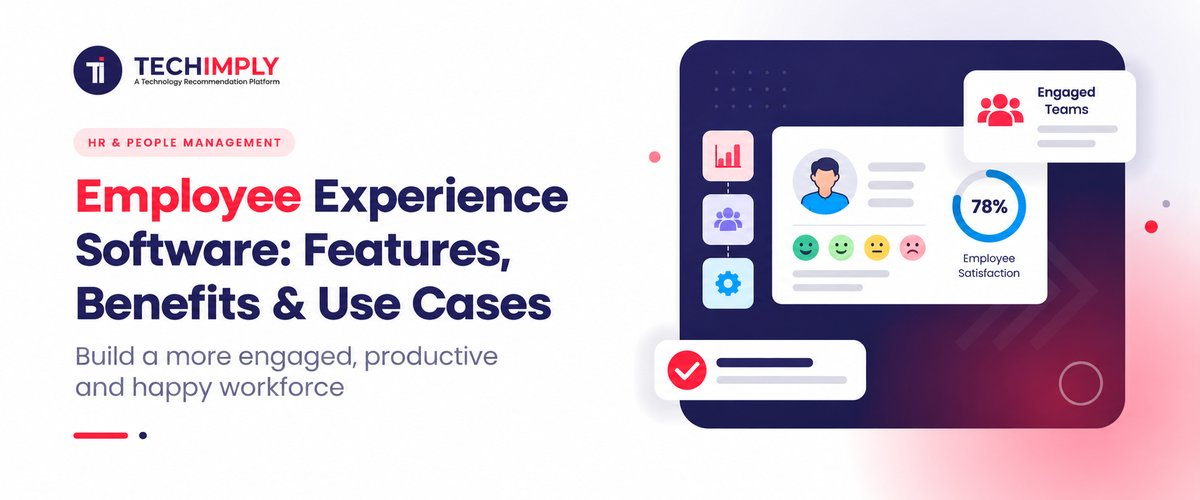
Employee experience software helps organizations understand and improve how employees interact with the workplace throughout their employment journey.
It can cover activities such as:
- Employee feedback and surveys
- Employee onboarding
- Internal communication
- Employee recognition
- Performance conversations
- Employee development
- Self-service resources
- Workplace analytics
- Employee engagement measurement
- Personalized employee journeys
The important point is that employee experience is not limited to satisfaction surveys. In practice, an Employee Experience Software platform may connect several systems or functions so employees do not have to navigate a confusing collection of disconnected tools.

Pro-tip
To begin the process of selecting a provider, you should ask the supervisors which stage of employment is the most difficult to monitor. The options include the integration of new staff, the formal praise for work, the creation of schedules, or the collection of critiques; that specific response indicates the primary function to select. By doing this, you avoid purchasing a system for difficulties that the staff members have not reported.
Benefits of Employee Experience Software
Employee experience software is used by enterprises to build a better, more connected workplace. Consolidating feedback, communication, recognition, onboarding and employee assistance into one platform helps companies decrease friction at work and better meet employee demands.
- Improved onboarding: New employees are given structured knowledge, tasks and resources rather than relying on managers alone.
- Improved Employee Feedback: HR can see problems sooner with regular pulse surveys and feedback systems.
- More recognition of employees: Recognition features provide managers and peers an easier approach to recognise contributions.
- Improved Communication: Centralised communication can help eliminate confusion, particularly for distributed and hybrid teams.
- Better employee retention: The program can assist organisations detect friction areas that lead to unhappiness or turnover.
- Better decisions in HR: Analytics enable HR to see trends across teams, locations, tenure groups or other relevant dimensions.
The Core Features That Actually Make Up the Software
All the marketing language hides the fact that most employee experience platforms are driven by a handful of specific technical capabilities:
- Employee Onboarding: Guided checklists, document collection, and training courses for recruits will help ensure that a first week doesn’t solely rely on a manager recalling every stage.
- Employee Recognition: Companies acknowledge employees through peer-to-peer and manager-led shout-outs, integrated with their points-based employee reward system and employee incentive program.
- Employee Scheduling: Organizations need to create shift plans and track employee availability because their frontline and hybrid staff members work from various locations.
- Employee Database: The system contains all the employee data, such as jobs, start dates, documents, and work history. The system centralizes employee data to prevent HR teams from accumulating spreadsheets.
- Employee Monitoring: The technology uses pulse surveys, sentiment tracking, and usage data to identify employee disengagement, helping companies to spot the signs before employees decide to leave their jobs.
Not every business needs all five on day one. A ten-person startup probably gets more value from a clean employee database and a simple onboarding checklist than from a full sentiment analytics suite. A three-hundred-person company juggling shift workers across cities has a very different starting point.
How These Features Actually Move the Needle on Engagement
The main goal of these activities is to lead to employee engagement, although the software performs specific tasks such as schedule management and recognition point recording. Staff members who join through proper onboarding and receive occasional recognition while having a straightforward method to report issues will maintain their engagement longer than those who must discover things independently.
Indian companies still face issues with employee engagement despite attempts to improve it, as indicated by workforce research that reveals a large gap between employee retention and the growth of organizations. But, irrespective of the different survey and research findings, the one common problem is that most employees may not feel fully engaged with their work or organization. Communication, feedback, recognition, and employee support are more difficult to manage in hybrid and telecommuting environments.
Employee Experience Versus Employee Engagement: Are They the Same Thing
Not quite, and the distinction actually matters when evaluating software. Employee engagement is closer to a measurement of how invested someone feels in their work day-to-day. Employee experience is broader, covering the entire relationship between a person and their employer, from the ease of getting their first paycheck sorted to how clearly their employee performance is reviewed months later.
Employee engagement is mostly about how workers feel about their degree of participation, company, team, and job. Employee Experience is more extensive. It encompasses the many contacts influencing such emotions.
For instance, an employee may be very involved with their colleagues but have a bad experience asking for time off since the procedure is drawn out and perplexing. That is why employee experience management usually examines the whole journey instead of one interaction rating.
One approach to consider it is:
- Employee Engagement: "How connected personnel members feel?"
- Employee Experience: "What is going on over the staff journey to produce that mood?"
Employee experience management software sits on top of both, pulling data from onboarding, recognition, scheduling, and feedback systems into one place so that HR doesn’t have to read five different reports to understand one employee’s status.
Where Recognition and Advocacy Fit Into the Picture
Since they are visible and simple to show- a badge here and a points alert here- recognition elements sometimes draw the most notice. Often missed is the way recognition ties to something greater: employee advocacy.
Whether it's on a review website, at a recruiting fair, or just in conversation with a friend looking for work, employees who feel truly valued are considerably more likely to talk favorably about their company outside. A well-run employee incentive program or employee reward program is not only a retention lever; it also serves as an employee branding tool and a source of organic employee advocacy, at almost no extra expense above what the recognition program now spends.
Practical Use Cases for Employee Experience Software
The strongest way to understand this category is to look at where businesses can actually use it.
Use Case 1: New-Hire Onboarding
Each company team has a different onboarding experience. Sales, engineering, finance, and others have different onboarding. The system does not provide a universal checklist, but each employee receives position-specific information and tasks.
Use Case 2: Continuous Feedback
Pulse surveys that HR conducts throughout the year serve as an alternative to traditional annual performance reviews. The organization can analyze responses from different organizational units, employee service durations, geographic locations, and other relevant classification systems.
Use Case 3: Recognition Programs
Managers and colleagues can recognize good work through the platform. A company can connect this with an employee incentive program when it wants recognition to include structured rewards.
Use Case 4: Employee Scheduling
Companies with frontline, shift-based, or spread teams have the employee experience directly influenced by employee scheduling. Employees need to know where and when they should be working, and when timetables change. Connecting scheduling information to other systems at work can help eliminate confusion.
Use Case 5: Employee Performance
A clearer performance process can be created using check-ins, goals, comments, and development plans by managers. This helps employee performance to have a more continuous structure instead of focusing everything into one yearly review.
Use Case 6: Employee Monitoring With Context
Employee monitoring is a sensitive area. Organizations should be clear about what information is collected, why it is collected, who can access it, and how it will be used. Monitoring tools should not automatically be treated as employee experience tools. Excessive surveillance can damage trust rather than improve it.
Why Indian Businesses Are Paying Closer Attention to This Right Now
Two things are colliding at once. Though employees say they really appreciate the flexibility of hybrid work, which has become almost the norm in much of metropolitan India, managers find it difficult to duplicate the informal check-ins and course corrections that used to happen naturally in a shared office.
Meanwhile, once recruiting, ramp time, and lost institutional knowledge are taken into consideration, replacing an employee in India usually costs anywhere from half to double their yearly salary; the window between twelve and twenty-four months of service usually bears the highest resignation risk. Put those together and employee experience management stops being a nice HR initiative and starts looking like a fairly direct cost control measure.
Do You Know?
The most dangerous window for an employee to leave India usually spans twelve to twenty-four months of service, just before someone has sufficiently ingrained themselves in a job to feel devoted to remaining and after the initial onboarding enthusiasm wanes.
How to Choose Employee Experience Software
Before comparing vendors, define the problem. If onboarding is inconsistent, prioritize onboarding workflows. If employees rarely provide feedback, focus on listening and survey capabilities. If recognition is weak, look for recognition and reward features. If HR cannot understand why engagement is changing, prioritize analytics and employee experience management.
Also check:
- Integration options
- Data security and access controls
- Mobile experience
- Reporting capabilities
- Customization
- Ease of use
- Automation options
- Pricing structure
- Scalability
- Vendor support
Pay attention to whether the platform can actually connect with your existing employee database and HR systems.
Conclusion
Hundreds of small events- joining a firm, locating knowledge, conversing with a manager, getting feedback, being recognized, asking for assistance, changing responsibilities, and finally moving on define the employee experience. Software for employee experience can assist companies in identifying those events and enhancing the ones that cause needless friction. The best systems do more than simply track worker participation. They connect listening to action, contextualize employee data, empower recognition and onboarding, and enhance manager understanding of the employee experience.
Related Read :
- Best Guide to Tax on Employee Gifts & Rewards in India
- Handle Employee Absenteeism with Cloud HR Software
- Employee Performance Reviews: Best Practices & Tips
- Employee Onboarding Process: Complete Step-by-Step Guide
- Best Identity Management for Employee Lifecycle Explained
- Payroll Setup Checklist: Hiring Your First Employee