
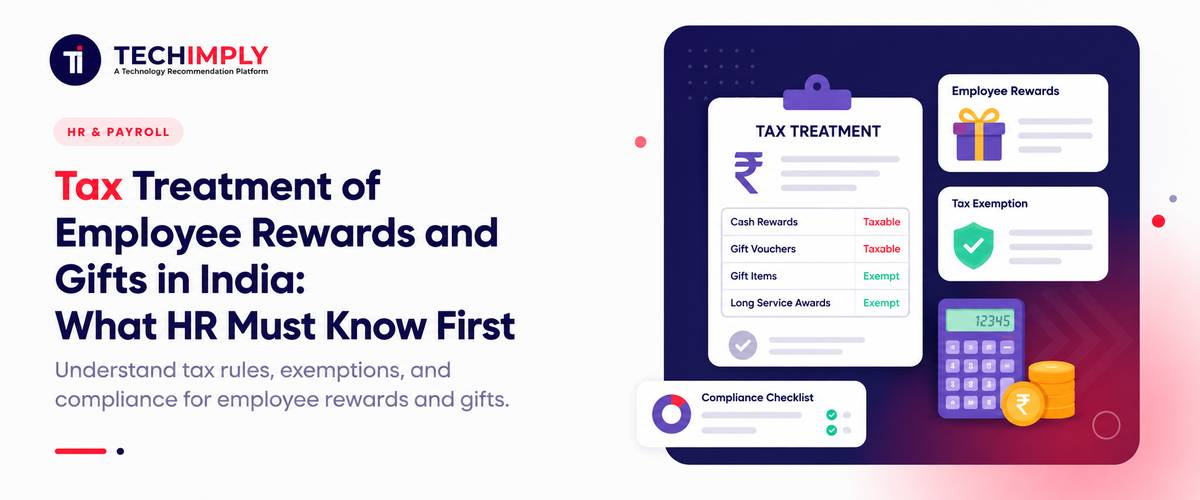
Indian organisations invest substantially in employee reward software and structured employee benefit programmes as part of their talent management strategies. Yet a troubling gap persists between how organisations perceive the tax status of these benefits and what Indian income tax law actually requires. The result is pervasive non-compliance, missed documentation, and exposure to substantial tax adjustments.

Looking for Employee Reward Software?
Check out Techimply's List of the Best Employee Reward Software in India for your business.
The core issue stems from a fundamental misunderstanding. Employers often operate under the assumption that workplace gifts occupy a tax-privileged position similar to personal gifts among family members. This assumption finds no basis in law. Income tax authorities treat employer-provided gifts as employment-derived income subject to taxation, regardless of the gift's form, frequency, or stated purpose.
Are Employee Gifts Taxable in India?
1. Basic tax treatment
The Income Tax Act does not exempt gifts provided by employers. Section 89 specifically addresses this category of transfer, establishing that gifts received by employees from their employers constitute taxable income. This treatment reflects the fundamental principle that value transferred in connection with employment carries tax consequences for the recipient.
2. Gift versus salary or perquisite
The terminology applied to a workplace benefit does not alter its tax consequences. Whether an employer describes a payment as a gift, recognition, or benefit, the tax treatment depends on the benefit's actual characteristics and connection to employment, not the label applied to it.
3. Why the nature of the reward matters
The tax consequences of a reward depend entirely on what the reward is. An organisation cannot achieve tax efficiency by relabelling compensation components. Yet understanding the specific nature of each reward type enables organisations to apply appropriate tax rules and, in certain limited instances, to structure awards in ways that align with tax-preferred categories.
Tax Treatment of Different Employee Rewards
1. Cash rewards
Cash payments from employers enter an employee's income stream without qualification. Performance bonuses, spot recognitions, achievement payments- all are ordinary income taxable at the employee's applicable income tax slab rate. No mechanism exists within tax law to render cash rewards tax-neutral.
2. Gift vouchers and gift cards
The economic substance of a gift voucher is indistinguishable from cash, and tax law treats it accordingly. A voucher with a face value of Rs. 3,000 is income of Rs. 3,000 to the recipient, regardless of the subsequent redemption pathway or whether the voucher is ultimately used, partially used, or abandoned.
3. Physical gifts
Physical items given to employees- electronics, merchandise, appliances, gifts- are valued at cost to the employer for tax purposes. If an organisation purchases a tablet computer for Rs. 28,000 to recognise an employee's achievement, the employee's taxable income increases by Rs. 28,000. The employee does not receive any valuation concession because the payment took the form of a physical object rather than cash.
4. Performance awards
Awards explicitly tied to performance outcomes- achievement of sales targets, project completion, delivery of quality metrics- carry tax implications identical to other forms of employee compensation. The fact that an award is performance-contingent does not create exemption or preferential treatment absent specific statutory provision.
5. Festival or occasion-based gifts
Gifts distributed at Diwali, Christmas, New Year, or other festive occasions are taxable income. The occasion does not create exemption or preferential treatment. A Diwali gift of Rs. 2,500 provided uniformly to all employees is nonetheless taxable income to each recipient employee.
6. Recognition awards
Awards honouring meritorious service, exceptional contribution, or distinguished achievement represent a distinct category with potential, though narrow, exemption eligibility. Specific provisions of the income tax law permit exemption or concessional treatment for certain long-service or meritorious service awards, provided stringent conditions are met.
An award recognising 25 years of continuous service, structured through a formal scheme, with the amount reasoned proportionately to the service period, and with comprehensive documentation of eligibility criteria may potentially qualify for exemption or relief.
What Is the ₹5,000 Gift Exemption?
1. How the threshold works
A limited exemption exists for gifts of modest monetary value- specifically, not exceeding Rs. 5,000- provided in connection with certain personal life events. The exemption applies narrowly to gifts given on occasions such as marriage, birth of a child, or specific religious festivals, and only when the gift is given without any consideration or expectation of return. The threshold operates on a per-gift, per-occasion basis, not as an annual aggregate. An employee receiving multiple gifts throughout a year has each gift assessed independently against the Rs. 5,000 benchmark.
2. What HR should consider when calculating value?
Determining a gift's taxable value requires establishing its fair market value as of the transfer date. For purchased items with clear invoiced costs, this calculation is straightforward. For assets without transparent market pricing, such as proprietary merchandise, in-house designed items, or assets acquired through complex arrangements, fair market value determination may require professional assessment. The pattern and frequency of gifting to individual employees influences how tax authorities assess whether a gift maintains its character as a gift or should be recharacterised as a recurring benefit.
3. Common misconceptions
A belief prevalent in Indian workplaces holds that any gift valued below Rs. 5,000 is automatically exempt from taxation. This is factually incorrect and leads to systematic under-reporting. The exemption applies only to gifts given on prescribed personal occasions. A workplace gift of Rs. 4,000 provided to celebrate an employee's tenure milestone is fully taxable because tenure is not a prescribed occasion. Another misunderstanding suggests that physical gifts enjoy tax advantages over cash equivalents.
Are Performance-Based Rewards Taxable?
1. Performance awards
An award granted when an employee achieves a quantified performance objective (completion of a project within budget, attainment of sales revenue targets, delivery of quality benchmarks) constitutes income to the recipient employee. The performance-contingency does not provide relief from taxation. What does matter is structure and documentation. An award granted through a transparent scheme with announced criteria, objective measurement, and consistent administration presents a stronger case for legitimate business characterisation than an entirely discretionary payment.
2. Sales incentives
Employees earning compensation tied to sales performance, revenue targets, customer acquisition, and deal closure receive this compensation as ordinary income subject to tax at applicable slab rates. Sales incentives are not distinguished from base salary in tax treatment. The combined total of salary and incentives is taxed based on the employee's overall income level and applicable tax bracket.
3. Long-service awards
Organisations providing awards to employees upon reaching service milestones- typically at 10, 20, or 25-year marks- may potentially claim exemption or concessional treatment if specific conditions are satisfied. These conditions relate to the formalisation of the scheme, the reasonableness of award amounts relative to service recognised, and the completeness of supporting documentation.
4. Spot awards
Spot awards given immediately and unexpectedly to recognise exceptional conduct, customer service excellence, process improvement, or rapid problem resolution are taxable like any other employee compensation. The spontaneous nature of the award, or its modest amount, does not trigger exemption.
How HR Should Handle Gifts Through Payroll
1. Record keeping
Each gift or award must be documented contemporaneously with sufficient detail to explain the transaction to a tax auditor. A minimal record stating merely "Rs. 7,000 gift to Kavya Patel" provides insufficient information. An adequate record would capture the recipient's identification, the gift date, the gift nature, its cost or value, the specific business purpose, and the circumstances triggering the gift.
The documentation should be retrievable by employee, by gift type, by date, and by business purpose. This organised structure demonstrates systematic compliance and facilitates identification of patterns or irregularities.
2. Employee-wise tracking
Maintaining individual employee gift records throughout each financial year enables identification of cumulative gifts to each employee, verification of consistency in award allocation, and detection of administrative errors such as duplicate gifts.
3. Payroll reporting
All taxable gifts must be incorporated into payroll systems with clear segregation from salary and routine allowances. The payroll system should capture and report gifts as distinct compensation components, enabling HR to verify that gifts are processed with appropriate tax treatment rather than erroneously excluded from taxable income.
4. Tax deduction and TDS considerations
Cash gifts and vouchers require tax withholding at the point of payment or delivery. The withholding amount is calculated based on the employee's anticipated total annual income and applicable tax slab. This withholding must be deposited with the income tax department within prescribed timelines.
Common Mistakes HR Teams Make
1. Treating every gift as tax-free
The foundational misconception that all employee gifts enjoy tax exemption leads to pervasive compliance failures. This belief results in inadequate documentation, incomplete payroll reporting, and exposure to substantial tax notices. The misconception likely stems from familiarity with personal gift exemptions, which do exist in limited circumstances.
2. Ignoring vouchers
Vouchers are treated by many HR practitioners as instruments escaping normal taxation or documentation requirements. The assumption that vouchers are not "real money" and therefore not subject to cash-equivalent taxation misrepresents the law fundamentally. Vouchers are taxed identically to cash. Withholding and reporting obligations are identical. The misconception arises from the psychological perception that vouchers are not immediately convertible to cash, creating an impression of non-income.
3. Not maintaining gift records
Organisations distributing gifts without systematic record-keeping forfeit the ability to defend their tax treatment during examination. The absence of documentation also creates vulnerability to inconsistency and administrative error.
4. Applying the ₹5,000 rule incorrectly
Misapplication of the Rs. 5,000 threshold represents a recurrent and costly error. Many organisations assume all gifts below Rs. 5,000 are automatically tax-free, or they interpret the threshold as an annual per-employee aggregate exemption. Neither is correct.
Employee Gift Tax Compliance Checklist
1. What HR should document
For each reward or gift provided, HR should maintain records capturing the following information
- The recipient's name and employee identification number.
- The gift date and any relevant anniversary or achievement date.
- A clear description of the gift type and nature.
- The cost or fair market value of the gift.
- The business purpose or occasion justifying the gift.
- For performance-based awards, the performance criteria and evaluation results.
- For long-service awards, the formal scheme documentation and eligibility calculation.
- Approval authorization from appropriate management.
- Communication to the employee regarding tax implications if applicable.
Centralised record systems maintained by HR, finance, and payroll teams facilitate compliance. Employee reward software platforms designed with compliance features maintain these records systematically.
2. What payroll should verify
Payroll teams should independently confirm that all rewards have been properly classified, valued, and processed in employee income calculations. The verification process should encompass
- Confirmation that gifts have been included in employee gross income for the relevant financial year.
- Verification that TDS has been appropriately withheld on cash gifts and vouchers.
- Confirmation that physical gifts are reported as income even without TDS withholding at delivery.
- Verification that treatment is consistent with prior-year treatment and with other similar rewards.
- Identification of any claimed exemptions and confirmation of supporting documentation.
- Cross-checking between payroll records and HR records to identify discrepancies.
3. When to consult a tax professional
- HR and finance teams should engage tax advisors in the following circumstances.
- When establishing a new employee reward programme requiring determination of tax treatment and documentation standards.
- When introducing reward types previously unfamiliar to the organisation.
- When evaluating potential exemption eligibility for specific reward categories.
- When an employee disputes the tax treatment applied.
- When a tax authority issues a notice regarding reward taxation.
- When designing long-service award schemes seeking to optimise tax treatment while ensuring compliance.
- When implementing or upgrading employee reward software systems to ensure proper tax configuration.
Consistent engagement with tax professionals is a protective measure preventing costly compliance errors and audit exposure.
Conclusion
The central challenge facing Indian organisations managing employee benefits programmes is bridging the gap between operational practice and tax law requirements. Organisations frequently operate under assumptions about gift taxation that lack legal foundation, resulting in systematic non-compliance masked by the routine nature of reward programmes. Recognition that employee gifts are generally taxable, that different reward types carry different tax obligations, and that comprehensive documentation is essential forms the foundation of defensible compliance.