

Managing business operations through separate applications can create problems that are difficult to identify until a company starts growing. The finance team may maintain one set of records, warehouse employees update another, and management may struggle to get an accurate picture of inventory, orders, and expenses. Cloud ERP software addresses this problem by bringing essential business functions into one connected platform.

Looking for ERP Software?
Check out Techimply's List of the Best ERP Software in India for your business.
Employees can access shared information through the internet instead of depending entirely on software installed on office computers or company servers. For Indian businesses, this approach can make it easier to coordinate operations across branches, manage inventory, and monitor financial activities. However, choosing a cloud-based system requires more than comparing subscription prices.
What Is Cloud ERP Software?
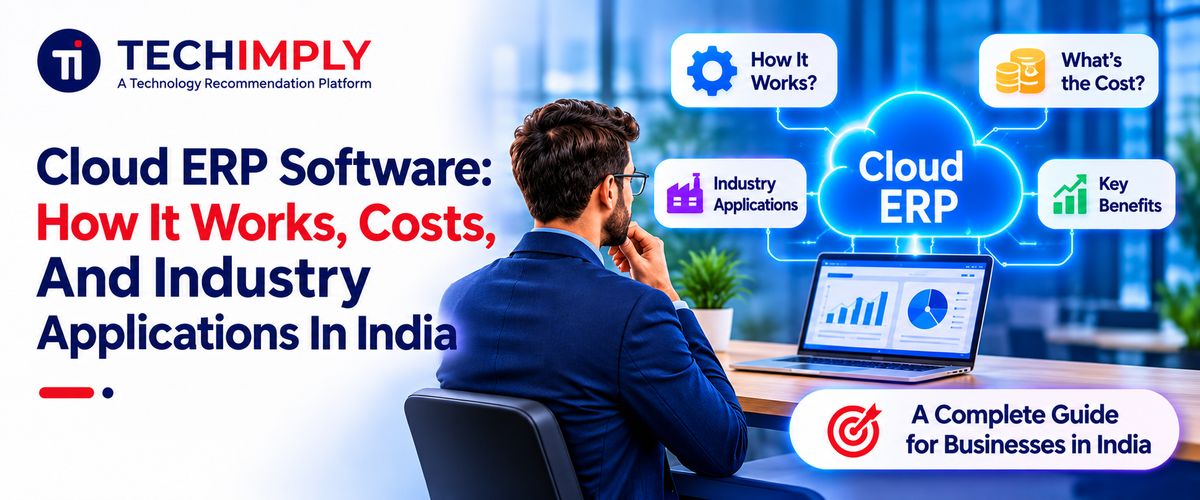
Cloud ERP software is a type of enterprise resource planning system that operates on cloud infrastructure and can be accessed via the internet. It integrates various business functions, including accounting, procurement, inventory management, production, sales, and human resources, all within a unified platform.
Unlike traditional on-premises ERP, companies do not need to maintain all the application infrastructure on their own premises. The software provider typically manages hosting, infrastructure maintenance, and software updates.
For example, consider an Indian manufacturing company that purchases raw materials from multiple suppliers. Its procurement team records purchases, the warehouse updates stock availability, the production department tracks material consumption, and the finance team processes supplier payments.
Without an integrated ERP system, these activities may involve separate records and repeated data entry. A cloud-based ERP connects these activities. When the warehouse records incoming materials, the updated inventory information becomes available to authorised users in other departments. This shared information helps management understand business activity without collecting separate reports from every team.
Do You Know?
A business can use a hybrid ERP deployment to keep selected applications on-premises while moving other business functions to the cloud. This can be useful during a phased migration.
How Does a Cloud ERP System Work?
A cloud ERP system operates through applications hosted on remote servers. Employees access the platform using supported browsers or mobile applications, depending on the provider.
The system stores business information in a centralised environment and makes relevant records available to authorised departments. Here is how the process generally works:
-
Data collection: Employees enter information about purchases, sales, inventory, production, and financial transactions.
-
Centralised processing: The ERP system records transactions and updates connected business modules.
-
Departmental access: Employees can view information according to their assigned permissions.
-
Workflow automation: The platform can automate selected activities, such as purchase approvals, invoice generation, and inventory notifications.
-
Reporting: Managers use dashboards and reports to monitor business performance.
For instance, when a distributor receives a customer order, the system can help check stock availability, create the required order records, and connect the transaction with invoicing and inventory processes. The exact workflow depends on the ERP configuration and the modules a business purchases.
What Are the Different Cloud ERP Deployment Models?
Not every cloud ERP solution operates in the same way. Businesses should understand the deployment options before selecting a platform.
1. Public Cloud ERP
Public cloud ERP runs on infrastructure provided by a third-party cloud management platform. Multiple customers may use the same underlying infrastructure, although their business data remains logically separated. This model can suit startups, SMEs, and growing organisations that want to avoid maintaining their own servers.
2. Private Cloud ERP
Private cloud ERP uses dedicated cloud infrastructure for one organisation. It offers greater control over the hosting environment and configuration, depending on the provider. Large enterprises with specific security, operational, or regulatory requirements may consider this approach.
3. Hybrid Cloud ERP
Hybrid ERP combines cloud-based applications with on-premises systems. A business may retain certain applications on its own infrastructure while moving other functions to the cloud. This option can help organisations that cannot migrate all their existing systems at once.
4. Multi-Tenant and Single-Tenant ERP
These terms describe how cloud applications share infrastructure.
-
Multi-tenant: Multiple customers use the same application environment, with their data logically separated.
-
Single-tenant: A dedicated application environment is assigned to an individual customer.
A dedicated environment does not automatically guarantee better security. Businesses should evaluate access controls, encryption systems, backups, and provider practices.
What Are the Benefits of Cloud ERP for Businesses?
The value of cloud ERP depends on how well it addresses an organisation's operational problems.
Access Business Information From Different Locations
Companies operating from multiple branches often struggle to maintain consistent information. Cloud ERP allows authorised employees to access shared business records from different locations. For example, a distributor with warehouses in Ahmedabad, Pune, and Bengaluru can use a connected system to monitor inventory and orders across locations.
Reduce Infrastructure Management
Traditional ERP deployments may require servers, hardware maintenance, and internal technical resources. With SaaS ERP, the provider generally manages the hosting infrastructure and routine software updates. This reduces the infrastructure responsibilities handled directly by the business, although internal IT oversight remains important.
Improve Inventory Visibility
Inventory errors can affect purchasing decisions, customer orders, and working capital. An integrated ERP system can connect stock records with procurement, sales, and warehouse operations. Managers can use this information to identify shortages, excess inventory, and stock movement.
Connect Financial and Operational Data
When financial information remains separate from operational records, reporting can take longer. Cloud ERP can connect transactions across departments, helping finance teams monitor purchases, expenses, invoices, and other business activities.
Support Business Expansion
A company may initially operate from one location but later expand into additional branches or production facilities. Cloud ERP solutions can support expansion through configurable modules, additional users, and infrastructure capacity, subject to the provider's pricing and technical limits.
Which Industries Use Cloud ERP Solutions?
The requirements of an ERP system vary depending on the industry. A manufacturing company needs production planning, while a distributor may prioritise stock management and order processing. Here are some common applications.
Manufacturing
Manufacturers use ERP to connect production planning, raw material procurement, inventory, and financial operations. For example, a textile manufacturer can monitor material availability, production schedules, and finished goods through connected modules. Businesses can explore Manufacturing Software when comparing industry-specific production tools. The ERP platform should integrate with these operational requirements rather than create another disconnected record system.
Retail and Distribution
Retailers and distributors need accurate information about purchases, stock movement, sales, and supplier orders. Distribution ERP software can connect these activities and help businesses monitor inventory across multiple outlets or warehouses. Relevant solutions include inventory management and Stock Management Software.
Pharmaceutical Industry
Pharmaceutical businesses often handle batch records, production activities, inventory, distribution, and quality documentation. Pharma ERP systems can support these workflows through suitable production, inventory, and compliance modules. A generic ERP platform may require additional configuration to meet pharmaceutical operating requirements.
Education
Education ERP platforms coordinate administrative activities, student information, fees, and institutional resources. However, schools and colleges may need specialised education platforms rather than a conventional manufacturing-focused ERP.
Real Estate and Construction
Real estate businesses coordinate project expenses, procurement, vendor payments, and resource planning. A real estate ERP system can connect financial and operational information, making it easier to monitor project activities.
How Much Does Cloud ERP Software Cost in India?
Cloud ERP pricing depends on the provider, selected modules, number of users, deployment model, and implementation requirements. Most providers use one or more of these pricing approaches:
|
Pricing component |
What it covers |
|
User subscription |
Monthly or annual access for users |
|
Module charges |
Additional business functions |
|
Implementation |
Configuration and deployment |
|
Data migration |
Transferring existing business records |
|
Integration |
Connecting other business applications |
|
Training |
Preparing employees to use the system |
|
Support |
Technical assistance and maintenance |
A low subscription price does not necessarily mean a low total cost. For example, a company may purchase an affordable ERP subscription but later require paid integrations, custom reports, and additional implementation services. Before signing a contract, ask the provider for a complete cost estimate covering the initial setup and recurring expenses.
What Should Businesses Check Before Choosing Cloud ERP?
Selecting ERP software is a long-term business decision. A suitable platform should support current requirements while allowing room for future changes.
Consider these factors before making a decision:
-
Business Requirements: Identify the departments and processes that need integration.
-
Scalability: Check whether the platform can support additional users, locations, and operations.
-
Integration: Verify the compatibility with current accounting, inventory, payroll, and CRM systems.
-
Security: Review encryption, access permissions, backup procedures, and incident response policies.
-
Customisation: Understand which workflows can be configured and which require development.
-
Reporting: Check whether dashboards provide the information management needs.
-
Vendor Support: Evaluate implementation assistance, training, and ongoing technical support.
Indian companies should also examine GST-related workflows, e-invoicing requirements where applicable, data export options, and the provider's ability to support local business processes.
What Are the Common Challenges of Cloud ERP Implementation?
Cloud deployment does not automatically make implementation simple. Companies still need to prepare their data, processes, and employees.
Data Migration Problems
Old records may contain duplicate entries, missing information, or inconsistent formats. Migrating these records without cleaning them can create problems in the new system.
Employee Resistance
Employees may be comfortable with existing spreadsheets and manual processes. Without proper training, they may continue using old methods alongside the new ERP.
Integration Difficulties
Existing applications may not support direct integration. Businesses should check API availability, data formats, and additional integration expenses before implementation.
Dependence on Internet Connectivity
Employees need reliable connectivity to access cloud applications. Businesses with multiple operating locations should evaluate network availability and backup connectivity arrangements.
Unclear Implementation Scope
Adding too many custom features during the initial deployment can increase complexity and delay implementation. A better approach is to prioritise essential workflows, test them, and introduce additional functionality in planned stages.
Is Cloud ERP Suitable for Small and Medium-Sized Businesses?
Cloud ERP can be suitable for SMEs when disconnected processes start affecting business visibility and operational control. For example, a growing trading company may need to coordinate purchasing, sales, inventory, and accounting systems across multiple locations.
Instead of maintaining separate spreadsheets, it can use an integrated ERP platform to connect these functions. However, a small business with simple operations may not need a comprehensive ERP suite immediately. The decision should depend on the number of processes involved, the cost of manual work, reporting requirements, and future expansion plans.

Pro-tip
Before requesting an ERP demonstration, prepare a list of your five most time-consuming business processes. Ask the vendor to demonstrate how the system handles those exact workflows.
Conclusion
Cloud ERP software can help businesses connect departments, maintain shared records, and manage operations without maintaining all the underlying application infrastructure themselves. However, the right choice depends on the organisation's size, industry, existing applications, and implementation budget. Before selecting a platform, identify the processes that need improvement and compare providers based on functionality, integration, security, and total ownership cost. A well-planned implementation is more valuable than purchasing an extensive ERP package that employees struggle to use.
Related Reads
Best ERP Modules List: 9 Core Components Explained
Top Construction ERP vs Project Management: Key Differences
ERP for Multi-GSTIN Businesses Managing Branch Accounting Across States
ERP Vs CRM Comparison For Business Operations, Sales, Finance, and Customer Management