


If you are trying to manipulate your customer interactions using messy spreadsheets, scattered emails, or publish-it notes, you're leaking revenue. In modern-day hyper-competitive market, seeking to scale a business without a centralized platform is close to impossible.
That is exactly why modern companies rely on a CRM system.
This comprehensive guide breaks down everything you need to know about customer relationship management system software, showcases real-world crm systems examples, and reviews the 9 best crm systems of 2026 to help you close more deals and automate your growth.

Looking for CRM Software?Check out Techimply's List of the Best CRM Software for your business.
What is a CRM System?
A CRM (Customer Relationship Management) system is a specialized software tool designed to manipulate all of your organisation’s relationships and interactions with both current prospects and current clients.
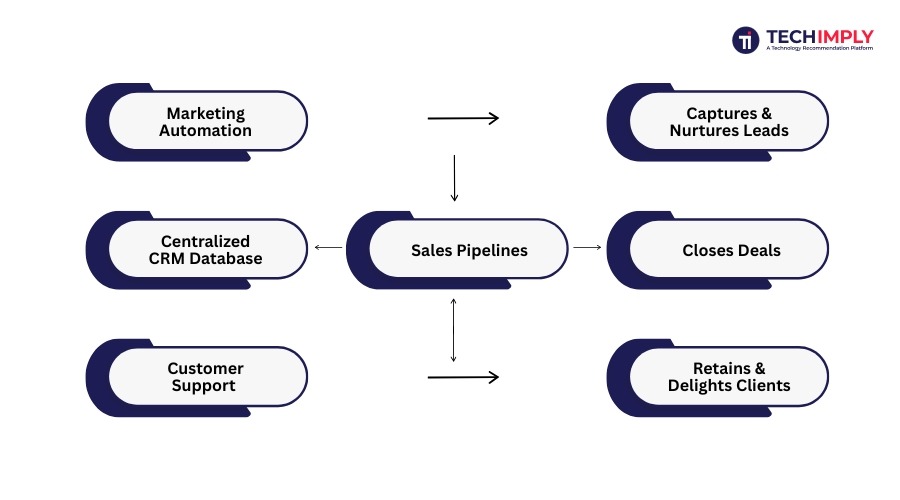
At its core, a crm system software acts as a single, centralized database to your whole corporation. It unifies sales, advertising and marketing, digital commerce, and customer support workflows into one cohesive platform.
Instead of shifting between multiple point solutions, online crm systems allow your sales management crm systems to track a buyer’s journey from the very first ad click down to the final invoice and post-purchase support ticket.
3 Core Types of CRM System Tools
Not all crm system tools are built the same way. Depending on your business goals, you will generally look at 3 categories of different crm systems:
- Operational CRMs: These are the most common sales crm systems. They focus on front-office automation Operational CRMs: These are the most common sales crm systems. They attention on the front-office automation specially streamlining income pipelines, dealing with contacts, and executing marketing campaigns.
- Analytical CRMs: These systems analyze customer facts backstage to find shopping for patterns, customer retention rates, and provide deep facts visualization for govt forecasting.
- Collaborative CRMs: Built for massive organizations, those equipment make sure that consumer statistics flows smoothly throughout siloed billing, income, and help departments so no purchaser message falls via the cracks.
What to Look For in a CRM System
When evaluating these tools, look past the marketing hype. Prioritize these core criteria to find a system that fits your daily workflow:
- User Adoption & Interface UI: The best features are useless if your sales reps refuse to use the software. Look for intuitive visual design and minimal clicking requirements for daily data entry.
- Automation Capabilities: Ensure the platform can handle repetitive tasks—like sending follow-up emails, assigning leads, and updating deal statuses—without manual intervention.
- Mobile Accessibility: Your sales team isn't always at a desk. A robust mobile app with offline capabilities is essential for field sales and real-time updates.
- Deep Reporting & Custom Dashboards: You need a clean view of your sales metrics, conversion rates, and pipeline health at a glance.
The 9 Best CRM Tools of 2026
Choosing from a huge crm systems list may be overwhelming. To make your choice much less complex, we've got compiled the definitive crm system names and companies main the market in 2026 based totally totally on competencies, implementation ease, and superior automation capabilities.
1.Salesforce (Best Enterprise & AI-Driven CRM)
Salesforce continues its reign as the absolute heavyweight champion among the biggest crm systems, commanding over 20% of the global market share. In 2026, its real power lies in its native AI ecosystem, Agentforce, which offers autonomous sales forecasting and predictive lead scoring.
-
Key Features: Advanced workflow builder, Agentforce AI assistant, real-time analytics dashboards, and custom object creation.
-
Pros: Unmatched scalability; massive partner app ecosystem (AppExchange) offering over 7,000 integrations.
-
Cons: Extremely high total cost of ownership; steep learning curve requiring dedicated administrators.
-
Best For: Mid-market to large enterprise organizations requiring deep customization.
2.HubSpot (Best CRM System with Built-In Marketing Automation)
HubSpot is arguably the fastest-growing major CRM vendor for teams that view sales and marketing as one single motion. It ranks as the absolute best crm systems built-in marketing automation 2025 2026 because it avoids the clumsy layout of legacy platforms, making it incredibly adoptable for growing business crm systems.
-
Key Features: Automated email nurturing sequences, shared team inboxes, smart form builders, and advanced landing page tracking.
-
Pros: Exceptional, ultra-intuitive visual sales pipelines requiring nearly zero employee training; highly generous free tier.
-
Cons: Pricing scales up exponentially as you add more contacts or unlock premium automation tiers.
-
Best For: Fast-growing teams wanting top-tier inbound marketing and seamless lead monitoring.
3. Creatio (Best No-Code & Agentic Workflow Platform)
Creatio is a disruptive force among top crm systems due to its "True No-Code" architecture. It natively combines standard customer data management with powerful, pre-built AI agents (like Quote Generation and Account Research agents) that operate via natural language processing.
-
Key Features: Drag-and-drop workflow studio, autonomous background AI agents, out-of-the-box vertical industry editions.
-
Pros: Radically reduces total cost of ownership by up to 37%; highly customizable without writing a single line of code.
-
Cons: Smaller community marketplace for third-party plug-ins compared to market giants.
-
Best For: Organizations that need to design fully custom corporate workflows using natural language.
4. Pipedrive (Best Focused Sales CRM System)
Designed particularly "by salespeople, for salespeople," Pipedrive strips away non-essential capabilities to double down on activity-based selling methodologies. Its clean interface ensures that sales development representatives always understand exactly what follow-up action to take next to prevent deals from stalling.
-
Key Features: Visual deal pipelines, smart email/call tracking, automatic task reminders, and sales forecasting tools.
-
Pros: Lightweight, incredibly fast to set up, and highly intuitive for daily sales interactions.
-
Cons: Minimal built-in marketing automation or heavy customer support ticketing features.
-
Best For: Small-to-medium businesses requiring clear pipeline visibility without enterprise bloat.
5. Monday CRM (Best Modern & Highly Visual UI)
Monday CRM transforms classic project management flexibility into a sleek, visually stunning sales platform. It is the fastest platform available on the market to install, allowing teams to build custom customer views in minutes.
-
Key Features: Color-coded status boards, automated column updates, instant board-to-dashboard tracking.
-
Pros: Highly customizable, user-friendly interface; extremely fast onboarding and implementation times.
-
Cons: Lacks deep, native analytical capabilities or complex financial data tracking out-of-the-box.
-
Best For: Startups and teams migrating away from basic spreadsheets for the first time.
6. Zoho CRM (Best All-in-One Value for SMBs)
Zoho CRM offers excellent feature density at a fraction of the cost of its enterprise competitors. Backed by its built-in AI assistant, Zia, Zoho provides email sentiment analysis, predictive trend tracking, and direct integration into Zoho’s massive library of 45+ business apps.
-
Key Features: Zia AI engine, canvas design studio for UI customization, multi-channel customer communication.
-
Pros: Exceptional feature depth for the price; seamless fit for companies using other Zoho software tools.
-
Cons: The user interface can occasionally feel cluttered due to the sheer volume of options.
-
Best For: Cost-conscious small-to-medium teams searching for enterprise-grade features on a budget.
7. Microsoft Dynamics 365 Sales (Best for Microsoft Infrastructure)
If your organization runs entirely on the Microsoft 365 suite (Outlook, Teams, Azure), Dynamics 365 is your natural choice. It injects CRM data natively into your Teams chats and Outlook inbox, using deep Copilot integrations to summarize meetings and draft customer email replies.
-
Key Features: Microsoft Copilot AI integration, automated relationship health scores, native PowerBI data pipelines.
-
Pros: Unrivaled data synchronization across corporate Microsoft IT environments; incredible enterprise reporting.
-
Cons: Complicated implementation process that almost always requires an outside deployment consultant.
-
Best For: Large organizations deeply embedded within the Microsoft software ecosystem.
8. Freshsales by Freshworks (Best for Digital Chat & Messaging Channels)
Freshsales stands out among modern crm systems providers for its deep, native integrations with modern communication stacks like WhatsApp, live chat, and SMS. Powered by its Freddy AI engine, it automatically tracks real-time email engagement and provides dynamic deal health scores.
-
Key Features: Native omnichannel messaging box, AI-powered deal scoring, integrated cloud telephony.
-
Pros: Extremely fast out-of-the-box deployment; intuitive modern layout designed around consumer messaging apps.
-
Cons: Advanced pipeline customization options are somewhat limited in standard pricing packages.
-
Best For: Modern sales operations interacting with buyers across a wide variety of web and chat channels.
9. Bitrix24 (Best for In-Depth Reporting & Analytics)
Bitrix24 serves as a highly robust, low-cost platform that includes client management, project boards, and advanced telephony tracking. It provides unique data visualization models and custom report generation interfaces that rival expensive standalone business intelligence suites.
-
Key Features: Built-in telephony server, detailed performance metrics dashboards, internal company collaboration workspace.
-
Pros: High-end reporting metrics paired with an exceptionally affordable flat-rate user pricing tier.
-
Cons: The platform interface has a higher learning curve due to the massive blend of internal and external tools.
-
Best For: Multi-departmental teams requiring a blend of internal collaboration tools and heavy client analytics.
Quick Comparison: The Most Popular CRM Systems
|
|
|
|
|
|
|
|
|
|
|
|
|
|
|
|
|
|
|
|
|
|
|
|
|
|
|
|
|
|
|
|
|
|
|
Why CRM Implementation Fails: Over 60% of CRM rollouts run into issues now not because the software fails, however due to the fact the interface is too complex for the sales group to undertake every day. When evaluating crm system companies, prioritize ease of use and team purchase-in over lengthy lists of stripling technical capabilities.
Common CRM Mistakes to Avoid
Over 60% of CRM rollouts run into issues not because the software fails, but because of predictable execution mistakes. When implementing your customer relationship management system software, make sure to avoid these pitfalls:
Over-Engineering From Day One: Don't try to automate your entire business model in week one. Start with simple contact logging and expand over time.
Ignoring User Adoption: If your sales representatives hate the interface, they will keep using personal spreadsheets, leaving your pipeline numbers completely inaccurate.
Allowing Bad Data to Accumulate: Without strict data entry rules, duplicate accounts and out-of-date phone numbers will quickly turn your CRM into an unorganized digital junkyard.
How to Choose the Right CRM Provider for Your Business
To ensure you secure high go back on funding (ROI) out of your deployment, run your shortlisted crm gadget carriers through this 3-step qualification technique:
- Map Your Current Sales Cycle: Do you close offers through short e-commerce transactions, or do you manage multi-month B2B account cycles? Match your actual-global cadence to the software (e.G., choose Pipedrive for quick pipeline execution, or HubSpot for content material-driven nurturing).
- Audit Your Existing Tech Stack: A CRM have to act as an open data hub. Ensure the software you choose gives native, one-click API integrations along with your current email networks, accounting systems, and outside advertising structures.
- Calculate the True Cost to Scale: Many carriers draw you in with low entry-degree pricing levels, simplest to fee steep charges as you upload contacts or unencumber computerized sequences.

Pro-tip
- Appoint a CRM Champion: Assign one tech-savvy member of your team to own the platform, manage permissions, and run onboarding sessions for new hires.
- Clean Data Regularly: Set aside a quarterly maintenance day to merge duplicate contacts, remove old leads, and keep your pipeline pristine.
Conclusion : Making the Right Choice for Your Growth
Choosing from a massive crm systems list isn't about finding the platform with the most features; it’s about finding the one that your team will actually use every day.
Whether you are looking for the best crm systems with built-in marketing automation 2025 2026 like HubSpot, an AI-driven powerhouse like Salesforce, or a highly visual platform like Monday CRM, the right choice will bridge the gap between your data and your deals.
As you evaluate different crm systems, remember that a great customer relationship management system software should eliminate friction, not create it. Avoid the entice of over-engineering your setup early on. Start by way of mapping your modern-day income cycle, prioritizing user adoption, and deciding on a crm system software that could seamlessly scale alongside your enterprise.
Stop letting qualified leads slip thru the cracks of messy spreadsheets and disconnected email threads. Invest in a committed crm machine today to unify your crew, automate your history workflows, and build a predictable engine for long-term sales increase



.jpg "TOP 10 Antivirus software for Total Online Protection")


