


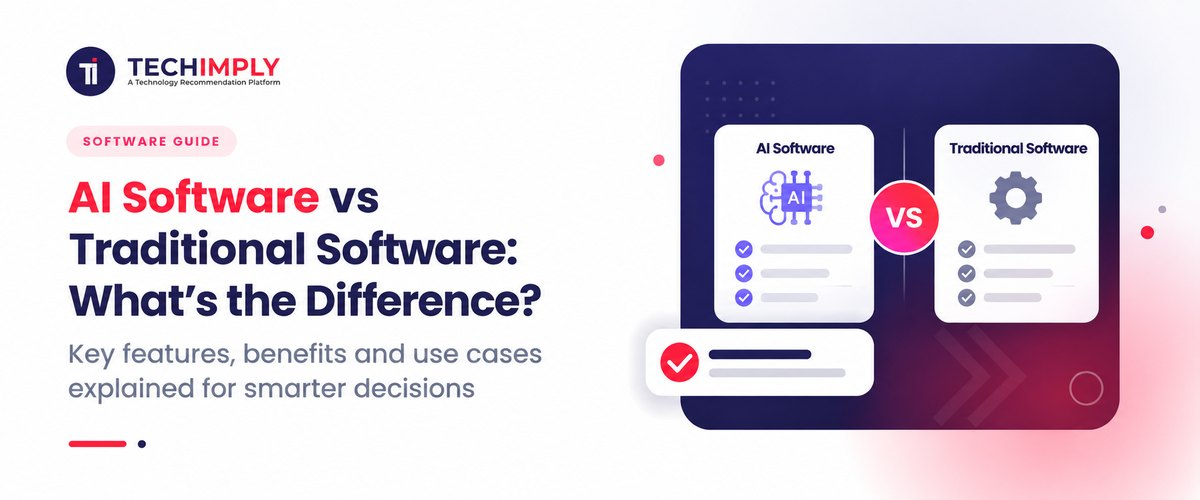
Choosing between AI software vs traditional software is not just about features. It comes down to how much intelligence your business actually needs.
While traditional software executes on set rules, AI software can analyze data, identify patterns, predict, generate content and make suggestions. But it's not all the time the best choice.
If your small business has a standard process, then standard software may be more affordable. AI software might be more suitable for businesses that require forecasting, automation, or data-driven insights.
The right one is dependent on the problem you need to solve.
AI Software vs Traditional Software: Quick Comparison
|
Area |
Traditional Software |
AI Software |
|
How it works |
Follows predefined rules |
Uses models and data to produce outputs |
|
Adaptability |
Changes when developers update rules |
Can adapt based on new data or model updates |
|
Decisions |
Mostly rule-based |
Can predict, recommend, classify, or generate |
|
Accuracy |
Usually predictable for defined inputs |
Can vary depending on data and model performance |
|
Development |
Often simpler for fixed workflows |
Usually requires additional AI and data work |
|
Maintenance |
Mainly code, infrastructure, and security updates |
Includes software, model, data, monitoring, and evaluation |
|
Data needs |
Can work with limited business data |
Often benefits from relevant, high-quality data |
|
Best fit |
Stable and predictable processes |
Pattern-heavy, complex, or data-driven tasks |
The important point in an AI software comparison is not that one type is automatically better. Each solves a different kind of business problem.
What Is Traditional Software?
Think about a process your business already follows step by step. Traditional software simply turns those rules and workflows into a system that gives you a predictable result.
For instance, payroll software could work out the salary of an employee based upon attendance, deductions, bonuses, and taxes. Likewise, a billing system can create a bill when you input the necessary details.
The main traditional software benefits are predictability, control, easier testing, and straightforward maintenance. If your business follows clear and stable processes, you may have little reason to add AI.
Traditional software development can also be easier to plan because developers work with defined requirements instead of evaluating how well an AI model performs.
What Is AI Software?
AI software is a type of software that utilizes artificial intelligence to perform tasks that require analysis, prediction, recognition, or content creation.
Take example, if a customer's ticket is sent by fixed rules, AI-powered software can grasp the customer's message, determine the issue, make a suitable reply, and place the ticket in priority.
The real value of AI is that it can handle situations where fixed rules are not enough.
If you are exploring AI tools for your business, you can also compare Artificial Intelligence Software available on Techimply.
AI Software vs Traditional Software: Key Differences
-
How They Work
Traditional software generally follows explicit instructions. AI software uses models that process data to produce predictions, recommendations, classifications, or generated outputs.
That difference matters when your business process changes frequently.
A fixed approval workflow may work perfectly with traditional software. Demand forecasting based on hundreds of variables is a better candidate for AI.
-
Learning and Adaptability
Traditional software does not normally learn from new transactions by itself. If you want a new rule, a developer usually needs to modify the system.
AI software can be designed to learn patterns from data or use updated models. That does not mean every AI application automatically improves over time. Data quality, model updates, testing, and monitoring still matter.
-
Decision-Making
Traditional systems are strong when the decision can be clearly defined.
For example:
If invoice amount > ₹1,00,000 → send for senior approval.
AI is more useful when the decision depends on patterns.
For example, a transaction may be monitored to look for irregularities in how the transaction is used and warnings issued if there is unusual activity that is not covered by a simple rule.
-
Accuracy and Predictability
In traditional software, it is well known that the same input and rules lead to the same output.
AI systems can behave differently because their outputs depend on the model, data, context, and evaluation process. Accuracy therefore needs to be tested rather than assumed.
This is one reason AI vs traditional software is not simply a question of which technology is more advanced.
-
Development Cost
Traditional software development can be less expensive when the requirements are straightforward.
Data preparation, model selection, evaluation, integration, monitoring, and infrastructure are some of the extra tasks that can be required in AI software development.
-
Maintenance
Typical software maintenance includes bug fixes, security updates, infrastructure and feature updates.
AI software may require all of those plus model monitoring, evaluation, data updates, prompt or model changes, and checks for declining performance.
So, when comparing AI software vs conventional software, look at the cost after launch, not only the initial development quote.
-
Security
Neither AI nor traditional software is automatically more secure.
Traditional software has the common risks of vulnerabilities, unauthorized access and disclosure of data. There are new issues with AI to consider, including training data, model behavior, prompt manipulation, and sensitive information.
-
Data Requirements
Traditional software can often operate effectively with relatively little historical data.
AI software is typically more useful when fed with relevant, clean and representative data. Even with a complex model, an AI system can be less useful due to poor data.
Do You Know?
Just because a tool uses AI doesn’t mean it learns from your business data. There are other who use pre-trained models, and there are others who are trained for specific tasks. When picking one, inquire into how your data will be utilized, kept, and secured.
AI Software vs Traditional Software: Cost Comparison
The AI software cost you see on a quote may not represent the full cost of ownership.
As part of traditional software, you normally account for licensing or building fees, hosting, integrations, support, security, and updates.
Apart from the AI usage and the data preparation, you might also have to consider evaluation, monitoring, AI infrastructure and AI-related tasks.
That is why comparing only the initial purchase price can produce the wrong conclusion.
If you are a small business with an inventory and billing system, you might need all of this with traditional software. If you're a small business and you need inventory and billing, then traditional software might be enough. If a business problem demands the use of AI, then the added cost is worth it for an ecommerce company attempting to predict the demand for thousands of products.
Which Is Faster to Develop?
It depends on the type of software.
In some cases, the process of creating a simple traditional application with clear requirements can be quicker due to the fact that the rules and expected outputs are clearly defined.
While AI can help with parts of the coding, testing, documentation, and prototyping processes, creating an AI product is not simply about generating code. Even though you've done all the above, it takes time for data to be prepared, evaluated, secured, integrated, and human-reviewed.
AI software development is not always quick to develop, from start to finish.
Which Is More Secure?
There is no universal winner.
The behavior of traditional software is predictable and the workflow is well defined, making traditional software easier to control. AI can also create other risks that necessitate specific controls and testing.
Some questions that should be asked when making security choices for an Indian enterprise are: Where is the data stored, who can access it, will it be processed by a third party AI provider, what happens when the information is kept for longer than is necessary and what happens if the AI gets it wrong?
When Should You Choose Traditional Software?
Traditional software is often the better choice when:
- Your processes are stable and clearly defined
- You need predictable outputs
- Rules can describe the workflow easily
- Your business has limited useful data for AI
- You need straightforward maintenance
- AI would add complexity without solving a real problem
For instance, a small distributor might require inventory, invoicing, accounting and order management. AI is not necessarily the freshest option.
Value of traditional software benefits can be greater when reliability and predictable behaviour are higher order benefits than prediction or automation.
When Should You Choose AI Software?
It is when your business has to handle large or complex data sets or automate tasks that are not easily defined with a set of rules that AI software gains more interest.
Common AI software benefits include:
- Predictive forecasting
- Automated document analysis
- Personalized recommendations
- Intelligent customer support
- Fraud or anomaly detection
- Natural language processing
- Automated classification
- Pattern recognition
For instance, an Indian e-commerce firm might leverage AI to predict customer orders, suggest products, detect irregular orders, and study customer reviews.
If prediction, pattern recognition or data analysis play a major role in your use case, you can check out the Machine Learning category for Techimply's Machine Learning Software.
|
Business Need |
Better Choice |
|
Fixed, predictable workflows |
Traditional software |
|
Repetitive, rule-based processes |
Traditional software or rule-based automation |
|
Prediction and forecasting |
AI software |
|
Personalization and recommendations |
AI software |
|
Complex or unstructured data |
AI software |
|
Strictly deterministic calculations |
Traditional software |
|
AI added to an established business workflow |
Hybrid approach |
When Should You Use a Hybrid Approach?
For some companies, AI software isn't the answer and neither is traditional software.
A hybrid approach can combine predictable software workflows with AI where intelligence adds value.
Consider a CRM. Contacts, sales stages, permission and billing rules can be handled by traditional software. AI can summarize calls, offer follow-up ideas, score leads or uncover patterns in customer behaviour.
The same principle works in ERP, HR, customer support, finance, and supply chain systems.
This also ensures that you have greater control. Don't have to overhaul an entire software system because one part of the workflow could be improved by AI.

Pro-tip
Use a single process in your business that is difficult because of volume, complexity or patterns that change over time as a starting point for considering an investment in AI. Time, cost, and error measurements taken today. If AI can enhance that one process to the point that it is worth the expense and risk, go there rather than trying to implement AI across an entire system.
Real-World Business Examples
- Retail: Traditional software can be used to handle billing, inventory and product records. AI can include the power of demand forecasting and tailored suggestions.
- Banking and finance: Transactions and account rules can be supported with traditional systems.
- Manufacturing: Conventional Software controls the production schedule and stock. AI can be used to foresee equipment issues or quality issues based on sensor or image data.
- HR: Old HR software for employee records, attendance, and payroll. Use AI to analyze resumes, summarize employee feedback, or respond to common HR queries.
- Customer service: The traditional software can be programmed to route tickets based on predetermined rules.
Conclusion
Then which one do you pick? It's hard to say what's better – AI software or traditional software – unless you understand what your business needs.
For processes that are known, there may be a need for just traditional software. When it comes to forecasting, personalization, and intelligent automation, AI software might be worth considering.
For many Indian businesses, the combination of both can provide you the proper balance of control and intelligence.


.jpg "The Unforeseen Challenges of SAP S/4 HANA Implementation")


