


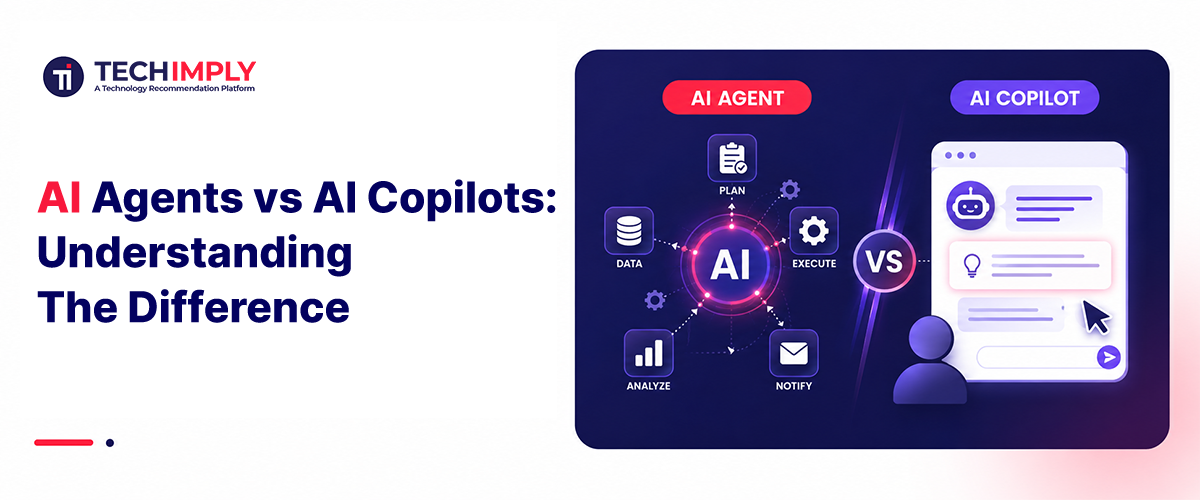
The most important distinction between AI agents and AI copilots is not the AI model they use. It is the level of responsibility they take inside a business process.
An AI copilot supports an employee who is already responsible for the work. An AI agent can sort of take responsibility for completing defined steps within that work, often across multiple systems and with limited human input.
This difference is becoming critical as businesses move beyond basic AI assistants and explore agentic AI, and autonomous AI too. Companies aren’t only asking, “where can AI improve productivity.” They’re asking which business processes can be safely passed off to AI, which decisions must still be overseen by humans, and how much autonomy an AI system should really have.
So the conversation about AI agents vs AI copilots isn’t just a tech comparison anymore. It’s turning into a question about operating model, risk , governance, and even business design.
AI Copilots: Built Around Human Decision-Making
AI copilots are made to help people work faster, and yeah, mostly smoother. They can write out documents, recap meetings, look through data, produce code, look up what’s inside internal knowledge, and even propose next moves. The employee stays right in the middle, and basically decides what to accept, what to tweak, or what to fully turn down.
So because of that, AI copilots are especially handy in jobs where professional judgment is not just something you can straightforwardly automate, and where it’s risky to pretend everything will always behave. An experienced artificial intelligence development company can help businesses build these copilots around real workflows, ensuring they support human decision-making rather than trying to replace it.
This also helps enable the next generation of enterprise AI assistants, which can give employees one common interface to pull company information, policies, documents, and business knowledge without bouncing between tools all day.
AI Agents: Designed Around Goal Completion
AI agents are built for a higher level of operational independence. Rather than simply responding to a user's request, an AI agent can work toward a defined objective. It can determine the steps required, use approved tools, interact with connected systems, evaluate results, and continue the workflow.
The technology behind this approach typically combines an AI model with tools, APIs, business data, workflow logic, memory, AI agent development, and access controls. The result is closer to a digital worker than a traditional chatbot.
AI Agents vs AI Copilots: The Business-Level Difference
The clearest distinction is the role each system plays in a business process.
|
Business Dimensions |
AI Copilots |
AI Agents |
|
Primary Purpose |
Assist Employees |
Complete defined objectives |
|
Human Role |
Active throughout the task |
Involved at key points or exceptions |
|
Workflow Control |
Human-led |
AI-led within boundaries |
|
Decision Support |
Strong |
Can make limited decisions |
|
System INtegration |
Usually on rent |
Can act across connected tools |
|
Best Use Case |
Knowledge work and productivity |
Repeatable multi-step processes |
|
Risk Profile |
Lower operational autonomy |
Requires stronger governance |
This does not mean that AI agents replace AI copilots. In many enterprise environments, they will work together. A copilot can help an employee understand a situation and make a decision. An agent can execute the routine steps that follow that decision.
The combination can create a more effective form of enterprise AI assistants, where AI supports both human reasoning and business execution.
Autonomous AI Requires the Right Level of Autonomy
The growing interest in autonomous AI raises an important question for business leaders: how much independence should an AI system have?
A company might want an AI copilot to summarise a legal document, but also there is a need to decide how far that summarizing can go and where the responsibility should sit. It may want an AI agent to process routine internal requests. It may require human approval before an AI system sends a customer compensation offer.
The right model depends on the risk and complexity of the task.
A useful approach is to think about autonomy in stages:
- Assist: AI provides information or recommendations.
- Prepare: AI creates an output for human review.
- Execute with approval: AI performs an action after receiving permission.
- Execute independently: AI completes approved, low-risk actions without intervention.
- Escalate exceptions: AI manages routine cases and sends unusual situations to a human.
This framework gives businesses a more practical way to evaluate AI agents. The goal should not be maximum autonomy. The goal should be appropriate autonomy.
Why AI Agents Are Moving Into Enterprise Workflows
The rising interest in agentic AI is kinda driven by the hidden complexity behind day to day business tasks. It’s like, a lot of effort is already there but it’s not visible, so when you look closer, the operations are more layered than they first seem. Many workflows involve employees moving between applications, checking information, copying data, and following predefined rules. This creates an opportunity for AI agents to coordinate work across systems. Claudeforce can support this kind of cross-system workflow automation.
McKinsey’s 2025 State of AI research found that 62% of respondents said their organizations were at least experimenting with AI agents. But, most organizations hadn't scaled AI across the whole enterprise. This points to a big reality for business leaders: the experimentation pace is moving faster than the actual enterprise rollout.
Taking an AI agent from a pilot into production is not just about having a capable AI model. Businesses also need dependable data, protected system access, well defined permissions, ongoing monitoring, careful testing, human handoff or escalation, plus measurable performance benchmarks. That is why successful AI Agent Development Services focus on the complete workflow rather than the AI model alone.
The Future is Copilots and Agents Working Together
The future of enterprise AI is unlikely to be a choice between AI agents vs AI copilots. Businesses will increasingly use both. Copilots will remain valuable for knowledge work, analysis, creativity, and decision support. AI agents will gradually step into more structured workflows that use a bunch of steps, and interconnected systems sorta.
Together they can form a new model for human–AI teaming, where things feel less rigid and more practical. For business leaders, the real key challenge is to choose what AI should only support, what it should take over, and where human sign-off has to stay mandatory, no shortcuts. As autonomous AI grows even more capable, orgs that take it on with clear processes, governance, and business results you can actually measure, will tend to be in a stronger position to harvest value from the tech.
For companies exploring this transition, AI Agent Development Solutions can provide the technical foundation for building secure, connected, and purpose-driven agentic workflows. Webline India is among the technology teams working in this evolving space, helping businesses explore practical applications of AI within their digital operations.


![Top 8 Online Video Downloader for PC Windows [2025]](https://cdn.techimply.com/uploads/blog/1947/1832715714080917.jpg "Top 8 Online Video Downloader for PC Windows [2025]")


