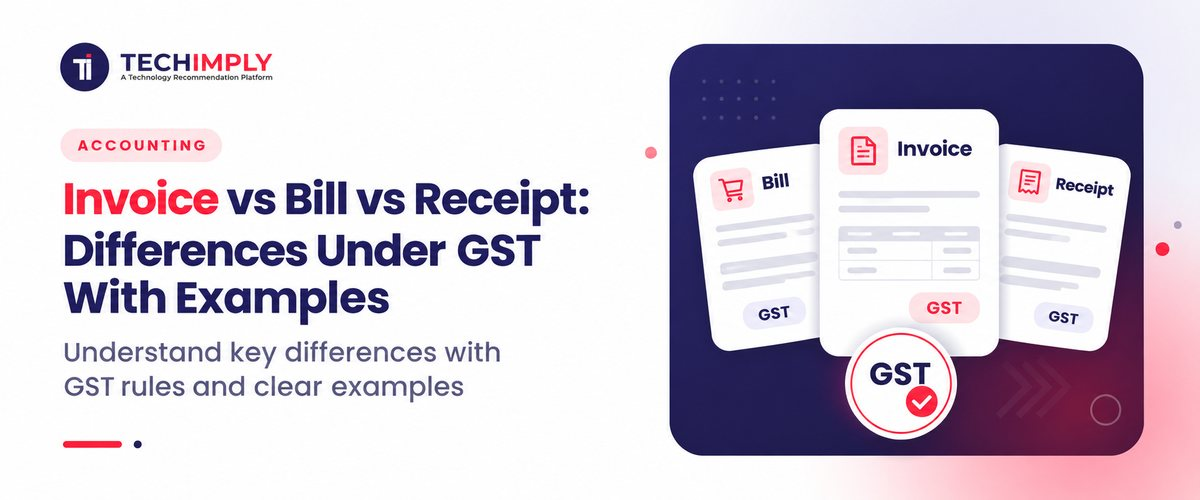
A Pune distributor sends a customer a document titled "Bill," collects ₹30,000 as advance, and later hands over a handwritten slip marked "Receipt." Three documents, three different legal roles, and only one of them may let the buyer claim input tax credit. Many small businesses use invoice, bill, and receipt as if they meant the same thing. Under GST, they do not. Each document answers a different question: what was supplied, what is owed, and what has been paid. Wrong labels usually surface later, during return filing or an audit. This guide explains the differences under GST, shows how each appears in practice with Indian examples, and covers how GST Billing Software keeps all three consistent and compliant.
Invoice, Bill and Receipt at a Glance
In short, an invoice records a supply and the tax payable on it. A bill is either the buyer's name for that invoice or a tax-free bill of supply. A receipt only confirms that money has changed hands. For input tax credit (ITC), the buyer relies mainly on the supplier's tax invoice, not on a bill or receipt. The table below separates them the way GST law does.
|
Document |
Issued by |
Purpose |
Shows GST? |
|
Tax invoice |
Registered supplier |
Records supply and tax |
Yes |
|
Bill of supply |
Composition or exempt supplier |
Records supply without tax |
No |
|
Receipt voucher |
Supplier receiving advance |
Records advance received |
Where tax applies |
|
Payment receipt |
Seller, by trade practice |
Confirms settlement |
No |
Why the Distinction Matters for Indian Businesses
The three documents feed different parts of the GST system. The invoice drives GSTR-1 and the buyer's ITC, so errors travel from one return to another. Penalty exposure also sits with the invoice: under Section 122 of the CGST Act, supplying without an invoice or issuing an incorrect one can attract a penalty of ₹10,000 or the tax evaded, whichever is higher. Receipts and bills of supply rarely draw the same scrutiny, but a missing receipt voucher can still complicate the time of supply during an audit. Many businesses assume that a paid bill is a closed matter, yet the tax position depends on documents, not on payment.
What Is an Invoice Under GST?
Under Section 31 of the CGST Act, 2017, a registered person supplying taxable goods or services must issue a tax invoice. The document records what was supplied, to whom, at what value, and with how much tax. The buyer uses it to claim ITC, and the seller uses it to report outward supplies in GSTR-1.
Mandatory Details Under Rule 46
Rule 46 of the CGST Rules lists what a valid invoice must contain. That includes the supplier's name, address, and GSTIN, a unique serial number of up to 16 characters, the date of issue, and the recipient's details where they are registered. The invoice also needs an HSN or SAC code, a description, quantity, taxable value, and the rate and amount of CGST, SGST, IGST, or cess. For inter-state supplies, the place of supply must be stated, and the invoice must indicate whether tax is payable under reverse charge.
When to Issue It
For goods, the invoice must be issued before or at the time of removal or delivery. For services, the limit is 30 days from the date of supply, extended to 45 days for banks, insurers and certain financial institutions. Late issuance can disturb the time of supply, which in turn affects when tax becomes payable.
The E-Invoicing Layer
Larger taxpayers face one more step. E-invoicing applies once aggregate turnover under a PAN has exceeded ₹5 crore in any financial year since 2017-18, and such invoices are reported to the Invoice Registration Portal (IRP), which returns an Invoice Reference Number (IRN) and a QR code. Since April 2025, taxpayers with turnover of ₹10 crore or more cannot report an invoice, credit note, or debit note to the portal once it is more than 30 days old. GST Software connected to the IRP handles this automatically, but businesses should still confirm current thresholds on the GST portal, since notifications change.
Corrections: Credit and Debit Notes
Once an invoice is issued, it should not be edited. Corrections go through a credit note when the taxable value or tax is reduced, or a debit note when it increases, as provided in Section 34. A credit note must be linked to the original invoice, and the supplier can reduce tax liability only within the time limits and conditions the law sets. This is another reason invoice discipline matters.

Pro-tip
Keep separate numbering series for tax invoices, bills of supply and receipt vouchers, and lock them in your Online Accounting Software so entries cannot be edited after issue.
What Is a Bill, and How Is It Different From an Invoice?
GST law does not define a standalone "bill" the way it defines an invoice. In daily trade, the word carries two meanings. A buyer's accounts team calls the supplier's tax invoice a purchase bill once it arrives for booking and payment, and a shopkeeper may call the counter slip a bill. What matters legally is the document's content, not the word printed on top.
Bill of Supply
The one bill the law does recognise is the bill of supply. Section 31(3)(c) requires it from composition dealers and from suppliers dealing only in exempt goods or services. It resembles an invoice but cannot show tax, because none is being charged. A composition dealer's bill must also carry a statement that the dealer is a composition taxable person and is not eligible to collect tax. Buyers cannot claim ITC on a bill of supply, which is why purchasing from a composition dealer raises the effective cost for a registered business that needs credit.
Reverse Charge Documents
Under reverse charge, the buyer pays the tax instead of the supplier. For such purchases, the recipient issues a payment voucher when it pays the supplier and, for supplies from an unregistered person, a self-invoice. Accounts teams often treat these as ordinary purchase bills, which is how reverse charge liability slips past returns.
Where Mistakes Start
A frequent error is a regular-scheme supplier issuing a plain "bill" with no GSTIN, no HSN code,e and no tax breakup. The customer loses ITC, and the supplier still owes the tax. If you are registered under the normal scheme and charge GST, the document must be a tax invoice.
What a Receipt Proves
A receipt confirms payment. It does not describe the supply in the detail an invoice does. In practice, two documents carry the same name, and they serve different purposes.
Receipt Voucher
Section 31(3)(d) requires a supplier who receives an advance payment to issue a receipt voucher at the time of receipt. It records the amount, the payer and, where tax is payable on the advance, the rate and tax amount. Under current rules, tax on advances is generally payable for services but not for goods. If the supply is later cancelled and no invoice is raised, the supplier issues a refund voucher. Confirm the treatment for your case with a tax professional.
Payment Receipt
The payment receipt is a commercial document, not a GST-prescribed one. A seller hands it over after settlement, and it becomes useful during disputes, audits, and ledger reconciliation. It cannot replace an invoice, and it cannot support an ITC claim on its own.
Worked Example: One Transaction, Several Documents
Take a Pune-based IT services firm billing a Chennai client for consulting worth ₹1,00,000 plus 18% IGST. The client pays an advance first, and the documents follow in this order.
- The client pays ₹35,400 as an advance. The firm issues a receipt voucher showing ₹30,000 plus ₹5,400 IGST.
- After the work is delivered, the firm's Billing and Invoicing Software generates a tax invoice for ₹1,00,000 plus ₹18,000 IGST, totalling ₹1,18,000. The earlier advance is shown as adjusted.
- The client's Accounts Payable Software books this invoice as a purchase bill, and the balance of ₹82,600 is paid. The firm's Accounts Receivable Software then closes the open item.
- The firm issues a payment receipt for the balance, and all entries post to its Accounting Software. The client claims ₹18,000 as ITC on the invoice, subject to the usual conditions, including the supply appearing in GSTR-2B.
Common Mistakes
Teams usually discover these errors during return reconciliation or an audit, when fixing them is slower.
- Treating a receipt as proof of tax paid. It carries no tax breakup, so the buyer cannot claim ITC on it.
- Skipping the receipt voucher on advances. Smaller firms often overlook it because the money feels like a deposit, not a sale.
- Restarting or editing invoice numbers mid-year. Locked series in Billing and Invoicing Software prevent duplicates.
- Booking purchase bills without checking GSTR-2B. Accounts Payable Software can flag supplier invoices that have not appeared there.
- Reporting e-invoices late. For taxpayers at or above ₹10 crore, the portal will reject documents past the 30-day window.
Do You Know?
A GST invoice number can run to 16 characters using letters, numerals, hyphens, and slashes, but it must be unique within a financial year.
How Software Keeps These Documents in Order
Manual documents work until volumes grow. Once a business issues a few hundred documents a month, errors in numbering, tax splits, and advance adjustments become likely. GST Billing Software handles the issuing side: it applies CGST, SGST or IGST based on place of supply, enforces unique serial numbers and produces the invoice, bill of supply or receipt voucher from the same master data. Tools sold as Billing and Invoicing Software often add credit notes, e-way bills and recurring invoice schedules.
Reporting is a separate job. GST Software pulls invoice data into GSTR-1, reconciles purchases against GSTR-2B and, where applicable, pushes invoices to the IRP for an IRN. For businesses above the e-invoicing limit, that integration matters more than the invoice layout.
Money movement needs its own tracking. Accounts Receivable Software follows each invoice until payment, applies advances against it, and flags overdue balances. On the buying side, Accounts Payable Software records supplier bills, matches them with ITC visible in GSTR-2B, and schedules payments. Both usually sit within broader Accounting Software, so every invoice and receipt posts to the ledger without re-entry. Teams spread across offices, or working with an external CA, often prefer Online Accounting Software because everyone sees one set of books.
Conclusion
An invoice proves the supply and carries the tax, a bill is either the buyer's record of that invoice or a tax-free bill of supply, and a receipt proves payment. Keeping the three apart protects the buyer's ITC and the seller's returns. When you shortlist GST Billing Software, check that it issues all three document types, supports IRP reporting if your turnover requires it, and posts cleanly into your Accounting Software.