


Accounting software for small retail businesses is a digital solution that helps retailers manage billing, inventory, taxes, expenses, and financial reporting from a single platform. By reducing manual work, improving accuracy, ensuring compliance, and offering real-time insights, it empowers small retailers to make informed business decisions, save time, and focus on growth. Retailers can now track sales, inventory, expenses, and taxes efficiently, gain actionable insights into profitability, and make data-driven decisions.

Looking for Retail Accounting Software?
Check out Techimply's Best Retail Accounting Software in India for your business.
Small retail businesses, including grocery stores, kirana shops, medical stores, clothing outlets, electronics retailers, and general stores, play a vital role in local economies. These businesses handle high-volume daily transactions, manage inventory, and comply with tax regulations like GST in India. Accounting software for retail businesses addresses these challenges by automating routine tasks and centralizing financial data.
What Is Accounting Software for Small Retail Business?
Accounting software for small retail businesses is a specialized system designed to support retail-specific operations. Unlike general accounting tools used by service businesses, retail accounting software integrates inventory management, billing, taxation, payroll, and financial reporting into a single platform.
Retail businesses deal with:
-
Frequent sales transactions
-
Returns and discounts
-
Multiple tax rates
-
Large product inventories with multiple SKUs
Accounting software ensures every sale is recorded accurately, inventory is updated automatically, and taxes are calculated correctly. Acting as a single source of truth, it helps business owners maintain control over finances and make informed decisions.
Why Small Retail Businesses Need Accounting Software
Small retail businesses operate on tight margins and handle large volumes of transactions. Manual bookkeeping makes it difficult to track real-time stock, identify profitable products, or stay compliant with tax regulations.
Accounting software solves these issues by:
-
Automating data entry and calculations
-
Recording sales, purchases, and expenses consistently
-
Monitoring inventory levels, customer payments, and supplier dues
-
Generating financial reports and GST-compliant invoices
By reducing errors, saving time, and improving efficiency, accounting software allows retailers to focus on customer engagement, marketing, and business growth.
Key Features of Accounting Software for Retail Businesses
Inventory Management
Inventory is the backbone of retail operations. Accounting software tracks stock in real-time, records purchases and sales automatically, and alerts when stock is low. Benefits include:
-
Monitoring fast-moving and slow-moving products
-
Reducing losses and overstocking
-
Streamlining procurement and supplier management
-
Improving cash flow and operational efficiency
Billing and Invoicing
Retail accounting software in india simplifies billing with features like
-
Barcode scanning for quick checkout
-
Multiple payment options, including cash, card, and UPI
-
Customizable invoice templates
-
Automatic discount and promotion calculations
GST and Tax Compliance
Accounting software ensures accurate tax calculations, generates GST-compliant invoices, and produces required tax reports. This automation reduces errors and ensures compliance, lowering the risk of penalties and audits.
Expense and Purchase Tracking
Track all operational expenses, such as
-
Supplier invoices
-
Salaries and wages
-
Rent and utilities
-
Marketing and miscellaneous expenses
This ensures better cash flow management and identifies cost-saving opportunities.
Financial Reporting
Generate comprehensive reports:
-
Profit & loss statements
-
Balance sheets
-
Sales summaries
-
Inventory valuation reports
These reports provide clear insights into financial performance and profitability.
POS Integration
Integrating accounting software with Point of Sale (POS) system ensures that all sales data flows directly into the accounting records, eliminating duplicate entry and improving accuracy.
Cloud Access and Data Security
Cloud-based solutions allow remote access from smartphones, tablets, or computers. Security features include:
-
Data encryption
-
Regular backups
-
Role-based access control
These features ensure business continuity and data protection.Retailers also rely on multiple devices for daily operations, and securing or regaining access to Android or PC systems is equally important. In such cases, tools like the 10 Best FRP Bypass Tools Free for Android & PC can help restore device access without data loss
Benefits of Using Accounting Software in Retail
1. Improved Accuracy
Automation reduces human errors in billing, inventory, GST calculations, and financial entries, helping retailers maintain better financial control and avoid disputes with customers, suppliers, and tax authorities.
2. Time and Cost Efficiency
By automating repetitive tasks, accounting software saves time and reduces administrative costs. Retailers can focus on customer service, marketing, and growth instead of manual bookkeeping.
3. Better Inventory Control
Real-time stock tracking helps prevent stockouts and overstocking, optimizes purchasing decisions, and improves cash flow.
4. Compliance and Risk Reduction
Automated GST calculation and reporting ensure regulatory compliance, reducing audit risks and legal penalties.
5. Support for Business Growth
Accounting software provides data-driven insights, helping retailers analyze performance, identify opportunities, and scale operations confidently.
Looking for E-commerce Platform Software?
Check out Techimply's Best E-commerce Platform Software in India for your business.
Types of Retail Businesses That Use Accounting Software
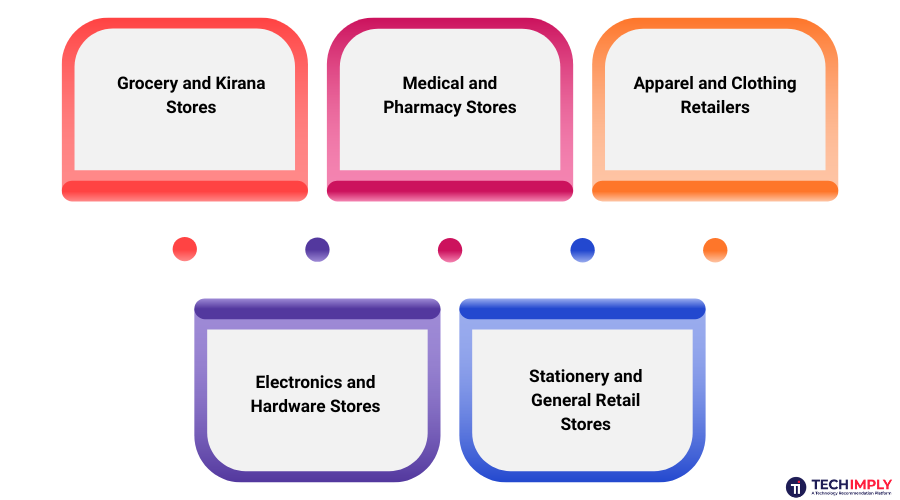
Grocery and Kirana Stores
High-volume, low-margin stores benefit from daily cash sales management, UPI and card payments, supplier credit tracking, and inventory updates.
Medical and Pharmacy Stores
Track batch numbers, expiry dates, GST billing, supplier compliance, and purchase margins. Generate audit-ready records easily.
Apparel and Clothing Retailers
Manage size, color, brand, and seasonal variations efficiently. Track returns, discounts, and margins across product categories.
Electronics and Hardware Stores
Track high-value items, warranties, serial numbers, and supplier payments with accurate financial reporting.
Stationery and General Retail Stores
Simplify invoicing, expense tracking, and inventory management software for retailer across a wide variety of SKUs.
Regardless of segment, accounting software adapts to business size, store operations, and scalability requirements.
Accounting Software vs Manual Bookkeeping
Manual bookkeeping:
-
Time-consuming and repetitive
-
Prone to errors
-
Difficult to comply with GST
-
Limited visibility of financial health
-
Not scalable
Accounting software:
-
Automates data entry and calculations
-
Ensures consistency and accuracy
-
Provides real-time dashboards
-
Supports business growth and scalability
For modern retail businesses, manual bookkeeping is no longer sustainable.

Pro-tip:
In 2026, most GST returns are now auto-filled directly from your digital invoices. This means if your software is synced, you can complete your monthly filing in minutes instead of days
Popular Accounting Software Options for Small Retail Businesses in India
| Software | Best For | Key Features | Pricing (Approx.) |
| TallyPrime | Established retailers & CA-driven audits | Deep GST compliance, offline reliability, robust inventory. | ₹750/mo or ₹22,500 lifetime |
| Zoho Books | Tech-savvy owners & E-commerce | Cloud access, automation, UPI/payment integrations. | Free (under ₹50L/yr) or ₹3,000+/yr |
| Vyapar | Micro-shops & Small traders | Extremely simple UI, mobile billing, offline & online sync. | ₹3,000 – ₹4,500/yr |
| Marg ERP | Pharma, FMCG, Grocery | Expiry tracking, batch management, POS-centric features. | ~₹9,999/yr (Silver) |
| Busy | Wholesalers & Multi-branch retail | Multi-location inventory, advanced discount schemes. | ~₹4,499/yr |
| myBillBook | Smartphone-first businesses | Quick mobile billing, barcode scanning, WhatsApp alerts. | ~₹2,999 – ₹4,000/yr |
How to Choose the Right Accounting Software
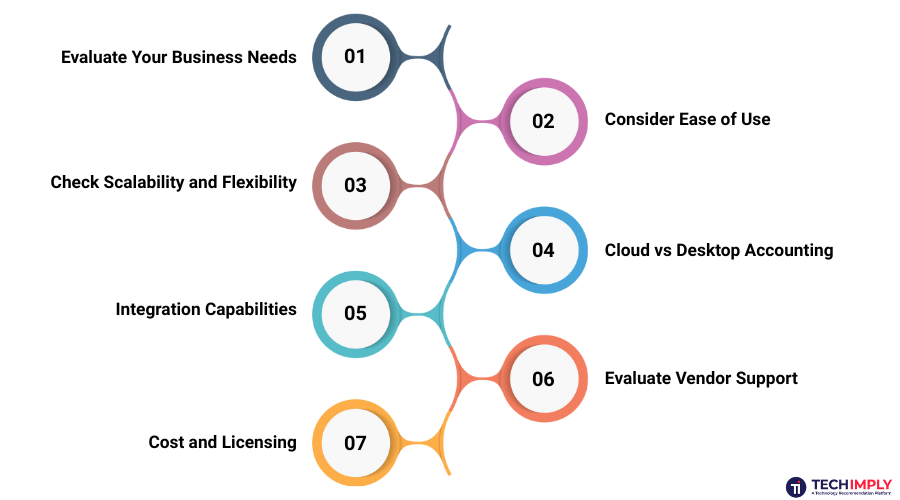
1. Evaluate Your Business Needs
Identify inventory size, transaction volume, GST compliance requirements, and reporting needs.
2. Consider Ease of Use
Choose intuitive software with minimal manual entry, dashboards, templates, and onboarding support.
3. Check Scalability and Flexibility
Ensure the software supports multiple stores, users, cloud access, and POS billing software integration.
4. Cloud vs Desktop Accounting
Cloud offers mobility, updates, backups, and integration with online platforms. Desktop may be cheaper but less flexible.
5. Integration Capabilities
Seamless integration with POS, payroll 8 best e-commerce accounting software accurate and unified financial records.
6. Evaluate Vendor Support
Opt for vendors offering onboarding, tutorials, responsive support, and transparent pricing.
7. Cost and Licensing
Assess subscription fees, add-ons, upgrades, and training costs for long-term value.
Challenges and Limitations of Retail Accounting Software
While the right software can transform a retail business, implementation often comes with significant hurdles. Understanding these challenges beforehand allows you to plan for a smoother transition.
Initial Setup & Data Migration
The transition from manual ledgers or legacy systems to new software is often the most difficult phase. Errors during the mapping of old inventory data or opening balances can lead to systemic financial discrepancies that haunt the books for months. Successful migration usually requires a dedicated "data cleaning" period to ensure that item codes, GST rates, and party details are perfectly accurate before going live.
Learning Curve & Staff Training
Even the most intuitive software requires a shift in mindset for staff accustomed to traditional billing methods. Training must cover not just basic invoicing, but also how to handle exceptions like sales returns, credit notes, and inventory adjustments. Without proper guidance, staff may bypass software features or enter "shortcut" data, which eventually ruins the accuracy of automated reports.
Cost Constraints
While "Free" tiers exist, small retailers often find that essential features, like multi-user access, barcode integration, or advanced GST filing, require expensive premium subscriptions. Beyond the initial purchase, businesses must also budget for hidden costs such as AMC (Annual Maintenance Charges), cloud storage fees, and potential hardware upgrades to run the software smoothly.
Customization Limitations
Most off-the-shelf retail is built for a "one size fits all" workflow, which might not align with unique business processes like specific loyalty schemes or complex discount structures. Small retailers often struggle when they need specialized reports that the software’s standard dashboard doesn't provide.
Internet Dependency
Cloud-based solutions offer great mobility, but they become a liability in areas with unstable internet, leading to "billing freezes" during peak customer hours. Hybrid models that store data locally but sync to the cloud are often necessary for high-volume retail environments.
Data Security
Shifting financial records to a digital platform introduces risks like data breaches, unauthorized access by staff, and potential data loss due to hardware failure. Retailers must ensure the software uses end-to-end encryption and provides Furthermore, a lack of regular automated backups can result in the permanent loss of years of financial history during a system crash.
Quick Tip:
Do You Know?
The 35% Efficiency Boost: Retailers who switch from manual bookkeeping to cloud-based accounting report closing their month-end books 35% faster on average.
Role of Accounting Software in Long-Term Retail Growth
The accounting software market was valued at USD 21.56 billion in 2025 and estimated to grow from USD 23.47 billion in 2026 to reach USD 35.86 billion by 2031, at a CAGR of 8.85% during the forecast period (2026-2031). In today’s modern market, the role of accounting software is very important.
1. Real-Time Financial Insights
Gone are the days of waiting for month-end reports to know if you made a profit. Modern software provides a Live Dashboard of your shop’s health. By tracking cash flow and margins daily, you can make informed decisions—like whether you can afford a second storefront or if you need to cut costs on a specific product line.
2. Scalability Across Locations
As your business grows from one shop to a chain, the software acts as your "Central Command." It allows you to monitor sales and stock across multiple locations from a single screen. This centralized control ensures that your expansion is organized rather than chaotic, as you can add new users and branches with just a few clicks.
3. Inventory Optimization & Forecasting
Profit in retail is often hidden in your stock. Accounting software uses AI-driven demand forecasting to analyze historical sales data and predict what you’ll need next month. This prevents "Deadstock" (money tied up in items that don't sell) and "Stockouts" (losing customers because an item is missing), ensuring your working capital is always moving.
4. Enhanced Tax Compliance & Audit Readiness
In India’s "GST 2.0" era, compliance is automated. E-Invoice software generates e-Way bills directly, ensuring you are always audit-ready without manual intervention. This "Formalization" makes your business more attractive to banks, making it significantly easier to secure business loans for expansion.
5. Unified Omnichannel Operations
Growth today requires selling both offline and online. Accounting software integrates your physical shop’s POS (Point of Sale) with e-commerce platforms like Amazon or Shopify. When someone buys a shirt online, your shop’s inventory updates instantly, preventing the embarrassment of selling the same item twice.
6. Data-Driven Decision Making
The software turns raw numbers into "Retail Intelligence." You can identify your Top 20% of products that generate 80% of your profit and double down on them. Instead of relying on "gut feeling," you plan your sales, discounts, and marketing based on hard facts, which drastically reduces the risk of failure.
7. Strategic ROI Planning
Long-term growth requires knowing where your money is most effective. Accounting tools help you monitor the Return on Investment (ROI) for every marketing campaign or new product launch. By understanding your cost structures from rent to employee payroll you can fine-tune your operations to be lean and highly profitable.
Conclusion
Accounting software for small retail businesses is no longer just a convenience it’s a necessity for operational efficiency, accurate financial management, and sustainable growth. By automating billing, inventory tracking, GST compliance, and reporting, it reduces errors, saves time, and provides real-time insights that empower retailers to make data-driven decisions. Scalable, cloud-based solutions with POS and e-commerce integrations ensure seamless multi-location management, better inventory control, and enhanced customer experience. Investing in the right accounting software enables small retailers to optimize cash flow, comply with regulations, expand confidently, and build a strong foundation for long-term profitability and business success.
Related Reads
How AI-Powered Accounting Software is Transforming Finance in 2024
How to Choose the Best ECommerce Platform for Your Business?
Best 15 Accounting Software For Small Business In India 2023
Emerging Trends in Cloud-Based Accounting Software for 2024
Must-Have Features To Look in Retail Accounting Software
Cloud-Based vs. On-Premise Accounting Software: Choosing the Best Option


.png "How To Add Instagram Feeds on Shopify Store")


