Managing a workforce in the 2026 Indian economy means navigating a landscape where AI and automation are rapidly blurring the lines between traditional roles. Whether you are an entrepreneur implementing next-gen HR software to orchestrate a diverse team or a candidate recalibrating for a tech-driven market, the distinction between a white collar job and blue collar job worker in India has taken on a brand-new meaning.

Looking for HR Software?
Check out Techimply's List of the Best HR Software in India for your business.
While these collar colors were once rigid markers of social hierarchy, the modern era defines them by the nature of the work, the environment, and the digital tools used to achieve peak efficiency. Let’s dive deep into the world of blue collar vs white collar employment to see how human ingenuity and AI is reshaping our economic future.
Blue-Collar Jobs Meaning
When we refer to blue collar jobs meaning, we are referring to a job that deals with manual work or skilled work. The name came into use for the durable blue clothes (such as denim or chambray) that were used by workers in factories to protect their dirty and greasy garments.
Blue-collar employee is usually one who does a physical labor job. This encompasses all th_e manufacturing and construction through the maintenance and logistics. By 2026, the meaning of blue collar workers has been extended to add the term New-Collar roles to denote highly skilled technical jobs that do not demand a 4-year university degree but only specialized training.
White-Collar Jobs Meaning
Conversely, white collar jobs are defined by professional, managerial, or administrative work. The name stems from the traditional white button-down shirts worn by office workers.
A white collar worker usually performs their duties in an office setting or via remote work.
These roles are often service-oriented or knowledge-based, focusing on data, strategy, communication, and technology. White collar employees are the backbone of the corporate world, filling roles in departments like finance, marketing, and human resources.
Suggested Read:
What are the Differences Between Blue-Collar and White-Collar Jobs?
Understanding the difference between white collar vs blue collar jobs requires looking at several key pillars of employment.
1. Nature of Work
The primary blue collar and white collar difference lies in the physical versus mental demand. Blue-collar roles are physically active, building, fixing, or moving things. White-collar roles are cognitive, analyzing, creating, or managing systems and people.
2. Education and Training Requirements
Historically, white collar jobs required a minimum of a bachelor’s degree. While this is still common, many white collar professional roles now value certifications and experience. Blue collar jobs often prioritize vocational training, apprenticeships, or technical diplomas. However, skilled blue-collar roles (like specialized welding or HVAC) now require significant technical certification.
3. Work Environment and Conditions
A white collar job and blue collar job differ significantly in their office space. Blue-collar work happens on construction sites, factory floors, or in customers' homes. White-collar work typically occurs in climate-controlled offices or home-based setups.
4. Compensation and Benefits
While white collar employees often receive an annual salary, many blue collar employees are paid hourly or based on project completion. However, in the 2026 context, high-demand skilled trades often command higher hourly rates than entry-level office positions.
Looking for Recruiting Software?
Check out Techimply's List of the Best Recruiting Software in India for your business.
Quick Comparison: Blue Collar Job vs White Collar Job Table (2026 India Context)
|
Aspect |
Blue Collar Job |
White Collar Job |
|
Work Nature |
Manual labor, technical trades, physical activity |
Administrative, managerial, creative, data-driven |
|
Typical Workplace |
Factories, outdoors, workshops, field-sites |
Corporate offices, coworking spaces, remote/home |
|
Pay Structure |
Hourly wages, piece-rate, or daily wages |
Monthly salary, annual bonuses |
|
Education/Entry |
Vocational training, ITI, apprenticeships |
University degrees, MBAs, professional certs |
|
Work Hours/Shifts |
Often shift-based (24/7 operations) |
Traditionally 9-to-5 (now increasingly flexible) |
|
Job Security (2026) |
High for skilled trades; vulnerable to automation in logistics |
High for specialized roles; vulnerable to AI in entry-level |
|
Typical Benefits |
Overtime pay, health insurance, ESI/PF |
Health insurance, paid time off, stocks, wellness perks |
|
Career Growth |
Master Craftsman, Site Supervisor, Business Owner |
Manager, Director, C-Suite Executive (CEO/CTO) |
Explain The Value of a white-collar job vs. a blue-collar job
The two sectors cannot be done away with in the 2026 economic ecosystem, as they operate like the hardware and software of one machine. The white collar professional, the advanced strategy, venture funding, and the advanced AI-driven software architecture of a company would not have been there without the white collar professional. They offer a cognitive roadmap and digital infrastructure that enable businesses to scale within a competitive global market.
On the other hand, the absence of the blue collar worker would mean the physical product would not be assembled, the infrastructure would not be serviced, and the logistics chain currently running on predictive AI would go dead. The blue collar worker has been made to rise in status in 2026 through the Gati Shakti and the Make in India initiatives of India, as well as the trend of Smart Manufacturing. This change is evidence that, despite living in an automated world, a nation is unable to prosper without a well-developed technology-enhanced manufacturing and service infrastructure.

Do You Know?
In 2026, a specialized Smart-Grid Electrician in a Tier-1 Indian city can earn up to 20% more than a junior Data Analyst, thanks to the massive "Make in India" infrastructure push.
Real-World Examples + 2025–2026 Salary Insights (India)
In the current market, the difference between blue collar and white collar jobs is becoming less about the paycheck and more about the lifestyle. Here is how the compensation stacks up across India’s major hubs like Bengaluru, Mumbai, and Delhi-NCR.
Key Takeaways
Salaries are monthly averages and vary by city (e.g., Bangalore vs. Lucknow).
1. Blue-Collar Jobs:
Modern blue collar jobs in India are seeing a massive skill premium.
- Electrician: ₹28,000 – ₹45,000 per month. Industrial electricians specializing in automation earn significantly more.
- Plumber: ₹22,000 – ₹42,000 per month. Those affiliated with premium home-service apps often see higher consistency.
- Welder: ₹30,000 – ₹55,000 per month. Specialized underwater or high-pressure pipe welders are among the highest-paid blue collar workers.
- AC Technician / HVAC Mechanic: ₹25,000 – ₹50,000 per month. Seasonal demand in India often leads to massive overtime bonuses.
- Delivery Executive (Zomato/Blinkit): ₹18,000 – ₹32,000 per month. Earnings are highly dependent on gig density and fuel incentives.
- Construction Supervisor / Mason: ₹35,000 – ₹65,000 per month. Experienced supervisors managing large sites are highly valued in the 2026 infrastructure boom.
2. White-Collar Jobs:
Being a white collar professional in the modern world is characterized by the capacity to operate in a multifaceted digital ecosystem.
- Software Developer: ₹60,000 – ₹2,80,000+ per month. Specializations in AI and Cybersecurity command the highest premiums.
- Accountant (Junior CA/Regular): ₹40,000 – ₹90,000 per month. Proficiency in automated payroll software is now a mandatory skill.
- Marketing Executive / Digital Marketer: ₹35,000 – ₹85,000 per month. Focus has shifted heavily toward performance marketing and AI-driven content.
- HR Executive: ₹30,000 – ₹70,000 per month. Roles now focus on Employee Experience and navigating HRM software analytics.
- Bank Officer / Financial Advisor: ₹45,000 – ₹1,10,000 per month. Modern banking roles require high-level relationship management skills.
Blue Collar: Common Software & Apps (Trades & Field Work)
Paper logs are a thing of the past. The 2026 blue collar employee is digitally empowered.
- Job Management & Field Service Software: Applications such as Workiz or the partner app of Urban company enable technicians to make reservations, GPS-monitor their next destination, and create an electronic invoice in real-time.
- Attendance and blue-collar workforce HRMS: Facial recognition and geofencing are elements of HR software used by factories. Such tools as BetterPlace or PagarBook assist in controlling the attendance of the contract employees in several locations.
- Gig/Quick Commerce & Job Portals: Apna and WorkIndia have become the most used job board software in the blue-collar segment, which has been linked to millions of people getting immediate jobs.
- Other Tools: Digital payment gateways (UPI) and simple CRM software to allow small trade businesses to monitor repeat customers.
White Collar: Common Software & Apps (Office/Professional Roles)
For white collar employees, the office is essentially a collection of high-powered software suites.
- Productivity & Office Suites: Beyond Google Workspace and Microsoft 365, collaborative whiteboard tools like Miro and Notion are standard.
- HRMS, Payroll & Recruitment Tools: Modern firms use recruiting software like Lever or Keka to automate the hiring funnel. Payroll software now handles complex tax regimes and remote-work stipends automatically.
- Specialized Professional Tools: Salesforce (CRM), Jira (Agile Management), and Adobe Creative Cloud remain the gold standard for white collar professional roles.
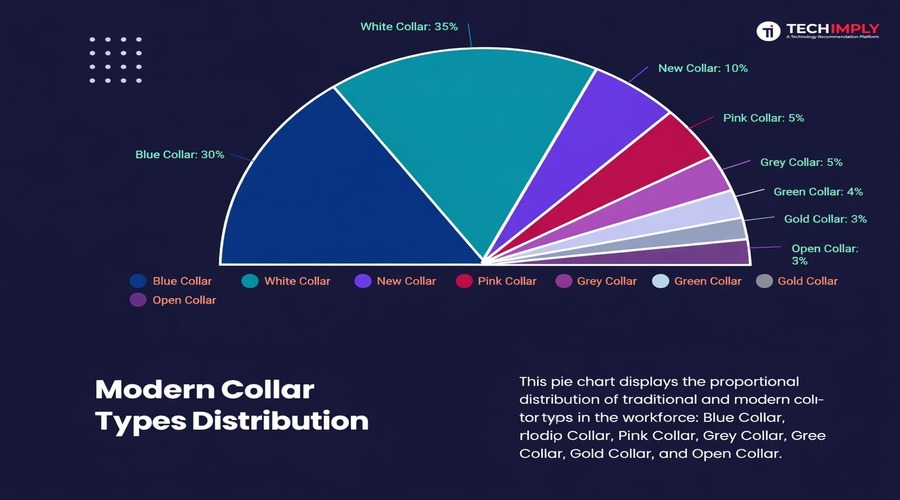
What Are Other Collar Work Classifications Besides White and Blue?
While the blue collar vs white collar workers debate dominates headlines, several other categories have emerged to describe the specialized roles of the mid-2020s:
- New-Collar Workers: These are the stars of 2026. They work in high-tech industries like cybersecurity, cloud computing, and EV diagnostics. They don't necessarily have a four-year degree but possess advanced certifications and high-level technical skills.
- Pink-Collar Workers: This term refers to the service industry—roles traditionally associated with care and interaction, such as nursing, teaching, retail, and hospitality.
- Grey-Collar Workers: These individuals fall right in the middle. Think of an airline pilot, an IT technician, or a high-end chef. Their jobs require a mix of the physical stamina of a blue collar worker and the technical knowledge of a white collar professional.
- Green-Collar Workers: These are the heroes of the sustainability movement. They work in renewable energy (solar/wind), conservation, and environmental engineering.
- Gold-Collar Workers: Highly specialized and highly paid professionals such as surgeons, research scientists, and high-stakes corporate lawyers.
- Open-Collar Workers: A term popularized by the rise of the gig economy and remote work—people who work from home or digital nomads who don't fit into a traditional office or factory box.
Reality in 2026 India: Blue Collar vs White Collar Jobs – What's Actually Happening?
In India, we are witnessing a Great Convergence. The shortage of skilled tradespeople (plumbers, electricians) has driven their income higher, sometimes surpassing entry-level white collar jobs. Meanwhile, the rise of AI is automating routine white-collar tasks like basic data entry and junior coding.
The employment services market size has grown rapidly in recent years. It will grow from $2.14 trillion in 2025 to $2.37 trillion in 2026 at a compound annual growth rate (CAGR) of 10.7%. This rapid growth is fueled by a desperate need for specialized talent and the integration of sophisticated HR software across every imaginable industry.
Gen Z in India is increasingly looking at Skilled Trades as a viable entrepreneurial path, while white-collar professionals are adopting Blue-Collar grit by working in the gig economy or starting small-scale manufacturing units. The lines are no longer drawn by social class, but by technical proficiency.
Pro-Tip:
When selecting HRM software for a mixed workforce, prioritize Mobile-First platforms. Your field staff needs WhatsApp-integrated attendance, while your office staff needs deep-dive analytics. A unified system is the only way to prevent data silos.
Conclusion
The distinction between blue-collar workers and white-collar workers is no longer based on status- it is based on the tools you are working with. In the case of recruiting software to locate the next lead architect or in the case of HRMS software to control a factory floor containing a thousand people, both are indispensable. With technology entering all types of employment, the most effective employees in 2026 will be those who can find a middle ground between physical dexterity and being digitally literate.
Suggested Read:
- AI-Driven Recruitment Software: Transform Hiring for Staffing Agencies
- 20 Smart Recruitment Strategies That Work in 2026 | Modern Hiring Tips
- Enterprise HR Software: Top Features, Benefits & Use Cases (2026)
- Best SaaS HR Software: Define, Features, Benefits, Cost
- Develop a Successful Compensation Strategy in HRM
- Top HRM Challenges 2025: AI, Retention & Well-being
- PEO vs Payroll: What’s the Difference and Which One Should You Choose?
- Enterprise HR Software: Top Companies Ranked for 2026 Efficiency
- Transform HR: How an Integrated Payroll ERP System Works