Sourcing world-class talent in India’s competitive corporate market requires a strategic and efficient recruitment approach. Companies in major hiring hubs such as Bangalore, Mumbai, and Gurgaon often need to decide whether to build an in-house recruiting team or partner with a staffing agency. India's growing flexible workforce has increased demand for staffing partners that can help companies respond to changing project requirements.

Looking for Recruiting Software?
Check out Techimply's List of the Best Recruiting Software in India for your business.
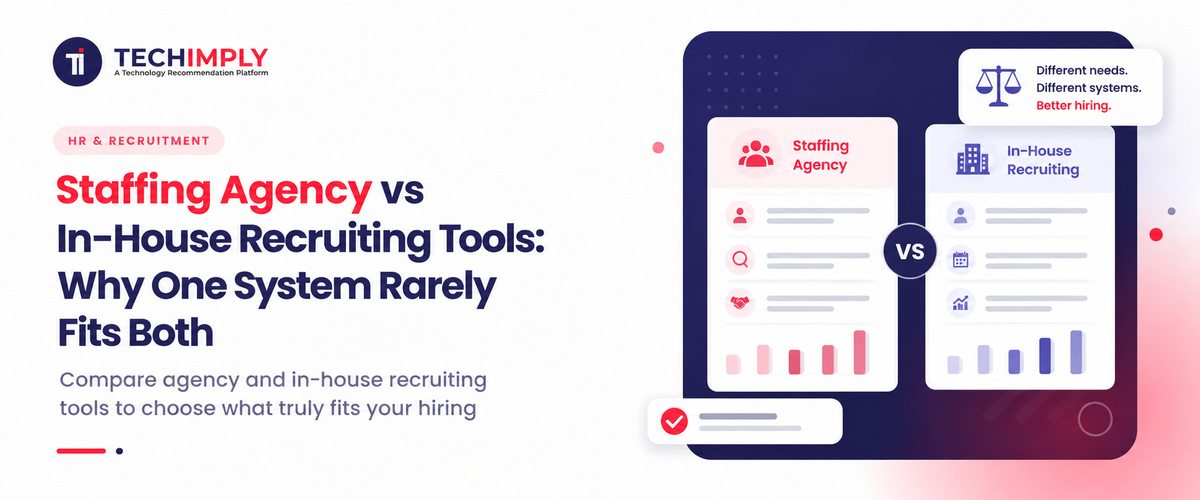
However, choosing a hiring methodology is just the first step. The real operational bottleneck happens when deploying the supporting digital infrastructure. Many expanding enterprises assume that any generic Applicant Tracking System can handle both operating models. The reality remains that a staffing agency vs in-house recruiting architecture requires completely different digital foundations.
Staffing Agency vs In-House Recruiting: What’s the Difference?
An internal acquisition model operates as a core department embedded directly within the enterprise corporate boundary. HR professionals work with department managers to forecast staffing needs, determine salary levels, and cultivate a positive image of the company's work environment in the long run. The internal recruiter has to deal with the entire process of hiring new employees, ranging from advertising job posts on Indian job sites like Naukri or Foundit to organizing the onboarding process, training employees, and creating employee engagement plans.
On the contrary, a third-party staffing agency is a standalone business-to-business professional service business. Enterprise clients outsource their sourcing, assessment, and placement needs to this third-party agency to find suitable candidates without their own labor investment. The agency front-loads the expense of active sourcing and candidate assessment by assuming all the labor risks at the outset.
Key Differences
1. Hiring Speed
In India's fast-moving business ecosystem, fill time is a critical performance indicator. When comparing a staffing agency vs in-house recruiting approach, external agencies consistently win on speed. Agencies maintain massive, pre-vetted talent repositories that they cultivate daily. This is particularly relevant for specialized technology and engineering roles, where agencies can provide access to qualified candidates more quickly. For specialized roles, external agencies can often provide qualified candidates more quickly by using established talent networks and focused sourcing strategies.
Internal talent acquisition departments generally operate at a more conservative pace. Internal recruiters must manage multi-layered budget approvals, coordinate with various line managers, draft internal compliance documentation, and wait for organic applications to roll in.
2. Recruitment Cost
The financial structures of these two hiring methods involve completely different corporate accounting strategies. Maintaining an internal recruitment team demands significant, permanent fixed overhead. A company must commit to monthly base salaries, employee provident fund (EPF) contributions, office space, and expensive corporate licenses for public resume databases. Even during a hiring freeze or a market slowdown, these fixed internal human resource expenses remain completely unchanged.
Partnering with an external agency shifts these fixed costs into a flexible variable expense model. Reviewing resumes or interviewing agency candidates carries zero upfront financial risk. The commercial obligation triggers solely when a candidate accepts an official offer letter.
3. Access to Talent
The depth and nature of the accessible talent pool changes drastically depending on the chosen model. Internal talent acquisition teams rely heavily on active job seekers. These are individuals who actively visit corporate career pages, view public job advertisements, and submit applications. Unfortunately, this passive strategy often misses out on elite passive candidates who are currently employed, performing exceptionally well, and not browsing traditional job boards.
External staffing agencies excel at mapping out the passive talent market. Because agency consultants operate as dedicated domain specialists, they spend months building discreet professional networks with top performers working at competitor firms. For companies expanding their search globally, resources such as the global hiring guide 2026 can also help identify the best countries to hire remote talent based on role, budget, time zone, and communication needs.
4. Hiring Control
Maintaining absolute governance over candidate touchpoints is the primary reason organizations choose to keep recruitment operations internal. Internal human resource specialists understand company culture, core values, and day-to-day office environments intimately. Every communication, phone screening, and interview invitation directly reinforces the company's precise brand reputation in the open market.
Outsourcing pipelines to a third-party firm means giving up a layer of that direct quality control. External agents are heavily driven by financial commissions and might occasionally misrepresent role expectations or over-promise perks to secure a quick placement.
Staffing Agency Recruiting Tools vs In-House Recruiting Tools
1. Candidate Management
The architecture used to manage profiles inside a modern application reveals its true intended audience. When evaluating a staffing agency vs in-house recruiting software strategy, profile data structures differ completely. An internal corporate platform treats a candidate as a potential permanent addition to the family. The record in the profile that's placed in the internal frameworks is, as a result, focused on background verification, assessment results, interview scorecards, and onboarding workflows.
The opposite is a dedicated staffing agency software system, which views a candidate profile as an extremely dynamic and moveable component. The database is primarily concerned with immediate availability status, hourly or monthly billing rates, core skill tags, and multi-client submittal histories.
2. Talent Pool Management
For an internal human resource specialist, talent pool management centers on building a secure, highly organized data repository for a single organization. The database is strictly structured around corporate departments, ensuring clear internal access controls, data privacy compliance, and clean records that eventually transition into long-term employee files.
For an external staffing consultant, talent pool management revolves entirely around search speed, deep filtering, and absolute volume. The application must empower agents to run complex Boolean search strings across millions of unformatted resumes, instantly separating permanent job seekers from freelance contractors.
3. Workflow and Reporting
The reporting dashboards found within professional recruitment software serve entirely different operational masters. Corporate internal dashboards display metrics tailored for Chief Human Resource Officers and executive leadership teams:
- Overall cost per hire across various business divisions
- Average time to fill trends per hiring manager
- Workplace diversity, equity, and inclusion (DEI) metrics
- Quality of hire tracking based on one-year retention rates
Agency-focused performance dashboards prioritize individual productivity and real-time revenue metrics:
- Total revenue billings generated per recruiter
- Job order to submittal conversion ratios for each corporate client
- Candidate interview to placement percentages
- Active aging reports tracking outstanding client placement invoices
4. Client vs. Internal Hiring
An internal talent acquisition system operates entirely inside a single corporate perimeter. There are no external stakeholders or buyers to account for. This allows user access permissions to remain flat, collaborative, and entirely focused on internal team alignment and interview scheduling.
An agency-grade system must feature a highly secure, multi-tenant CRM Software architecture. Agency consultants require tools to track new business development leads, manage active client service contracts, and share candidate profiles using automated, blind resume links that completely mask direct candidate contact details until an interview fee structure is locked in.
Pros and Cons of Staffing Agency Recruitment
Benefits
- Rapid Workforce Scaling: Essential for filling mass vacancies quickly when launching new Global Capability Centers (GCCs) in Indian tech capitals.
- No Commercial Invoice, No Upfront Financial Risk: Early-stage companies can safeguard cash flow when they need to place a product at stage 1.
- Deep Domain Expertise: Quick access to niche specialists who have a detailed understanding of intricate technical frameworks or area industrial labor legislation.
- Saves Internal Leadership Time: This removes the tedious task of sifting through thousands of unqualified resumes and lets management concentrate totally on executing core business.
Limitations
- Higher Unit Costs: A single specialized executive search fee can easily outpace the entire annual salary of a mid-level internal recruiter.
- Diluted Cultural Assessment: External consultants cannot fully experience or authentically communicate the daily workplace culture of an enterprise.
- Disjointed Candidate Journeys: Communication gaps between agency touchpoints and corporate managers can lead to a confusing applicant experience.
Pros and Cons of In-House Recruitment
Benefits
- Strong Employer Brand Identity: Builds long-term market presence and trusted relationships, directly with the local talent community. Internal HR individuals can make an accurate assessment of subtle behavioural alignment and long-term values matching.
- Cost efficiencies that can't be ignored: For companies that require regular, consistent, high-volume hires over the course of the year, the cost of maintaining an in-house team payroll is significantly less.
- Unified Onboarding Transitions: Guides the candidate through a seamless, frictionless process from initial screening phone call directly into its internal corporate learning programs.
Limitations
- Unyielding Fixed Overhead: Requires continuous corporate financial investment regardless of whether the business is expanding or entering a hiring freeze.
- Susceptible to Operational Bottlenecks: Internal teams can easily become overwhelmed when sudden, massive hiring spikes arise unexpectedly.
- Limited Sourcing Boundaries: Often confined to active applicants on public job boards, missing out on valuable hidden passive talent networks.
Why One Recruiting Tool Rarely Fits Both
|
Feature |
In-House Recruiting |
Staffing Agency |
|
Candidate management |
Employee-focused |
Multi-client |
|
Talent database |
Internal talent pool |
Large searchable database |
|
Client management |
Usually not required |
Essential |
|
CRM |
Limited |
Core functionality |
|
Candidate submissions |
Internal workflow |
Client-facing |
|
Billing & commissions |
Usually unnecessary |
Essential |
|
Reporting |
Cost-per-hire, time-to-fill, retention |
Placements, revenue, margins |
Different Workflows
The daily operational mechanics of these two hiring models cannot live comfortably inside a single software pipeline. An internal corporate recruitment workflow is deep, collaborative, and linear. It requires coordinating panel interviews with multiple department heads, aggregating qualitative interview feedback scores, and navigating complex corporate salary approvals with internal compensation committees.
Different Recruitment Requirements
An internal human resource unit evaluates a candidate through a long-term retention lens. Consequently, their core software must connect natively with internal HRM Software, enterprise resource planning (ERP) systems, and internal payroll software.
Different Reporting Needs
A corporate talent acquisition dashboard focuses heavily on long-term efficiency metrics, strategic human resource planning, and corporate compliance tracking. An agency platform functions fundamentally as a commercial tracking board, highlighting pipeline margins, individual agent commission structures, and billable hours.
When Should You Choose Staffing Agency or In-House Recruiting?
1. When Staffing Agencies Make Sense
Relying on external staffing professionals becomes highly strategic when internal human resource teams face specific operational barriers:
|
Scenario |
Operational Reason |
Business Benefit |
|
Niche Tech Hiring |
Securing specialized professionals like cloud architects or niche data scientists. |
Immediate access to pre-vetted, highly elusive passive talent pools. |
|
Sudden Market Scaling |
Setting up a brand-new geographic office or launching a new product division overnight. |
Rapid deployment of talent without breaking internal human resource bandwidth. |
|
Project-Based Contracts |
High-volume seasonal hiring for e-commerce logistics, retail, or festival surges. |
Highly flexible staffing that can be scaled down easily when peak seasons conclude. |
2. When In-House Recruitment Works Better
Building and relying on an internal talent acquisition architecture is the superior choice under stable, predictable business conditions:
- Consistent Yearly Headcount Growth: When an organization faces steady, ongoing hiring needs across standard operational and management positions.
- Deep Cultural Focus: For companies where long-term employee retention and perfect alignment with core values are absolute priorities.
- Strong Local Brand Equity: When an enterprise already possesses a powerful employer brand that naturally attracts premium active talent organically.
3. When a Hybrid Approach Is Suitable
For mid-sized and large enterprises across India, the ideal approach is frequently a well-coordinated hybrid model. Under this strategic framework, an internal talent acquisition team manages core permanent hiring, safeguarding corporate culture and employer brand equity.
This approach allows internal recruiters to retain control over permanent hiring and employer branding while using staffing partners for niche roles, temporary workforce requirements, or sudden hiring spikes. The recruiting technology should support both workflows through clear integrations, permissions, and data-sharing processes.
How to Choose the Right Recruiting System
1. Hiring Volume
Total annual hiring demand should dictate software selection. If an organization manages a steady, predictable stream of internal corporate openings, an enterprise applicant tracking system built for deep collaboration is ideal. However, if a business operates an external agency model handling thousands of fast-moving contract placements, it must prioritize specialized staffing agency software built for high-velocity database searching and rapid resume generation.
2. Budget
Calculate the total cost of ownership before buying any software platform. Corporate internal tools are typically priced based on total internal employee headcount or the number of active human resource users, making them predictable, fixed annual expenses.
3. Recruitment Speed
Evaluate software user interfaces purely through the lens of daily operational click-speed. An agency-facing tool must allow a consultant to view a profile, verify a mobile number, and generate an anonymized client submittal link in just a few clicks.
4. Scalability
India's hiring market continues to evolve across sectors such as healthcare, consumer electronics, and pharmaceuticals. Recruiting systems therefore need to scale alongside changing hiring demands. Software systems must scale dynamically alongside these macroeconomic shifts. Ensure the chosen system features robust API connectivity, enabling it to connect smoothly with major Indian job portals, Video Interview Software, and modern background verification networks.
Conclusion
Selecting the correct operational model and pairing it with the appropriate software framework is essential for winning talent in India's competitive business market. Forcing a high-velocity, commission-driven external agency to work inside a structured internal corporate tracking platform or asking an internal human resource team to use an agency-style sales system
creates massive operational friction, leading to lost data and dropped candidates. The right recruiting system should reflect how an organization actually hires. In-house teams typically need collaborative workflows, employer-brand control, interview management, and long-term hiring analytics, while staffing agencies need high-speed candidate search, client management, candidate submissions, and revenue tracking. Before selecting a platform, organizations should evaluate hiring volume, workflow complexity, recruitment speed, reporting requirements, and scalability.