In previous years, auditors of information technology at medium-sized non-banking financial companies examined firewalls, data backups, and antivirus software. Today, IT and information-security audits increasingly examine who has administrative access to critical applications, how that access is approved, and whether the institution can produce evidence of those controls

Looking for Privileged Access Management Software?
Check out Techimply's List of the Best Privileged Access Management Software in India for your business.
That shift is not accidental. It follows directly from how RBI and SEBI have rewritten their expectations around IT risk in the last few years, and it explains why privileged access management has moved from a technical nice-to-have to a standing item on the compliance checklist for regulated entities.
What Changed In The Regulatory Conversation
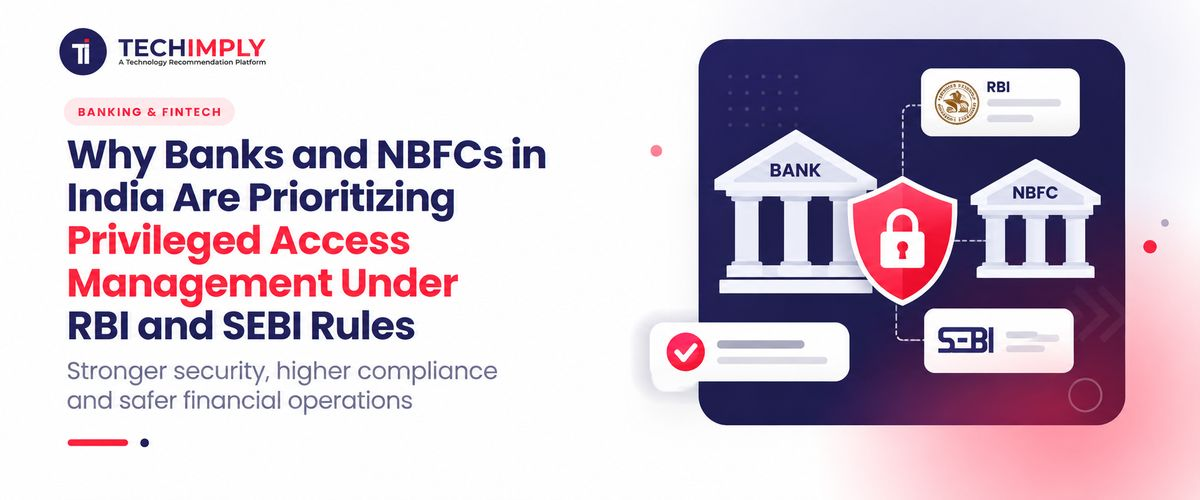
The Reserve Bank of India consolidated its IT-related instructions for banks, NBFCs, credit information companies and financial institutions into a Master Direction on Information Technology Governance, Risk, Controls and Assurance Practices, which took effect from April 2024. It brought access control, system monitoring and audit evidence together under one framework, rather than leaving them spread across older, separate circulars.
SEBI took a parallel path for the securities market through its Cybersecurity and Cyber Resilience Framework, which applies to stock brokers, depositories, asset management companies, portfolio managers and other market intermediaries. Privileged access and the principle of least privilege sit explicitly inside that framework rather than as an implied expectation, which is a meaningful shift from how these requirements used to be written.
Neither regulator is asking institutions to buy a specific product. Both are asking a more basic question: can you show, with evidence, who holds elevated access, how that access was granted, and what was done with it.
Do You Know?
Cybersecurity frameworks classify regulated entities into tiers based on size and systemic importance, with the largest market infrastructure institutions facing the strictest privileged access requirements. Even smaller intermediaries are expected to show some form of privileged access control, just calibrated to their scale.
Why Privileged Accounts Draw This Level Of Attention
An ordinary employee account, if compromised, usually exposes one person’s worth of data and permissions. An administrator account on a core banking platform, a treasury system, or a customer database can touch thousands of accounts at once, alter records, or move funds. In a financial institution, the gap between an ordinary account and a privileged one is not incremental. It is the difference between a contained incident and a systemic one.
Regulators know this, which is why access governance and privileged access management specifically, rather than general cybersecurity language, now appear as named expectations. A bank can have strong perimeter security and still fail an audit if nobody can explain who had standing access to the general ledger system last quarter.
What Prioritizing PAM Actually Looks Like Inside A Bank or NBFC
In practice, this rarely means a single big project. It shows up as a set of specific, checkable controls layered onto the systems that matter most.
- Credential vaulting for core banking, treasury, and customer database administrator accounts, so passwords are not known to individual staff
- Session recording on systems where an unexplained change would affect customer funds or records
- Time-bound, approved access for maintenance windows rather than administrators holding standing rights year-round.
- Multifactor authentication at the point of elevation, often through an authenticator app or a biometric check such as facial recognition, already familiar to many bank IT teams from customer-facing verification systems
- Clear separation between who requests elevated access, who approves it, and who reviews it afterward
None of this replaces the institution’s broader security management programme. It sits inside it, focused specifically on the accounts capable of the most damage. Most privileged access management software is designed to slot into an existing IT environment this way, as one focused layer rather than a wholesale replacement of what a bank or NBFC already runs.
The Evidence An Audit Actually Expects To See
A policy document stating that access follows least privilege is not, on its own, satisfying to an IS auditor anymore. What tends to hold up is a trail: who requested elevated access, who approved it, what the session did, and when the access was revoked. This is the evidence privileged access management is designed to produce, without relying on manual logs that are easy to forget or falsify.
Identity management plays a supporting role here too. It should show that a person’s access lines up with their current role, not a role they held two transfers ago, and access governance is the recurring review that catches drift when it happens. Auditors increasingly ask for both pieces together, not just one.
Vendor And Outsourced IT Access Adds A Layer Regulators Specifically Flag
Indian banks and NBFCs rely heavily on external partners for core banking support, data centre operations and specialised system maintenance. That outsourcing is normal and often necessary, but it also means privileged access regularly extends outside the institution’s own staff. Both RBI and SEBI expect institutions to treat vendor access to critical systems with the same rigour as employee access, including defined expiry and a documented reason for the access existing at all.
This is frequently the weakest link in an otherwise reasonable setup. An institution can have tight controls on its own admin team and still carry significant exposure through a support vendor’s login that was never switched off after a project ended.
Getting The Board And Audit Committee Comfortable With The Shift
IT teams often understand the technical case for privileged access management well before the board does. To explain this in commercial terms is helpful because the technology is a method to respond to recurring inquiries from the audit committee. The committee asks which employees can access systems that transfer funds or store client information. They also ask how fast technicians can revoke that access during an emergency.
It is also useful to describe the specific changes for employees during their daily routines. The existing identity management and single sign-on systems manage the standard logins for email, primary software, and internal websites. Password management practices for everyday staff accounts do not need to change at all. The change is specific and intentional because it only affects the limited number of accounts that manage the main systems. It does not affect the general employees, which ensures that the implementation causes less interference than a listener might assume.
A Realistic Starting Point For A Mid-Tier Institution
But few financial institutions possess the resources to renovate every system simultaneously, and government regulators do not require that speed. A logical order of operations begins when managers identify every account with administrative privileges on core systems, including accounts held by external service providers.
The staff places the systems with the highest security risks under credential vaulting and session recording first. To improve security, the IT department adds multifactor authentication at the point where a user requests higher privileges. On a regular schedule, management conducts reviews of access governance so the process is a continuous habit rather than a single reaction to an audit.
Single sign-on and password management tools remain useful for the institution’s broader workforce, but they were never designed to satisfy the specific evidence a regulator now asks for on administrator accounts. That gap is exactly why privileged access management has become its own line item rather than an assumed feature of general IT security.

Pro-tip
Before your next IS audit, pull a list of every account with administrative rights on your core banking or trading system and check how many of them belong to people who changed roles or left in the past year. That single exercise tends to surface more exposure than most institutions expect.
Conclusion
RBI and SEBI are not asking banks and NBFCs to eliminate privileged access, which would not be realistic for institutions that depend on administrators to keep core systems running. They are asking institutions to know exactly who holds that access, why, and for how long, with evidence to back it up. Privileged access management software has become the practical way to answer that question, layered into an institution's wider security management programme rather than replacing it, which is precisely why it has moved up the priority list for IT and compliance teams across Indian financial services.
Related Reads :
- What Is Privileged Access Management? A Guide for Indian IT and Security Teams
- IAM vs PAM: What's the Difference and Does Your Business Need Both?
- Best Facial Recognition Apps and Tools for Business
- Is Facial Recognition Technology Safe? Benefits, Risks & Privacy
- Best Identity vs Access Management: Key Differences