A founder running a logistics-tech startup in Gurugram once told his sales team, simply, to go after anyone who needed supply chain software. Six months later, the CRM software was overflowing with retailers, manufacturers, a couple of e-commerce sellers, even a school trying to sort out its bus routes. Almost none of it closed. Not for lack of trying.
The team had been chasing volume without ever agreeing on who actually belonged in that pipeline to begin with. That gap is exactly what an Ideal Customer Profile is supposed to close, and it's one a lot of growing Indian companies stumble into right after they've cleared their first handful of customers.
What an Ideal Customer Profile Actually Is
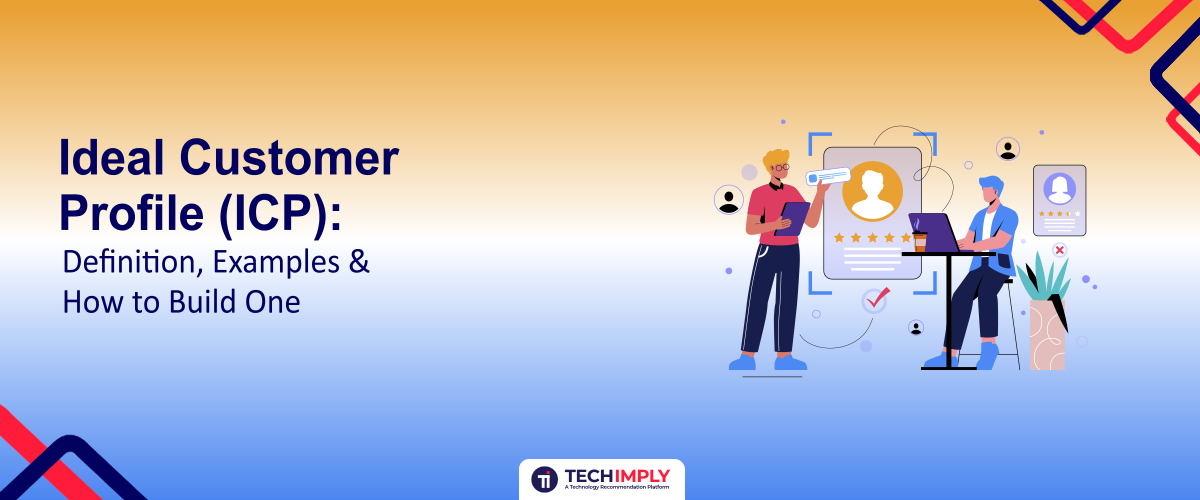
An Ideal Customer Profile is, at its core, a description of the kind of company or customer that gets real value out of what you sell and that you can serve profitably, and keep for the long haul. It isn't every company that could conceivably use your product. It's narrower. Sharper. It's the buyer who moves fast, stays subscribed, sends referrals your way, and doesn't eat up your support team's time arguing over edge cases the product was never built for.
People mix up ICP and buyer persona all the time, and honestly, the difference is worth pausing on. A persona is about a person their role, what they're chasing, the frustrations that follow them around at work, how they land on decisions. An ICP is about the company or account: its size, industry, budget, growth stage, and the exact problem it needs solved. Most B2B selling in India needs both running side by side. One tells you which companies are worth a look. The other tells you who to actually speak with once you're through the door. A 200-person manufacturer and a 20-person D2C brand won't decide things the same way, even sitting in the same industry on paper.
Why This Matters More for Companies Selling in India
Because India's market looks so enormous on paper, founders get pulled toward "go broad" thinking almost by default. But that scale cuts both ways. An HR software company could, in principle, sell to a five-person startup in Bangalore, a 500-person manufacturer in Pune, and a government-adjacent PSU all in the same quarter, if it wanted to. Each of those three comes with a different budget, a different sales cycle, a different way of making decisions, and different expectations of support. Run one sales motion across all of them and, more often than not, none of the three get served particularly well.
There's a resourcing angle underneath this too. Plenty of Indian startups and SMBs run sales and CS on lean teams often a fraction of what a comparably sized US company would staff. That little team ends up working hours on leads managed that were never converting anyhow without a definite ICP, while the accounts that truly match reside farther back in the queue than they ought to be. Most businesses miss this until the churn statistics reveal a distressing tale of their own: some consumer groups are always pricey to maintain and sluggish to renew; others renew without trouble and seldom open a ticket.
The Core Components of an ICP
1. Firmographics
Company size (revenue or headcount), industry, geography, growth stage that's firmographics. A B2B SaaS company selling inventory management software might land on an ICP like manufacturing or D2C brands with 50 to 500 employees, based in Tier 1 or Tier 2 Indian cities, doing at least ₹5 crore a year in revenue. None of that should be a guess. It should come from where your best existing customers actually sit, not from wherever you'd like them to sit.
2. Technographics
What's already running in the background at this company? A CRM integration pitch lands far better with a business already on Zoho or HubSpot than with one still running sales managment spreadsheets and WhatsApp groups still common enough among smaller Indian businesses. Technographic fit, more often than not, predicts onboarding friction better than firmographics manage on their own.
3. Behavioral and Situational Triggers
These are the moments a company becomes likely to buy now rather than eventually. Recent funding. A sudden jump in headcount. A new compliance requirement. An existing vendor contract nearing its end. Signals like these carry weight because, in B2B sales, timing decides almost as much as fit does.
4. Budget and Buying Power
A company can check every firmographic box and still be the wrong fit if it can't genuinely afford what you charge, or procurement needs eight months just to approve a five-figure invoice. It's tempting to assume a strong firmographic match means a viable deal. Budget reality and how fast procurement actually moves deserve their own separate check, not an assumption borrowed from the first one.
5. Pain Point Alignment
At the end of it: does this company actually have the problem your product solves, and does that problem feel urgent enough to spend money on? A company that might benefit from your product someday, but hasn't recognized the problem as painful yet, usually isn't ICP-ready regardless of how well everything else lines up.
Real ICP Examples Relevant to Indian Businesses
Consider a B2B SaaS company selling accounting automation software. A workable ICP might look like: Indian SMBs with 20 to 200 employees, in trading, manufacturing, or professional services, already on Tally or Zoho Books, pulling ₹2 to ₹50 crore in annual revenue, and currently losing real hours to manual GST reconciliation. That last detail the specific, painful task usually does more targeting work than the revenue band sitting next to it.
A D2C skincare brand approaches this from a different angle, though the underlying logic doesn't really change. Instead of company size, you're working out customer segments: urban professionals aged 25 to 40, in metro or Tier 1 cities, willing to pay more for clean-label or dermatologist-backed products, who mostly find brands through Instagram and prefer reordering on subscription. It's the same question a B2B ICP asks which segment returns the best lifetime value against acquisition cost just pointed at individuals instead of companies.
A digital marketing agency's ICP, meanwhile, tends to center on funding stage and marketing automation maturity rather than size alone: seed-to-Series-B startups that already have an in-house marketing hire (not nobody, and not a fully built-out team either), spending at least ₹3 lakh a month on paid acquisition, needing expertise that hire simply doesn't have yet. It isn't only about who can pay. It's about who has enough internal capability to actually put the agency's work to use agencies tend to lose accounts fastest when the client expects the agency to replace strategy entirely rather than support it.
How to Build an ICP Step by Step
-
Start With Your Best Existing Customers, Not Your Ideal Imagination
Pull your current customer list and rank it by revenue, retention, low support burden, and willingness to refer. The top 10 to 20 percent is where your real ICP starts not the customer you wish existed, the one you already have and would clone without a second thought. This step gets skipped more than it should, usually because pulling clean data takes real effort, and gut feel is right there and free.
-
Look for Patterns Across That Group
What do these accounts share, if anything? Industry, size, tech stack, how they found you, what triggered the purchase, how long the sales cycle ran. Anything repeating across most of the group is worth turning into a formal ICP criterion. Something showing up in just one or two accounts is probably coincidence, not signal.
-
Cross-Check Against Your Worst-Fit Customers
This one gets skipped constantly, and it really shouldn't be. Look at the churned accounts. The chronic support escalations. The customers who never got real value out of the product at all. What connects them? Usually it's the inverse of your best-fit pattern wrong size, a technographic mismatch, or a pain point that was never quite urgent enough to keep them around. This negative signal is often more useful on its own than the positive pattern, because it tells you exactly who to deprioritize even when they look promising up front.
-
Draft the Profile in Concrete, Testable Terms
Get rid of the general terms "growing businesses," "forward-thinking teams," and replace it with things someone can truly verify: range of employee numbers, income band, industry codes, tech stack, geography, and the particular cause or pain point underlying it. A good sales rep ought to be able to scan a lead in seconds to determine whether it fits without having to try to estimate intent.
-
Validate With Sales and Customer Success, Not Just Marketing
Marketing sometimes builds an ICP off in a corner, working from top-of-funnel data alone, without checking it against what sales and CS actually see in live deals and renewals. The mismatch tends to surface within the first few months of rolling out a new ICP: marketing hands over leads that match on paper, sales figures out within minutes they're the wrong fit. Bringing both teams in before the ICP is finalized catches this a lot earlier.
-
Revisit the ICP as the Business Changes
An ICP built when a company had ten customers rarely holds once it has three hundred product maturity, pricing, and market position have all shifted by then. Teams treating the ICP as a one-time exercise usually only notice the mismatch once conversion or retention starts slipping, and by then the fix takes far longer than a routine review would have.
Common Mistakes Businesses Make When Building an ICP
The most common one: building the ICP off assumptions about the market rather than actual customer data. A founder's mental picture of "who this is for" tends to come from whichever early customers happened to say yes not from whichever segment actually performs best over time.
A second mistake is making the ICP too broad so it doesn't feel limiting. "Any mid-sized company in India" isn't an ICP. It's the absence of one. The whole point of an ICP is its narrowness a profile wide enough to fit almost anyone gives a sales team nothing to prioritize against.
A third, common in fast-growing Indian startups specifically, is writing the ICP once during a fundraising deck exercise and never touching it again. As the product evolves and the customer base shifts, the original profile quietly stops matching reality, and teams keep operating on assumptions that stopped being true a while ago.
And then there's the case of a business running one ICP when it's actually serving two genuinely distinct customer types a payments company, say, selling to both large enterprises and small retail merchants. Usually, combining both into one profile means the qualifying standards and communication match neither group particularly well. Two well defined ICPs with their own criteria usually outperforms one seeking to span both and winds up fitting neither.
Conclusion
An ICP earns its keep only once it actually changes how a sales or marketing team operates day to day feeding lead scoring, shaping outbound priorities, getting raised honestly in deal reviews even when a tempting but poor-fit opportunity is sitting right there. It also means walking away, sometimes, from revenue that technically closes but doesn't match the profile, since those accounts tend to churn faster and cost more to support than the numbers suggest at signing.
Getting the ICP right isn't about writing one perfect document and calling it done. It's a shared, specific, testable definition of who you serve best checked constantly against what actually happens, and backed by the discipline to say no to deals that don't fit, even when the short-term revenue looks tempting.