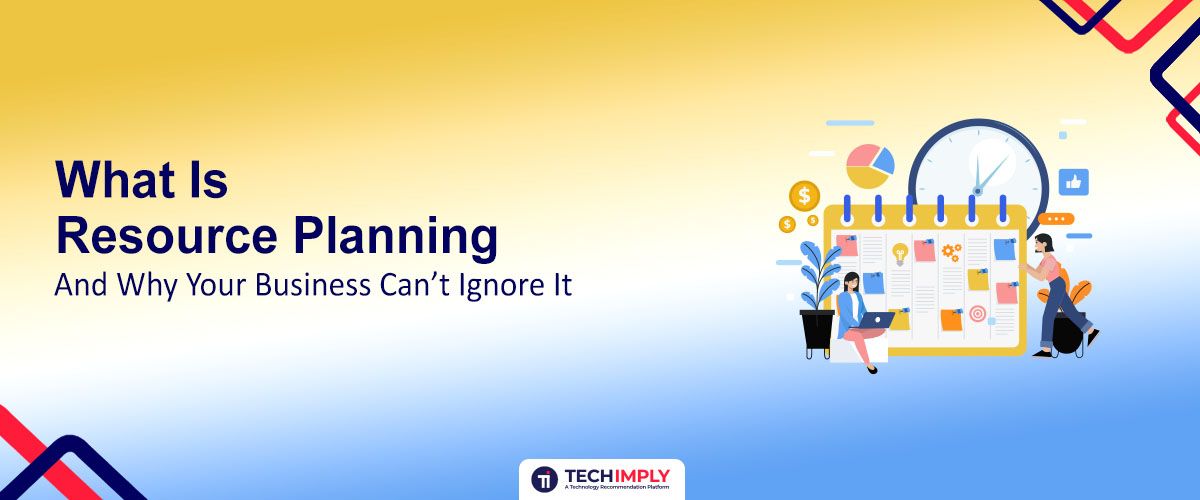
Managing a business often feels like a high-stakes puzzle where the pieces are constantly shifting. To stay ahead, organizations must master resource planning, which involves identifying and allocating the necessary assets to complete projects on time and within budget, when you implement a solid strategy, you ensure that your team, technology, and finances work in perfect harmony to meet your long-term objectives.

Looking for Resoirce Management Software?
Check out Techimply's List of the Best Resource Management Software in India. for your business.
Many leaders ask, what is resource planning and how does it differ from simple task management? Essentially, it is the deliberate process of organizing your company's diverse assets, ranging from human talent to physical equipment, to maximize productivity. By understanding the resource planning definition, you can transform your workflow from reactive firefighting to proactive growth, ensuring that no project stalls due to a lack of preparation.
What is Resource Planning?
To define the term resource planning, we must look at it as the strategic roadmap for your organization’s assets. It is the tactical process by which businesses identify, recruit, and assign the right resources to the right tasks at the right time. When you explain resource planning to a stakeholder, you are describing the bridge between a grand vision and the granular execution required to make that vision a reality.
At its core, what do you understand by resource planning? It is the ability to forecast future needs based on current data. It isn't just about listing what you have; it is about predicting what you will need six months from now. Whether you are using a digital resource planner or a manual ledger, the goal remains the same: to prevent bottlenecks and eliminate waste.
Resource Planning in Project Management
In the specialized field of resource planning in project management, the stakes are even higher. Every project has a finite timeline and a fixed budget. Therefore, project managers must utilize resource planning to ensure that specialists are not overbooked and that expensive equipment is used efficiently across multiple departments.
The Importance of Resource Planning
You might wonder, why is resource planning essential for a modern enterprise? Without it, even the most talented teams can fall into chaos. The importance of resource planning lies in its ability to provide clarity. It allows managers to see exactly who is doing what, which prevents employee burnout and ensures that financial capital is not tied up in idle inventory.
If we dive deeper into why do we need resource planning, the answer usually comes down to profitability. Businesses that ignore this process often face resource leakage, where time and money vanish due to poor scheduling. Furthermore, why is there a need for resource planning in a scaling business? It provides the scalability required to take on larger clients without crashing your internal infrastructure.

Do You Know?
Organizations that utilize dedicated resource management software report a 20% increase in project success rates because they can visualize capacity in real time.
Types of Resource Planning for Better Allocation
You should divide your assets to manage a company well. Various departments must be approached differently to make all the cogs in the machine move in the right direction.
1. Human Resource Planning (HRP)
People are your most valuable asset. HRP focuses on recruiting, training, and retaining the right talent. It ensures that your workforce possesses the skills necessary to achieve your corporate milestones.
2. Financial Resource Planning
This involves budgeting and managing cash flow. It ensures that you have the liquid assets available to pay for raw materials, marketing campaigns, and payroll without straining your reserves.
3. Material Resource Planning
For manufacturing and retail, this is critical. It involves managing physical inventory, machinery, and office space. Proper planning here prevents stockouts and reduces storage costs.
4. Strategic Resource Planning
This is the high-level view. It does fit your resources to the five-year mission of the company. It poses the question: Are we sufficiently structured to expand into a new market in a year?
5. Operational Resource Planning
This deals with the here and now. It focuses on daily shifts, weekly deadlines, and immediate task assignments to keep the business running smoothly day-to-day.
Must-Have Elements in a Resource Planning Template
In case you are creating a resource plan example, you should not omit certain data points to make it work. A template serves as a point of reference for your whole team.
-
The Project/Task Information: The scope must be defined. What are the deliverables? What is the deadline? In the absence of goals, your resources are going to be lost.
-
Resource Assignment: Indicate very specifically who is to do what. You should give specific skills that an individual ought to have to avoid giving a graphic designer a coding assignment.
-
Scheduling and Tracking: Use Gantt charts or timelines. Tracking progress allows you to see if a resource is taking longer than expected, which might require you to shift other deadlines.
Key Features of Resource Planning
Modern resource planning is a sophisticated discipline that relies on several core features to be effective.
1. Resource Identification and Classification
Before you can plan, you must know what you own. This feature involves cataloging every employee’s skills, every piece of software, and every available dollar. Once you classify these, finding the right tool for the job becomes instantaneous.
2. Resource Allocation
This is the act of spending your resources. You assign them to specific projects based on priority. Effective allocation ensures that high-priority projects get the A-team and the necessary budget to succeed.
3. Resource Optimization
Optimization is about doing more with less. It involves looking at your current usage and finding ways to be more efficient. For example, can one software license be shared across two departments? Can a meeting be replaced by a shared document?
4. Resource Scheduling
Time is everything. Scheduling ensures that resources are available when needed. It prevents the frustration of a developer sitting idle because the designer hasn't finished the wireframes yet.
5. Resource Monitoring
You must keep an eye on the pulse of your projects. Monitoring allows you to catch overutilization (burnout) or underutilization (waste) before they impact your bottom line.
6. Reporting and Analysis
Data-driven decisions are the best decisions. By generating reports, you can see historical trends. This helps you answer the question: Why is there a need for resource planning for our next product launch? Based on the successes and failures of the last one.
Resource Planning in India: A Unique Context
When we describe the process of resource planning in India, we have to consider the great diversity of the workforce and the fast-digitizing economy. The resource planning in India is often a compromise between a low-expense labor force and the requirement of advanced technical skills. Since such a vast market exists, why is resource planning needed in India? Since the market is very competitive, efficiency can be the only thing that can distinguish a successful start-up from a failing one.
The steps of resource planning in the Indian corporate sector often involve heavy emphasis on upskilling. Since the talent pool is massive, the challenge isn't just finding people but finding people with the exact niche skills required for global projects.
Why Resource Planning is a Complex Process
You will often hear experts say that resource planning is a complex process; explain why this is the case. The complexity arises because resources are not static. People get sick, machines break, and market trends shift.
Furthermore, when you describe the steps involved in resource planning, you realize you are managing dependencies. If Step A fails, Steps B through Z are all affected. This interconnectness is why a simple spreadsheet is rarely enough for a growing enterprise; you need a dynamic system that updates in real-time.
Pro-tip
Always build a 10-15% buffer into your resource plans. Unexpected delays are inevitable, and a buffer prevents one small hiccup from derailing your entire project timeline.
Steps Involved in Resource Planning
In order to undertake this successfully, there are steps that you must follow. Explain the resource planning process in the following manner:
-
Requirement Analysis: Find out what the project exactly requires.
-
Inventory Audit: Check out what is available in your possession.
-
Gap Analysis: Determine the gap between your possession and the necessity.
-
Acquisition/Allocation: Recruit the individuals or purchase the materials required and allocate them.
-
Review and Adjust: Keep on reviewing the progress and changing directions where needed.
These steps of resource planning will result in a resource planning model of success. The systematic methodology is the response to the question of what is the need of resource planning by offering a clear solution on the route to follow to the end.
Conclusion
In summary, resource planning is the backbone of any organized and profitable business. It provides the visibility needed to manage people, time, and money with precision. Whether you are a small start-up or a large corporation, understanding why is resource planning essential will help you avoid the pitfalls of mismanagement and wasted potential. By defining your resources, optimizing their use, and monitoring their progress, you set your business on a path toward sustainable growth. Don't let your assets manage you; instead, take control of your future by implementing a robust resource planner strategy today.


.png "Top 10 Benefits And Uses Of Transportation Management Software in India")