Future Trends in ERP are determining how organizations are running their business operations and data in a fast changing world of business technology. The current ERP systems are developing beyond classic management tools by being smarter, more adaptive, and cloud-integrated. All these developments are meant to enhance collaboration, automation, as well as data-based decision-making across the different departments. With the ongoing evolution of ERP technologies, businesses are finding new innovative solutions in which ERP is becoming easier to use, efficient and prepared to meet the upcoming digital challenges. A discussion on the Future Trends in ERP compiles how these systems are changing the current businesses.

Looking for ERP Software in India?
Check out Techimply's Best ERP Software for your business.
What Is ERP Trend?
ERP, which is also known as Enterprise Resource Planning, is a software that assists businesses in carrying out their day-to-day activities that include finance, sales, inventory, and human resources through a single interconnected system. The Emerging Trends in ERP indicate that this software is gravitating towards more intelligent, faster and more flexible solutions that can meet the demands of current business. Cloud-based ERP technologies have gained popularity with numerous companies today since they enable one to access information and collaborate from any part of the world.
At the same time, the features of ERP remain improved with automation, real-time data monitoring, and AI-based insights. Such transformations help organizations to save time, reduce errors and make quality business decisions. The general trend of ERPs indicates the role of technology in creating a more integrated and streamlined method of work management.

Fun Fact:
Most firms are unaware of the fact that ERP systems were initially constructed to support manufacturing in the 1960s. They today assist in all areas, including hospitals, schools, and that indicates the level to which the technology has developed.
What Are The Future Trends In ERP?
The ERP systems are developing a cloud platform, AI automation, mobile access, and robust data protection. The current ERP systems technology enhances the speed, minimizes manual labor, and assists distant teams. Flexible modules and enhanced analytics are preferred by businesses to make smarter decisions as ERP growth extends into more sectors. The global Enterprise Resource Planning (ERP) software market size is projected to grow from $92.6 billion in 2025 to $229.79 billion by 2032.
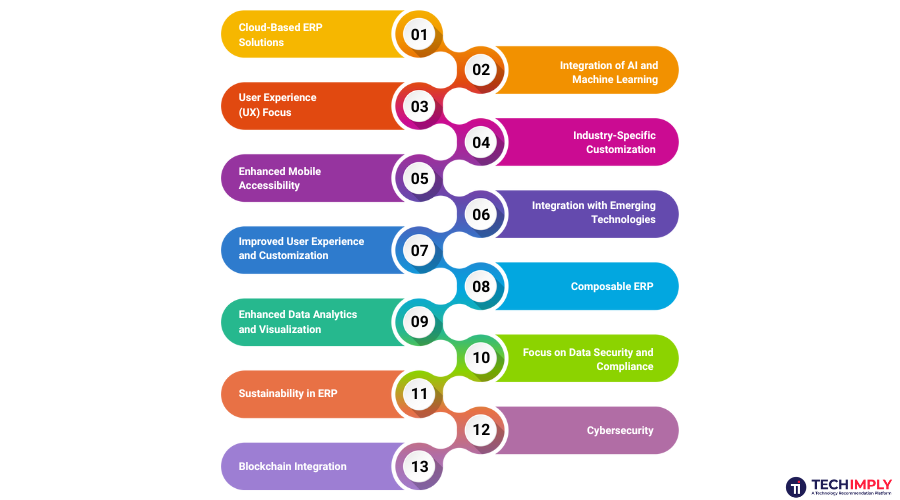
1. Cloud-Based ERP Solutions
ERP systems based on the cloud are becoming popular to use due to the ease of access and the lack of hardware intensity. This change saves maintenance and allows for remote work.
- Cloud Is Becoming The Standard: The shift towards the cloud ERP is happening in many firms due to the reduced cost and automatic updates. It is compatible with various devices, making it easier and quicker to use.
- Faster Deployment and Updates: The cloud ERP is installed faster as compared to traditional systems. The system is also secure, stable, and updated automatically, in tandem with new features.
- Enhanced Accessibility: Business data is available to the employees even at their homes, in the office, and during travel. This enhances teamwork and quick decision-making.
- Hybrid and Multi-Cloud Strategies: There are corporations that use cloud and on-premise models to strike a balance between security and flexibility. This method will aid in safeguarding confidential information.
2. Integration Of AI and Machine Learning
ERP is being enhanced by Artificial Intelligence (AI) and Machine Learning (ML) that automate routine processes, forecast threats, and minimize human mistakes. These are tools that help improve the forecasting, planning and accuracy of the data as the expansion of ERP continues to rise or expand across the world.
- AI foretells the demand for products and the delays in delivery.
- Robotic processes conserve time in routine processes.
- Machine learning identifies mistakes in data and enhances quality.
3. User Experience (UX) Focus
The simplified interface is easy to understand and enables employees to work efficiently in the organization and it takes less time to train. Dashboards are user-friendly, so the information is more apparent and decision-making is accelerated with reduced errors.
- The menus are designed in such a way that they are easy to navigate.
- Dashboards can be customized.
- There is less paperwork in the workflows.
4. Industry-Specific Customization
There are numerous processes, regulations, and workflows of industries and thus, a single standard ERP system does not suit all businesses. ERP vendors solve this by developing industry-specific modules. This saves time in terms of additional equipment and helps to keep the employees off the hook. It also assures enhanced precision since such a system operates according to the work style of that industry.
- Modules are industry specific.
- Inbuilt regulations eliminate compliance problems.
- Reduced time in installation because of prepared templates in the industry.
5. Enhanced Mobile Accessibility
With the global adoption of remote work, employees are required to use their phones to access business data wherever they are and at whatever time. Approval, report, and updates can be made without having to wait until desktop systems with mobile ERP apps. This is time-saving and increases speed in decision-making. It is also beneficial to the field workers, delivery teams and managers who travel frequently.
- Users are notified immediately through alerts.
- Analytics on phones are perceived by managers.
- The field staff input data without visiting the office.
6. Integration With Emerging Technologies
The ERP systems of today are integrated with new technologies such as IoT sensors, automation, and robotics. These technologies automatically gather real-time data collected by machines, warehouses, and devices. This minimizes errors due to manual operation and enhances safety in operations. It is also useful in the maintenance of equipment and tracking of assets without human intervention in businesses.
- The machines and inventory are automatically tracked by sensors.
- Robots are involved in habitual scheduling processes.
- AR helps technicians with maintenance.
7. Improved User Experience And Customization
ERP systems can now enable the employee to modify layouts, menus, and dashboards according to individual comfort. Simple design eases frustration and accelerates the process of learning for new users. The companies have the option of deactivation tools that are not in use to prevent confusion. This simplifies the system and makes it a pleasure when doing day-to-day work.
- Modules that are not related to the role of employees are not visible to them.
- Shorthorn saves time on operations.
- Long wearing comfort is enhanced by the use of color.
8. Composable ERP
Composable ERP allows businesses the liberty to select solely the modules required rather than purchasing all of them simultaneously. This removes the possibility of paying more to get things that they do not need and minimizes the complexity of systems. New modules can easily be added as the company expands. This increases the flexibility and cost-effectiveness of ERP.
- Individual selection of modules takes place.
- New tools can be easily added in the future.
- Less clutter enhances learning.
Data Insight:
Approximately 95 percent of the businesses indicate process enhancements in the transition to ERP. The largest improvements are usually found in inventory control and reporting.
9. Enhanced Data Analytics And Visualization
When the information is visualized, it is possible to make decisions more easily on the basis of the visual charts and dashboards. Contemporary ERP presents the trends, comparisons, and performance data in a clear manner. The leaders become able to identify issues before they happen and develop future strategies without fear. This enhances total business expansion and minimises conjecture.
- Charts tell more about it.
- Data refreshes instantly.
- The trends of the past help in planning the future.
10. Focus On Data Security And Compliance
ERP contains vital company data, financial data and customer data, and it is therefore necessary to ensure security. The data leakages can cause legal hassles, loss of money and reputation. Modern ERP systems have built-in access controls and encryption to protect confidential information. It also upholds government regulations to ensure that the companies are legally safe. ERP software minimizes the chances of unauthorized access by centralizing data in a controlled system, enabling the organization to set similar security standards.
- Only users are authorized to access.
- Information stored is encrypted.
- The data rules are adhered to by systems.
11. Sustainability In ERP
Businesses are increasingly aware of their environmental responsibility and are minimizing waste. ENERGY The ERP systems are currently following the energy consumption, raw materials, and production efficiency. This assists the businesses in adhering to green policies and incurring less in operational expenses. It also facilitates government environmental standards reporting.
- Sustainability performance is indicated on dashboards.
- The waste tracking prevents the loss of material.
- Supplier choice is in favor of greener sourcing.
12. Cybersecurity
Business systems are subject to cyberattacks, hence higher levels of protection are incorporated in ERP platforms. Security devices check patterns and behaviors of logins and access requests. The suspicious activity is raised as soon as possible to minimize damage. The existence of backup options will guarantee the safety of data in the attack.
- Additional logins enhance security.
- Early warning is applied to suspicious behavior.
- Backups eliminate data loss.
13. Blockchain Integration
The blockchain keeps data organized into blocks, which cannot be manipulated in a covert way, enhancing confidence in business systems. It is employed by ERP to check product history, transactions, and supplier records. Each update leaves behind a permanent trace, thus complicating fraud. This proves to be particularly useful in inventory and supply chain management.
- Permanent records do not allow any tampering.
- The flow of products may be tracked down.
- Secure ledgers curb attempts at fraud.
Conclusion
As a novice and a student in the world of ERP, it is important to know the emerging trends in ERP so as to stay abreast of the fast growing digitalization of the contemporary business environment. Current ERP systems are shifting away from the past management systems to intelligent, cloud-based, and AI-based solutions that enhance efficiency, automation, and collaboration. As the ERP latest versions evolve, the companies become more and more flexible, have enhanced data protection, and detailed analytical insights that enable smarter decision-making. Considering the fact that ERP is still being integrated with such technologies as IoT, blockchain, and machine learning, a student can expect to learn a system that not only makes work easier but also predetermines the future of enterprise innovation.
Suggested Read:
- How ERP Software Can Improve Financial Management and Reporting
- Key Benefits of Implementing ERP Software in Your Business
- Things To Know Before Choosing The Best Education ERP Software
- Accounting Software vs. ERP Software: What's the Distinction?
- What Are the Top Factors to Consider When Choosing an ERP Software?
- How Can ERP Software Help Small Companies?
- Best Cloud ERP Software for Small Business and SMBs
- 12 Best ERP Software for SME's Businesses in Singapore
- Role Importance of ERP Software in Supply Chain Management


.png "Top 5 Symptoms You Gravely Require New Hotel Management Software")