A SaaS company on the rise is given a security survey by tens of thousands of individuals. Why does this happen? The founder is conducting his initial online search for the term later in the day, and a line in that document requires additional SOC 2 data to be obtained.

Looking for Single Sign-On Software?
Check out Techimply's List of the Best Single Sign-On Software in India for your business.
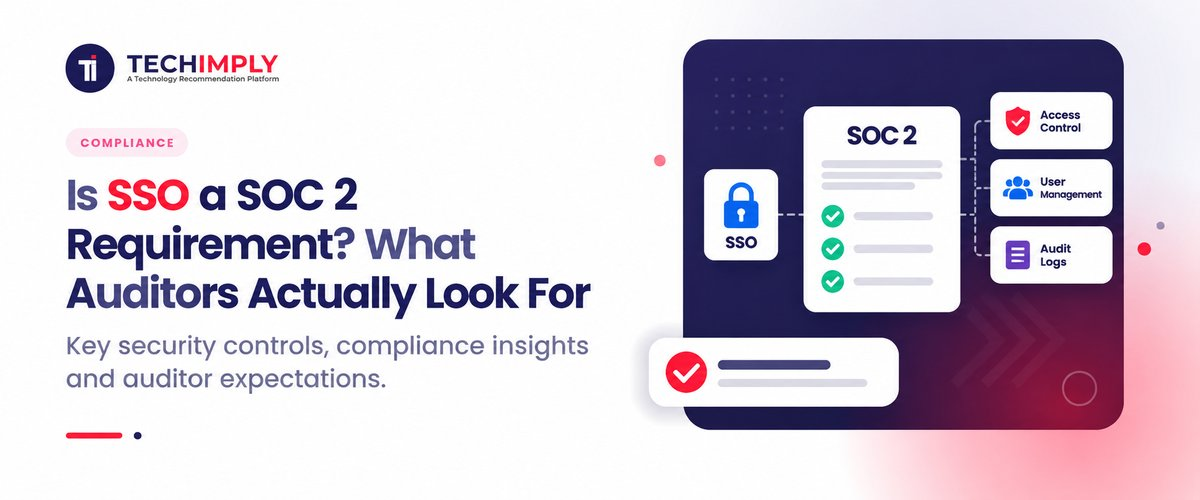
The question persists: is single sign-on functionality necessary for the product? To get to the bottom of the issue- yes or no- it's a big deal. Why is that?. This is what SOC 2 actually implies about access and authentication, as well as where single sign-on (SSO) comes in to assist in satisfying it.
What Does SOC 2 Actually Require for Access Control?
Trust Services Criteria serve as the foundation for SOC 2, and companies that include security system criteria in their reports are typically required to include the Common Criteria, which is also included in all reports. These criteria are optional. Another group, known as CC6, deals with logical access.
This is how a system controls who can enter, identifies them, allows access based on role, and removes access when it is no longer needed. SOC 2 does not list specific products or technologies. A company does not have to use a particular vendor or a particular protocol. It describes the outcomes ( such as access restrictions, consistent identity verification ) and leaves how you get that up to the company being audited.
Is Single Sign-On Literally Named as a SOC 2 Requirement?
No, not the name. The Trust Services Criteria text makes no mention of single sign-on anywhere. In theory, a company could pass a SOC 2 audit using individually managed logins for every identity system, assuming it can show consistent enforcement, timely deprovisioning, and appropriate access reviews across all of them.
In practice, once a company has more than a handful of systems in scope, it is very difficult to go down that path. This is why SSO appears in nearly every SOC 2 report that passes: not because the standard calls it out, but because it’s the hands-down most practical way to produce the evidence the standard actually asks for.

Pro-tip
Start connecting systems to your identity provider well before your audit period begins, not right before the auditor arrives. Type II evidence covers the whole observation window, so a system connected halfway through only produces partial evidence for that period.
What Do Auditors Actually Look For Around Authentication?
An auditor is not reading a policy document and taking it on faith. For a SOC 2 Type II report specifically, they sample real evidence across a period of several months, commonly three to twelve, to confirm that access controls were not just written down but actually operating the whole time.
- Consistent enforcement of authentication across every system considered in scope, not just the main product
- Multifactor authentication in place for administrative and sensitive access, and increasingly for standard user access as well
- A documented, followed process for granting access when someone joins and removing it promptly when they leave
- Evidence that access matches each person’s current role, not a role they held previously
- Logs showing login activity and access changes over the audit period, not just a policy claiming this happens
Every one of these is far easier to demonstrate through one connected identity provider than through a patchwork of separate application logins, each with its own inconsistent settings.
What Evidence Might an Auditor Ask For?
This is where many organizations discover that having a policy is different from proving that the policy operates. For example, an organization may have a written rule saying that employee access should be removed when someone leaves. An auditor may then want evidence showing that the process actually happened.
Depending on the audit scope and controls, evidence can include:
- Access requests
- Approval records
- User lists
- Access review records
- Termination records
- Deprovisioning logs
- Role assignments
- Authentication configuration
- Administrative activity logs
- Evidence of remediation
The exact evidence request depends on the organization's system, controls, audit scope, and auditor. The central point is that evidence should demonstrate the operation of the control rather than merely describe it.
Why Do Auditors Favor Centralized Access Over App-by-App Logins?
The underlying issue is evidence, not preference. If every application manages its own login, proving consistent access governance means pulling separate reports from every single one, checking that each enforces the same standard, and cross-referencing all of it against the company’s HR records for who actually joined and left during the period. That is a slow, error-prone process even for a company genuinely doing everything right.
A single identity provider produces one clean, centralized log covering logins, access grants, and removals across every connected application. That is a much smaller, more defensible body of evidence to hand an auditor, which is the practical reason SSO has become close to a default expectation rather than a literal rule.
Does SSO Alone Satisfy SOC 2, or Is More Needed?
SSO on its own answers the authentication half of the picture, but SOC 2 access criteria go further than login alone. A company still needs a documented process for how access is requested and approved, a defined schedule for reviewing who has access to what, and clear ownership of privileged or administrative accounts that typically sit outside standard SSO, which is where privileged access management usually comes in for anything touching production systems or sensitive data directly.
Password management practices for any system that still falls outside SSO coverage also stay relevant, since a handful of unconnected legacy tools is common even in companies with a mature identity setup, and auditors will still expect those specific systems to show reasonable, documented controls of their own.
What Should a Company Preparing for SOC 2 Do About SSO?
The practical path tends to follow a consistent order for companies going through this for the first time.
- List all systems that are included in the SOC 2 audit scope, including internal tools and not just the customer-facing product.
- Establish a single identity provider for as many systems as possible instead of leaving them on separate logins.
- Turn on multifactor authentication as the default for every connected account, especially administrative accounts
- Write down the actual access request, approval, and removal process, and follow it consistently before the audit period even begins
- Set a recurring access review, since ad hoc reviews right before an audit rarely hold up as genuine ongoing evidence
Do You Know?
A SOC 2. A single date only indicates that controls were properly designed in the Type I report. Most enterprise buyers demand the Type II report, which requires evidence that the same controls were in place during the entire observation period, making consistent SSO logs more important for Type I than Type II.
How Does Single Sign-On Fit Into the Bigger Security Management Picture?
It helps to place single sign-on inside the wider context an auditor is actually evaluating. SOC 2 is not assessing single sign-on as an isolated feature; it is assessing whether a company's overall security management programme, of which single sign-on is one significant piece, produces consistent, provable outcomes over time. A company could have excellent single sign-on and still fail an audit over unrelated gaps in change management or incident response.
Identity and access management, considered more broadly than single sign-on alone, is usually the section of a SOC 2 report that benefits most directly from a clean, centralized login setup. Auditors reviewing this area are really asking whether the company knows, at any given moment, exactly who can access what, and single sign-on is simply the most efficient way most companies have found to keep that answer current.
Conclusion
SOC 2 does not require single sign-on by name, and a company should be wary of anyone who states otherwise as a flat rule. What it requires is consistent, provable access control across every system in scope, and single sign-on happens to be the most practical way most companies have found to produce that evidence without a manual, error-prone process behind it. Treating single sign-on as close to a default rather than an optional nice-to-have is a reasonable reading of what auditors actually expect in practice, even without the standard ever using that specific term.
Related Reads :
- How Does CIAM Improve Customer Login and Account Security?
- Why Banks and NBFCs in India Are Prioritizing Privileged Access Management Under RBI and SEBI Rules
- Top Privileged Access Risks Businesses Face Today
- Top No-Code vs Low-Code: Differences, Examples & Guide
- What Is IAM and Why Is It Important for Business Security?