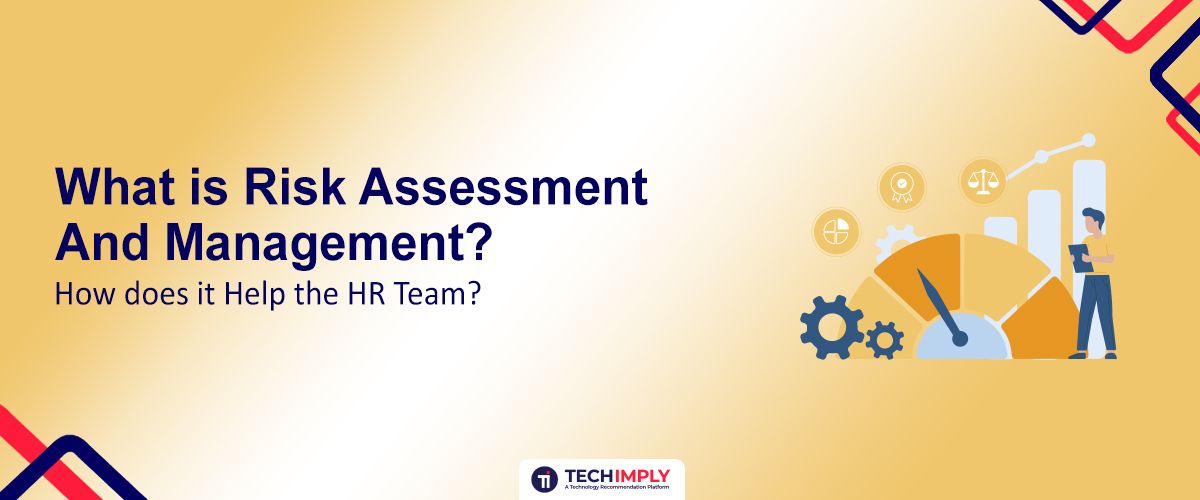
You might think HR is all about hiring and onboarding people. That is not true. Today’s fast-moving world requires HR to manage the risks that affect your people and your business. This is where the assessment and management of risks fit in, supporting compliance, safety, and employee well-being to help HR teams be prepared, protected, and proactive.

Looking for Risk Management Software?
Check out Techimply's List of best Risk Management Software for your business.
In this guide, you’ll get a clear understanding of what is risk assessment and management, how the risk assessment process works, and why mastering the risk management process is now essential for HR professionals in 2025. We'll also explore how risk assessment helps the HR team, what is the primary purpose of risk management in HR, and provide a curated list of the best risk assessment and management tools—including some free risk assessment and management options—to help you stay ahead.
What is Risk Assessment and Management?
Risk assessment and management in a company or organization refer to examining the workplace and determining what sorts of hazards can be potentially present and later minimizing or preferably eliminating them. This is to say, it allows one to identify problems before their occurrence and set proper strategies in place for handling them.
The risk assessment definition is to identify what could go wrong, who could be impacted, and the probability of such occurrences. Risk assessment is not supposed to resolve the issue. Rather, this is something for management to undertake. After identifying risks, one goes to risk management, that means planning for dealing with or avoiding those risks.
The main reason for risk management in HR is to ensure your people are safe, that you comply with the law and that your environment is secure. A good Risk Management Assessment makes you ready and confident for any situation.

Did You Know?
According to the Health and Safety Executive (HSE), over 565,000 workers sustained non-fatal injuries in the UK in a single year. Most of these could’ve been prevented with a proper safety risk assessment.
How Risk Assessment and Management Work?
Risk assessment and management work in two main steps. First, you identify risks—anything that could go wrong at work, such as safety issues, legal troubles, or broken processes. This is known as risk assessment. Then comes risk management, where you figure out how to reduce or avoid those risks. That might involve fixing a problem, changing how something is done, or putting new policies in place. So Altogether, this process totally helps you stay ahead of potential issues, protect your team, and keep your workplace running smoothly.
Interesting Read- 7 Reasons Risk Management Software Matters For All Employees
What is the Risk Assessment Process?
The risk assessment process offers a systematic way of identifying and managing risks at work. From a broader perspective, one must visualize and ask: What possible things could go wrong? Possible threats are then enlisted, such as safety concerns, compliance risks, or anything that may hurt people or the organization.
Next, you figure out who might be affected and how serious the risk is. Then, you decide what actions you can take to reduce or remove those risks.
You keep a record of what you found and what you’re doing about it. And you review everything regularly to make sure it’s still working. It is an easy procedure but a great assistance in having your crew safe and your place of work ready for anything.
Editor’s Note:
Remember to involve the employees while carrying out risk assessments — they often spot everyday hazards that managers may have overlooked. Moreover, this engagement helps in compliance.
How Risk Assessment Helps the HR Team?
Risk assessment lets your HR team identify potential issues ahead of time. It helps you spot safety risks, compliance problems and employee issues in the beginning. As a result, your workplace will be safer, accidents will decrease and you won’t face expensive legal problems. HR in making better plans for how to care for employees and their professional development. Whether you’re pursuing a career in HR or exploring a Financial advisor job, understanding risk assessment is key to creating a safe and compliant workplace.
Looking for HR Software?
Check out Techimply's List of best HR Software for your business for your business.
What is the Primary Purpose of Risk Management in HR?
A safe and productive workplace depends on regular risk assessments. They look for risks, examine the safety procedures in place and put new controls in place when needed. When you take this approach, you can avoid risks and keep both your employees and your workflow safe.
Key Reasons for Conducting Risk Assessments:
- Identifying Hazards: Identify the health and safety hazards in your workplace and with it the accidents and injuries that may occur.
- Evaluating Current Measures: Check if the hazards have already been controlled by the existing safety arrangements.
- Implementing Additional Controls: Introduce new systems or equipment if the existing ones are not adequate to bring the risks down to an acceptable level.
- Prioritizing Resources: Make sure that the most significant risks are dealt with on time and that the resources are available to allocate to them.
Neglecting the risk assessments can have awful results, such as financial loss from that portion of fines, legal actions, and decreased productivity accruing from accidents or equipment damage. For example, where two employees were trapped in the moving machinery, a certain business was fined an exact sum of £274,000; this steps proves how important a risk assessment can be.-Another example is in 2016, 2 Sisters Food Group, a major UK poultry processor, faced fines totaling £274,000 after two separate incidents where workers suffered severe hand injuries due to inadequate safety measures.
List of Best Tools and Software for Risk Assessment and Management in HR
If you are handling risks in HR then the right software can seriously lighten the load. Here are some great tools worth checking out:
1. Resolver
Resolver is a popular risk management platform that helps HR teams identify, assess, and manage risks efficiently.
What It Offers
- Incident tracking and reporting
- Automated risk assessments
- Action plans and task management
- Real-time dashboards and analytics
- Compliance tracking
What You’ll Like
- Easy-to-use interface for quick adoption
- Strong reporting and analytics capabilities
Potential Drawbacks
- Can be expensive for small businesses
- Limited customization options
Pricing: Resolver pricing is typically quote-based depending on company size and needs. Contact their sales team for details.
2. Logicmanager Inc.
LogicManager offers an integrated risk management solution tailored for HR and compliance teams.
What It Offers
- Risk identification and assessment tools
- Policy and compliance management
- Automated workflows
- Centralized document management
- Customizable reporting
What You’ll Like
- Highly customizable to fit unique business needs
- Strong customer support
Potential Drawbacks
- Interface may feel complex initially
- Pricing can be high for startups
Pricing: Pricing is custom and varies based on modules selected. You need to request a quote.
3. AuditBoard
AuditBoard is a cloud-based platform designed for risk, audit, and compliance management with features useful for HR teams.
What It Offers
- Risk and control assessments
- Issue tracking and resolution
- Audit management
- Automated workflows
- Real-time dashboards
What You’ll Like
- Intuitive user experience
- Good integration with other enterprise tools
Potential Drawbacks
- Setup can be time-consuming
- May be expensive for smaller companies
Pricing: Pricing is not publicly listed; you’ll need to contact AuditBoard for a quote.
4. Archer Enterprise and Risk Management
Archer provides a comprehensive platform for managing enterprise risks, including HR-related risks.
What It Offers
- Risk and control self-assessments
- Incident management
- Policy management
- Compliance monitoring
- Advanced analytics
What You’ll Like
- Robust enterprise-level features
- Scalable for large organizations
Potential Drawbacks
- Requires training to use effectively
- Can be pricey for smaller firms
Pricing: Archer’s pricing is customized based on company size and requirements.
5. DataGuard
DataGuard focuses on the management of risks relating to data privacy and compliance, an issue of critical importance to HR teams who have to manage such sensitive employee data.
What It Offers
- GDPR and data privacy compliance
- Risk assessments focused on data protection
- Automated policy management
- Real-time monitoring
- Employee training modules
What You’ll Like
- Focus on data privacy risks
- Easy compliance with regulations
Potential Drawbacks
- Less focused on general HR risk management
- Limited features outside data privacy
Pricing: DataGuard offers subscription-based pricing, starting at around $50/user/month, but exact pricing depends on features and user count.
Key Takeaways
The primary purpose of risk management is to protect people and ensure compliance.
Risk assessment does not include solving problems—it only identifies them.
Safety risk assessment is crucial for avoiding legal trouble and workplace accidents.
Tools like Resolver and LogicManager make the process easier and more effective.
Conclusion
For an HR team such as yours, risk assessment and management is a strategic advantage. It is much more than a mere compliance task. This enables you to stay ahead of legal issues while enhancing workplace safety for people and culture protection. With the understanding of risk assessment definition, use appropriate safety risk assessment tools to react to risks and move them into active prevention. The primary purpose of risk management in HR is resilience. The ayes have it. So check out the best free risk assessment and management tools around today—in fact, make the workplace uncertainty a thing of the past and replace it with a smarter, stronger future for your team.
Related Read-
- What You Need to Know About Risk Candidate Assessment in Financial Planning
- Enhancing Employee Engagement and Productivity with HR Software
- HR Software Statistics Trends
- Finding the Right Enterprise HR Software for your Business
- HR Software: What It Is and How to Choose the Best Solution
- Best HR software to Manage Your Remote Workforce
- Data-Driven Recruitment: Using HR Software to Make Informed Hiring Decisions
- 5 Steps To Choosing The Right HR Software For Your Startup
- Things Should Be Considered While Evaluating HR Software
- 10 Strategies for Optimizing Efficiency with Financial Risk Management Software