Posting job ads and waiting for resumes to come in are no longer adequate in finding and retaining top talent amidst today’s competitive job market. To improve the overall recruitment efficiency, lower hiring costs, and make informed hiring decisions, organizations have embraced data-driven recruitment. With data-driven recruiting and HR Analytics software, businesses can enhance every stage of their hiring process which results not only in better hires but also in a stronger workforce.
This article will discuss what is Data-driven recruitment, benefits of Data-driven recruitment, how recruitment analytics can enhance your hiring process, and major steps toward successfully implementing a Data-driven recruiting strategy.

Looking for HR Software?
Check out Techimply's HR software India for your business.
What is Data-Driven Recruitment?
Data-driven recruitment does not use gut feeling but measurable data, analytics, and technology to make its hiring decisions. It turns the hiring decision-making from an art to a science.
Sourcing channels, candidate engagement, time-to-hire, and quality-of-hire are a few metrics that are tracked by recruiters utilizing data-driven HR practices. This information enables patterns to be formed by the HR team, hiring needs predicted, and recruitment advertising campaigns to be conducted with precision toward the exact target using analytics dashboards thereby enabling data-driven hiring solutions.
In short, data-driven recruiting and HR analytics allows firms to stop guessing and start making data-driven hiring decisions based on evidence, which leads to improved long-term hiring results with the help of HR software online.
Firms using data-driven recruitment are 2x more likely to improve their quality-of-hire and 3x more likely to decrease time-to-hire — meaning data doesn’t just talk; it hires!Benefits of a Data-Driven Recruitment Strategy
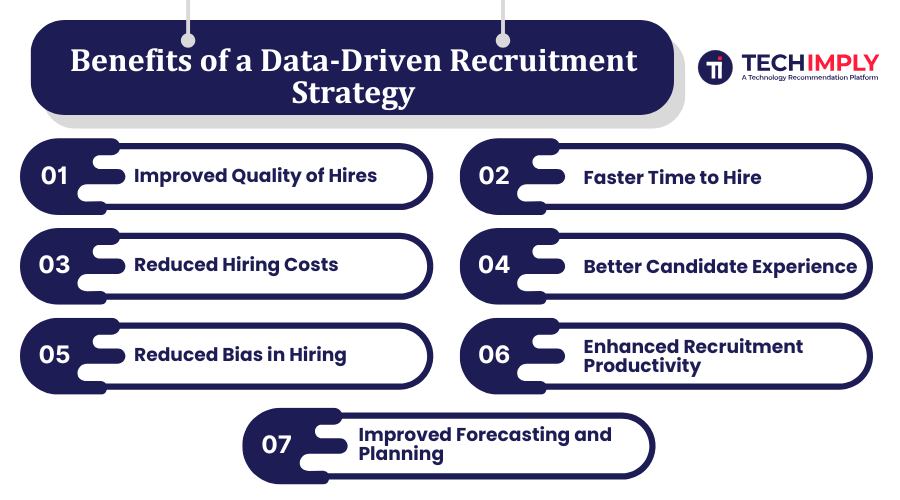
Using a data driven recruiting strategy can really boost results in different areas of hiring process.
1. Improved Quality of Hires
Recruitment metrics enable hiring teams to source candidates via the best channels and keenly evaluate them against well-laid indicators of performance, leading to data-driven talent acquisition that increases the probability of new hires fitting into the organization performing their duties effectively. Companies can perpetuate the enhancement of their hiring success by adopting data driven HR practices in the continuous improvement of sourcing and screening.
2. Faster Time to Hire
By keeping an eye on metrics at every step, recruiters can find problems and make things run more smoothly. For instance, automated hire decision management software speeds up candidate evaluation and communication. Data-driven hiring solution enables recruiters to make faster decisions at the same high standard of candidates. Employers who implement a data-driven recruitment reducing time-to-hire by 30% and enhance the quality of candidates.
3. Reduced Hiring Costs
The use of data-driven recruitment advertising enables better targeting, thereby reducing wasted ad spend, and predictive analytics helps to avoid costly mistakes in hiring. Data driven recruitment software integration with existing HR tools also ensures budget efficiency and maximum ROI.
You may also read: Why Do Startups Need Recruiting Software?
4. Better Candidate Experience
Personalized communication, timely updates, and relevant role recommendations greatly improve candidate satisfaction and engagement as enabled by data driven recruitment software. This method aligns well with a data driven recruiting strategy that keeps candidates informed and valued throughout the process.
5. Reduced Bias in Hiring
HR data-driven hiring implies making decisions based on factual information such as competency assessments and past performance, rather than subjective opinion. Firms can support diversity and inclusion in the workplace through data-driven hiring decisions.

Quick Insight :
Data-driven recruitment goes with evidence over instinct. Meaning decisions to hire are made based on data, not feelings.
6. Enhanced Recruitment Productivity
Automated data collection and data-driven hiring solutions give recruiters the time to concentrate on relationship building and other high-value tasks. Through leveraging data-driven HR insights, recruitment teams can focus on activities where they will have the greatest impact.
7. Improved Forecasting and Planning
With correct hiring information, HR leaders can forecast staffing needs, build strong pipelines, and match talent availability with business growth plans. A good setup of data-driven recruiting and HR analytics helps in strategic workforce planning.
Looking for Recruiting Software?
Check out Techimply's Best Recruiting Software for your business.
How Recruitment Analytics Can Enhance Your Hiring
Recruitment analytics helps HR professionals for tracking, measuring, and evaluating every single step within the hiring process. It will provide insight into what strategies of their plans are working and where adjustments are necessary.
For example:
-
Data driven recruiting tools can show you which sources of candidates give you the best ones.
-
Data-driven hiring metrics can show you where candidates leave application process.
-
Predictive models can help you figure out future hiring needs and optimize your recruitment steps accordingly.
Analytics makes sure that every step of the hiring process is as fast, accurate, and high-quality as possible when used with hire decision management software.
Key Components of Data-Driven Recruitment
Let’s understand that help in successful data-driven recruitment. Implementing data driven recruiting strategy involves several key components:
1. Smart Job Description Design
Oftenly, traditional job descriptions read like wish lists, which are filled with requirements whose success isn’t predicted. Data-driven job descriptions are different:
-
Rather than assumed qualifications, they emphasize on proven success indicators
-
They use language that has worked with attracting diverse audiences.
-
They include only necessary requirements based on data
A software company, for instance, examined the performance data of its engineering team and found that a computer science degree wasn't genuinely associated with better performance. Their talent pool was greatly increased while quality was maintained by eliminating this requirement.
Suggested Read:
2. Predictive analytics in screening
Because of rigorous filtering or unconscious bias, in initial screening phase, many candidates get lost. Data-driven screening uses:
-
Pattern recognition to identify candidates that might not fit traditional criteria.
-
Examination of the backgrounds of successful employees to identify uncommon signs of potential
-
Automated screening tools that does not focus on keywords but core competencies.
3. Structured Interview Processes
Unstructured interviews are unreliable for predicting job performance. Interviews through data-driven approach converts from casual conversations to reliable assessment tools:
-
The questions are created using performance information from successful employees.
-
Standardized scoring criteria are verified against real-world work performance.
-
Interview panels receive training on identifying and combating common biases.
Data At Each Step Of The Recruitment Funnel
If you have the right tools, recruitment can be an enjoyable process. Using data to analyze your recruitment funnel can reveal long-standing pitfalls and bring up hidden opportunities. Data driven recruiting can be part of every stage in recruitment funnel, that enables you to modernize and develop the best data driven recruiting strategy.
1. Finding
Successfully able to find out your source of hire enables recruiters to invest in effective channels and not waste time on marketing on places that lead to minimal outcomes. Data driven recruiting and HR analytics can lead you to places where top tech candidates are and it helps in improving your employer brand becoming attractive to job seekers.
2. Assessing
Data driven HR skill assessment tools can analyze applicants based on various factors that is impossible for recruiter to do it manually. This helps recruiters to selectively shortlist quality candidates for interviews. Through improved assessments, a company can significantly cut down on time to fill positions, boost candidate conversion rates, and enhance hiring quality. The rest of the recruitment funnel is overall impacted with receiving early insights into skilled candidates.
3. Interviewing
Since interviews can take up the most time during the hiring process, there are a number of tools that can help speed up and enhance the quality of these sessions. Accurate assessment of a candidate along with analytic reporting is provided by utilizing online test platform together with structured interviews. Accurate reporting on testing and interviewing the candidates does not just reduce time at the interviewing stage but data can provide better insight into suitable candidates instead on relying on emotional decision-making.
4. Retaining
Retention is critical because replacing the top performers and starting the recruitment funnel from scratch is both disruptive and expensive process. The right analytics can help you with data of why employees leave, how likely they’re going to resign, analyze existing employee satisfaction, and more. This all helps companies improve in areas where they lack, so that top performers can stay, and turnover remains intact. Losing a good employee is disastrous for a company.
Choose The Right Metrics And Suitable Data Sources
A successful data driven hiring approach starts with selecting the right KPIs and sources. Common metrics include:
-
Time-to-Fill
-
Quality-of-Hire
-
Source-of-Hire
-
Cost-per-Hire
-
Candidate Satisfaction Score
Suitable data sources include:
-
Applicant Tracking Systems (ATS)
-
HR management platforms
-
Employee performance data
-
Social media insights
-
Hire decision management software reports
Joining these with data driven recruitment software makes sure there is quick access to actionable information.
Key Takeaways
Automation, hire decision management software, and exact targeting make recruitment faster and reduce extra costs.
HR data-driven hiring lessens the use of gut feelings making diversity and fairness better.
Forecasting analytics support HR heads in predicting staffing needs and maintain a efficient talent pipeline.
Organizations that embrace analytics now will have a stronger talent edge in the future.
Conclusion
Data-Driven Recruitment is changing how companies hire people. Companies can make better, faster, and more consistent hiring decisions by using analytics, data driven HR practices, and data driven talent acquisition tools. There are clear benefits of data driven recruitment, such as finding better candidates to lowering hiring costs.
Utilizing data-driven hiring solutions and making sure they fit with business goals makes sure that hiring is not only reactive but also strategic. Companies that implement data driven recruiting today will have a competitive edge in the job market tomorrow.