Any restaurant that is being operated without proper tools may seem like one is attempting to prepare a five-course meal with one single pan; it is possible but incredibly inefficient. The necessity to have a powerful restaurant pos system is inevitable as the need to maintain order and profitability of your business increases because of your business expansion.

Looking for Restaurant POS software?
Check out Techimply's List of the Best Restaurant POS software in India for your business.
With a high-quality restaurant pos system, you can leave transactions behind and begin to run your business using precise data. The appropriate restaurant pos will simplify your day-to-day operations, whether you are running a fine bistro or a fast-food cafe point of sale by ensuring that daily activities are streamlined and there is no rubbish that slows down your employees.
What Is a Restaurant POS System?
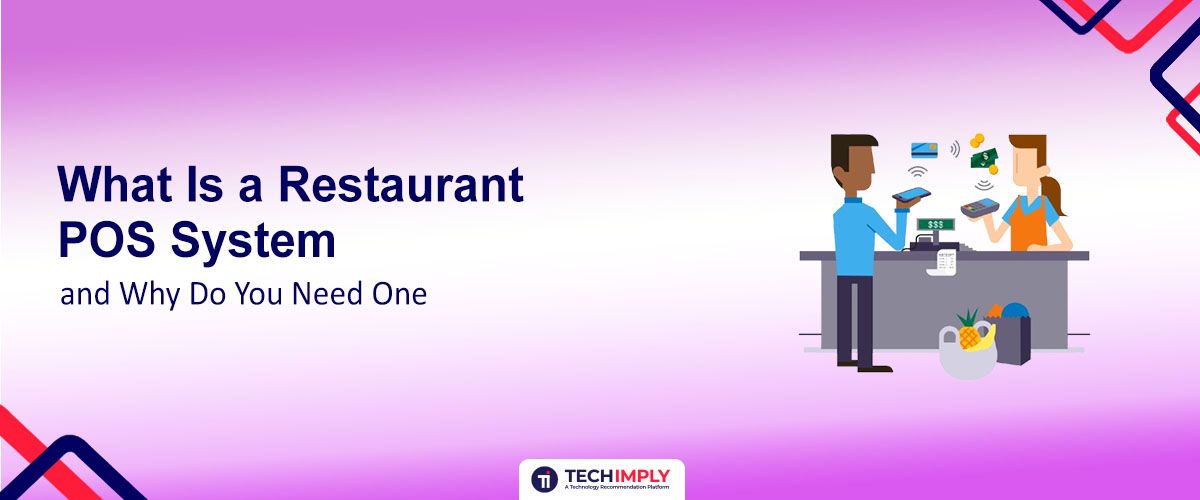
In order to know the worth of this technology, we should consider the point of sale system definition first. In the simplest understanding, a POS system is a set of software and hardware in which a customer pays to have his or her meal. A restaurant pos however, is far more than an online cash box in a contemporary dining establishment.
The pos software full form stands for Point of Sale software, and in a culinary context, it acts as a comprehensive restaurant system. It manages everything from the moment a server greets a guest to the final generation of a monthly revenue report. Unlike generic retail systems, a restaurant pos system is specifically designed to handle food-related complexities like menu modifiers, table management, and split checks.

Do You Know?
Restaurant pos systems that are based on the cloud do not stop working when your internet cuts off. They store the information locally and reconnect it to the cloud as soon as the connection is re-established so that you do not miss any sales.
Core component of Restaurant POS System
A complete restaurant system consists of several hardware and software pieces working in harmony. When you compare pos systems for restaurants, you will notice that while the brands differ, the essential components remain consistent.
1. POS Software
The software is the brain of the operation. It houses your menu, tracks your sales, and stores customer data. Modern restaurant pos systems typically run on cloud-based software, allowing you to access your business data from your smartphone even when you aren't at the restaurant.
2. Billing Terminal or Touchscreen
This is the primary interface used by your staff. It can be a stationary desktop monitor or a portable tablet like an iPad. Using a tablet for a cafe point of sale allows servers to take orders directly at the table, reducing the time guests spend waiting.
3. Receipt Printer
Even in a digital age, many customers still prefer a physical proof of purchase. Receipt printers are essential for the front-of-house, while dedicated impact printers are often used in the kitchen because they can withstand high heat and humidity.
4. Kitchen Display System (KDS)
A KDS replaces messy paper tickets. When a server enters an order into the restaurant pos system, it immediately appears on a screen in the kitchen. This ensures that the chefs see the orders in the correct sequence, reducing communication errors.
5. Card Reader and Payment Gateway
To get paid, you need hardware that accepts credit cards, mobile wallets (like Apple Pay or UPI), and chip-based cards. Ensuring your restaurant pos is integrated with a secure payment gateway protects both your business and your customers from fraud.
How Does a Restaurant POS System Work?
The beauty of a modern restaurant pos system lies in its seamless workflow. The global point of sale market size was valued at USD 33.41 billion in 2024. The market is projected to grow from USD 38.56 billion in 2025 to USD 110.22 billion by 2032, exhibiting a CAGR of 16.1% during the forecast period. It transforms a chaotic rush into a synchronized process.
Order Placement: The server enters the order into the restaurant pos terminal or tablet. The system automatically applies any discounts or happy hour pricing.
Kitchen Communication: The order is instantly routed to the KDS or kitchen printer. If there are multiple stations (e.g., bar, grill, and pantry), the restaurant system splits the order so each chef only sees what they need to prepare.
Billing: Once the meal is finished, the server generates a bill with a few taps. The restaurant pos system can easily handle complex tasks like splitting the check by seat or by item.
Payment: The guest pays via their preferred method. The restaurant pos updates the inventory in real-time, deducting the ingredients used for those specific dishes.
Reporting: At the end of the night, the owner can view a detailed report showing which items were the most popular and how much revenue was generated.
Why Do You Need a Restaurant POS System?
If you are still using a manual cash register or a basic spreadsheet, you are likely losing money without realizing it. Automation is the primary reason why you need a restaurant pos system.
Speed and Efficiency
During a busy lunch rush, every second counts. A restaurant pos speeds up the ordering process by allowing servers to send tickets to the kitchen without walking back and forth. This leads to faster table turnover and higher sales.
Reducing Manual Errors
Handwritten tickets are often hard to read, leading to wrong plate mistakes that result in wasted food and unhappy customers. A restaurant pos system ensures that the kitchen receives perfectly legible instructions every time.
Improved Customer Satisfaction
Customers today expect a smooth experience. Whether it's the ability to pay at the table or receiving an email receipt, a modern restaurant pos provides the convenience that keeps guests coming back.
Key Problems a Restaurant POS System Solves
The reason many of the owners are hesitant is due to the prices of point of sale systems, which are usually not as expensive as the cost of not having them. A restaurant system targets the most widespread pain points in the sector:
Long Billing Queues: You do not have to have long checkout lines at the point of sale since Fast Cafe will take seconds to process the payment.
Order Mismanagement: Lost tickets and forgotten appetizers are now a thing of the past. The pos system can monitor all items ordered through to delivery to the restaurant.
Stock Shortage: A nightmare to run out of a best-seller. A pos system automatically notifies you about the low levels of ingredients, and thus you can order them before you run out.
Revenue Leakage: There will be no digital trail and no records of free drinks or records of sales, resulting in revenue loss. The restaurant pos guarantees that anything that comes out of the kitchen is registered.
Pro Tip:
Built-in reporting of your restaurant pos system can help identify dead menu items. When a dish is not selling, drop it off to cut the inventory costs and to make the kitchen activities easier.
How to Choose the Right Restaurant POS System
Choosing the right pos system is one of the most important decisions you will make for your business. Because there are so many options, you should follow a structured approach to choosing a pos system.
1. Business Size and Type
A small coffee shop needs a different point of sale than a large fine-dining establishment. When choosing a pos system, ensure it has features specific to your niche, such as table mapping for restaurants or quick-pay for cafes.
2. Ease of Use and Training
The best restaurant pos is one that your staff can learn in minutes. If the interface is too complex, it will lead to errors and frustration. Always ask for a demo before choosing a restaurant pos system.
3. Pricing and Subscription Models
Point of sale system prices vary widely. Some companies charge a flat monthly fee, while others take a percentage of every transaction. When you compare pos systems for restaurants, look at the Total Cost of Ownership, including hardware, software, and payment processing fees.
4. Integration Capabilities
Your restaurant pos system should talk to your other tools. Can it connect to your accounting software (like QuickBooks)? Does it integrate with delivery apps like Swiggy or Zomato? Choosing the right pos system means finding a hub that connects your entire tech stack.
5. Customer Support and Reliability
Restaurants don't run on a 9-to-5 schedule. If your system crashes on a Saturday night, you need a provider that offers 24/7 support. This is a non-negotiable factor when learning how to choose the right pos system.
Conclusion
A restaurant pos system has ceased being a payment-taking tool; it is an all-inclusive management system that gives you the authority to operate a more viable and profitable business. Automating the duller aspects of the restaurant management system, such as inventory and manual billing, you can spend time on what is important in the restaurant: the food and the people. You can upgrade your existing system, or you may be adopting a restaurant pos system. Whatever your reason may be, remember that the right technology is an investment in your future. There is time to do some research and compare pos systems in restaurants, analyze your own needs, and choose the partner who will assist you to scale.