Building high-quality software is similar to constructing a complex machine. You might have perfect gears, a strong motor, and a durable frame, but if these parts do not fit together correctly, the machine will fail. This is why integration testing is such a critical phase in the development lifecycle. While unit testing ensures that individual pieces of code work in isolation, it cannot predict how those pieces will behave once they interact.

Looking for Integration System Software?
Check out Techimply's List of the Best Integration System Software in India for your business.
In the field of integration testing in software testing, the goal is to verify that data flows smoothly from one module to another. If you consider a digital payment app, one module might handle the user login while another manages the bank API. Using a structured approach to integration testing ensures that these individual software modules combined together during the build process function as a cohesive unit, protecting both the user experience and the company's reputation.
What is Integration Testing Meaning?
Integration testing meaning is the process of combining individual software modules and testing them as a unified system to verify that they work correctly together. In other words, once each module has been unit tested in isolation, integration testing checks whether those modules communicate and interact as expected when brought together. Think of it like assembling the parts of a machine, each gear may work perfectly on its own, but only when all the gears mesh together can you be sure the machine runs as intended.
This phase sits between unit testing and system testing in the software development lifecycle. It is one of the most important checkpoints in software quality assurance because many defects surface not within a single module, but at the boundaries where two modules exchange data or trigger each other's behaviour.
In simple terms, integration testing in software testing ensures that the data flows, API calls, database operations, and third-party service integrations all behave as designed, not just in theory, but in practice.
Do You Know?
Nearly 40% of software bugs are found at the integration level, not during unit testing. This is because individual modules often work perfectly in isolation but fail the moment they start talking to each other. That's exactly why integration testing exists as its own dedicated phase!
What is Integration Testing in Software Engineering?
Integration Testing in Software Engineering Integration testing is a formalized testing approach in which software modules that are integrated are tested to ensure that they fulfill both non-functional and functional requirements. The aim is to reveal flaws that occur at the interface of the components, regions that unit tests can tend to overlook.
The software systems in the modern world are seldom monolithic. They consist of front-end layers, back-end services, databases, APIs, and third-party integrations. Once these layers begin to interact, some unforeseen issues may arise, data mismatch, wrong API responses, wrong database queries, or broken business logic chains. These problems are what is caught through integration testing in software engineering before they get to end users.
The software testing documentation of Atlassian states that integration tests confirm the communication between components or services that your application uses, and they assist teams in identifying failures that would otherwise go undetected until production. Integration testing may involve testing two modules at the same time up to the validation of a complete subsystem.
Different Types of Integration Testing
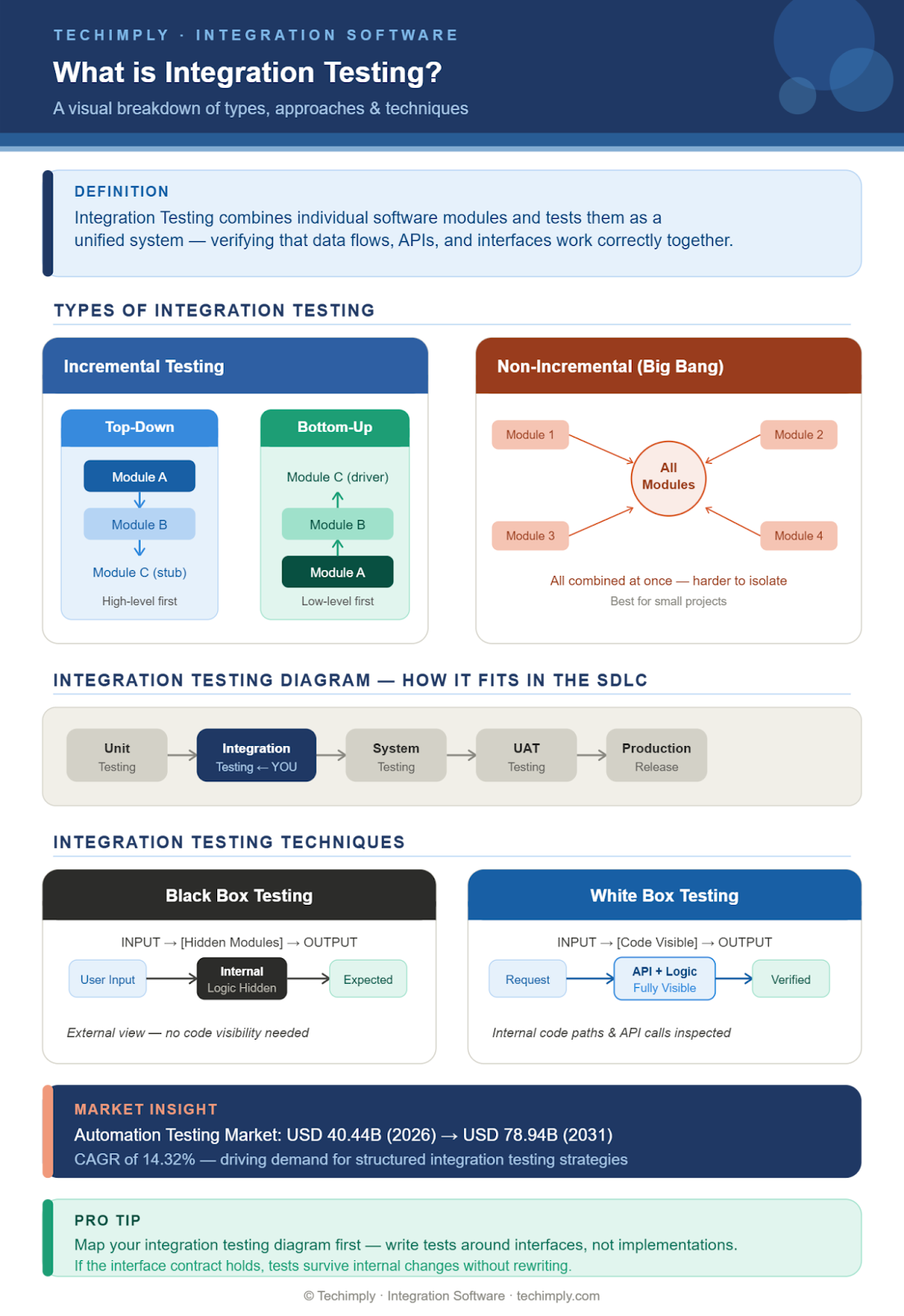
When planning a testing strategy, understanding the different types of integration testing helps teams choose the most suitable approach based on project size, architecture, and risk tolerance. Broadly, integration testing is classified into two main categories: Incremental and Non-Incremental.
1. Incremental Integration Testing
Incremental integration testing is an approach where modules are integrated and tested one at a time, or in small groups, rather than all at once. This makes it easier to isolate defects and track down exactly which module or interface caused a failure. Incremental integration testing further divides into two well-known approaches:
1.1 Top-Down Integration Testing
Top-down integration testing starts from the highest-level module and progressively integrates lower-level modules. Stubs are used to simulate lower-level modules that have not yet been developed or integrated. This approach is particularly useful for validating the overall system flow and main control logic early in the development cycle.
The primary advantage of the top-down approach is that the high-level design is tested first, allowing teams to identify architectural issues early. However, lower-level modules are tested later, which can mean critical logic at the data layer gets validated only toward the end.
1.2 Bottom-Up Integration Testing
Bottom-up integration testing is the reverse, it starts with the lowest-level modules and progressively moves upward. Drivers are written to simulate higher-level modules. This method is well-suited when the lower-level utility or data access modules are developed first and need to be validated before the higher-level logic is built.
Top down and bottom up integration testing are the two most widely used incremental strategies. The choice between them often depends on team structure, what gets developed first, and where the highest-risk interfaces are in the system.
2. Non-Incremental Integration Testing: The Big-Bang Approach
In the Big-Bang approach, all or most of the individual software modules are combined together at once and tested as a single unit. There is no gradual integration, everything is assembled and then tested together.
While this sounds straightforward, it can make defect isolation much harder. If something fails, it is difficult to pinpoint which module or interface caused the problem. The Big-Bang approach is typically used for smaller projects where the number of modules is limited and the team has high confidence in individual modules after unit testing.
Example of How to Do Integration Testing
To understand integration testing practically, consider a simple e-commerce application with three modules: a User Authentication Module, a Product Catalogue Module, and a Shopping Cart Module.
An integration testing example would look like this:
- A user logs in through the Authentication Module.
- After successful login, the system fetches the product catalogue from the Product Catalogue Module.
- The user selects a product and adds it to the cart via the Shopping Cart Module.
- The cart module communicates back with the catalogue module to confirm stock availability.
In this flow, integration testing would verify that: (a) the authentication token passes correctly to the product module, (b) the product data is fetched accurately, and (c) the cart module correctly reads and updates inventory. If any of these interfaces breaks, integration testing will catch it.
According to QAlified's integration testing guide, a solid integration test plan should clearly define the interfaces to be tested, the data to be used, and the expected outcomes for each interface interaction. This structured approach ensures repeatable and reliable results.
Simplilearn's integration testing documentation further highlights that defining entry and exit criteria for integration testing, just as you would for any test phase, is critical to maintaining process discipline and measuring completion accurately.
Various Integration Testing Techniques
The automation testing market has grown significantly in recent years, the automation testing market size reached USD 40.44 billion in 2026 and is projected to attain USD 78.94 billion by 2031, reflecting a 14.32% CAGR across the forecast period. This rapid growth highlights how central automated approaches to integration testing have become in modern software development. Two foundational techniques used in integration testing are Black Box Testing and White Box Testing.
1. Black Box Testing
Black Box Testing focuses on testing the integration from an external perspective, the tester does not have visibility into the internal code structure. The test cases are designed based on inputs and expected outputs.
In the context of integration testing, black box testing is used to validate that the integrated modules produce the correct outputs for a given set of inputs, without concerning the tester with how each module processes the data internally. This technique is particularly effective for integration testing API, where you send a request and validate the response without inspecting the underlying implementation.
2. White Box Testing
White Box Testing gives testers full access to the internal structure, code, and logic of the modules being integrated. In integration testing, this means testers can inspect how data moves between modules, trace code execution paths, and verify internal API calls.
White box approaches of integration testing are valuable when teams need to verify integration testing API calls between internal services, ensuring that the correct endpoints are being called, the right headers are being passed, and the responses are being handled as designed. Katalon's integration testing resources note that white box testing at the integration level can significantly improve code coverage and catch subtle data transformation errors.

Pro-tip
Always write your integration tests around interfaces, not implementations, map them out with an integration testing diagram first, so if a module's internal logic changes but the interface contract stays the same, your tests still pass without rewriting them.
Conclusion
Integration testing is not just a checkbox in the quality assurance process, it is a critical safeguard that ensures individual software modules combined together during behave correctly as a system. Whether you follow the approaches of integration testing such as top-down, bottom-up, or Big-Bang, the underlying goal remains the same: delivering software where every component, interface, and interaction works reliably. As systems grow more complex and the automation testing market continues to expand, investing in a structured integration testing in software engineering strategy will save teams significant time, cost, and reputation in the long run.