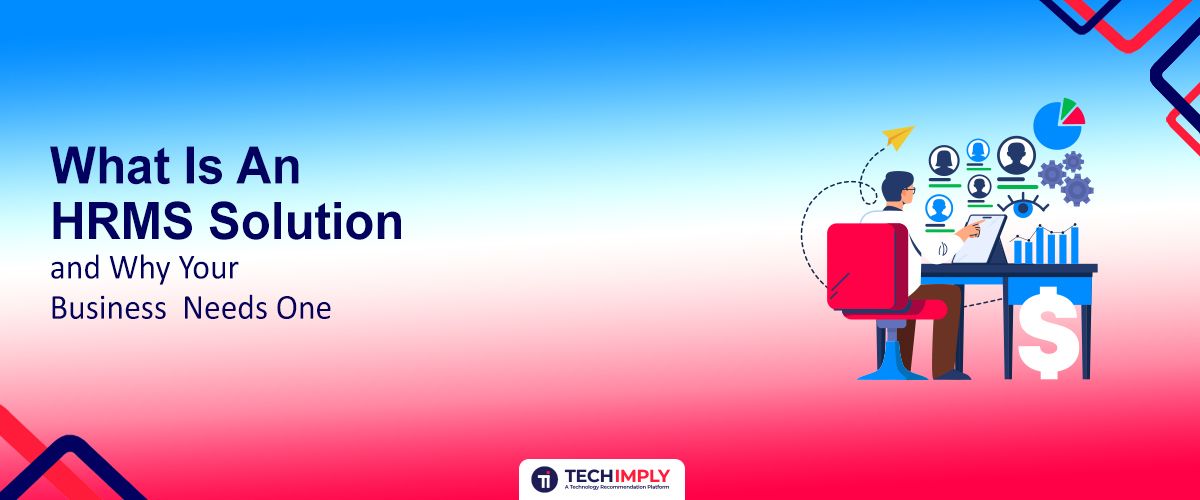
People management is no longer about report booklets and employee payrolls. The new challenges to business in 2025 include hybrid workplaces, quick skills change, employee well-being and the ever-present need to remain competitive. It is in that regard that an HRMS solution will help. It is not just a tool but the foundation of the contemporary HR as it unites such processes as recruitment, performance management and compliance with each other within one online roof.

Looking for the best tools to track attendance?
Check out Techimply's Check out Techimply’s Attendance Management Software for your business.
A human resource management system is not merely a database with data about the employees; it assists organizations in wiser, more informed decision making, promotes transparency and facilitates a more enjoyable experience of the managers and the employees. The appropriate HRMS solution is able to scale the businesses efficiently, and respond to market changes with features that include AI-driven insights to hyper-automation.
How To Choose An HRMS Solution
Choosing the appropriate HRMS solution is not merely a matter of software buy but a long term plan of people and process management. An updated human resource management system must assist the HR teams to streamline their day-to-day processes and forecast the business to meet the daily challenges. The most important issues to consider when comparing various HRMS platforms or human resource management solutions are as follows:

Pro Tip -
HRMS saves 40% of HR administration time - automate payroll, employee hiring, and performance monitoring in a single dashboard rather than using 5 or more tools simultaneously.
-
Ai-Enabled HRMS Solution
The HR system can be made smarter with AI anticipating attrition and automating leave approvals. This reduces manual labor and enables the HR managers to be strategic rather than doing paper work. As a matter of fact, 79% of organisations will increase AI expenditure by 2025 and budgets will increase by approximately 41%, which demonstrates its criticality in HR.
-
Focuses On Employee Well-Being
A proper HR management must embrace employee involvement, mental health initiatives and flexible policies. Employee welfare is directly connected with productivity and retention making it a necessary attribute.
-
Reskilling And Upskilling To Cope-Up With Market Changes
As the industries change rapidly, an HRM system should offer learning and development technology. Reskilling, certification and internal mobility features keep the employees relevant and businesses competitive.
-
Data Transparency
Records are very important in terms of accuracy and clarity. The current day human resource system enhances transparency by allowing employees and managers to access their information equally, be it the performance review or payroll history. This fosters trust and contributes to compliance.
-
Hyper-Automation For Process Optimization
Automation is faster and eliminates errors regardless of whether it is HRMS payroll, benefits administration, or time tracking. This is further enhanced by hyper-automation that unites various functions of HR to enable fluid work flows.
-
Third-party Application Integration
No HR tool works in isolation. The most appropriate human resource management program enables easy access to collaboration software, accounting software, and performance software, and before long, one interconnected system has been developed.
-
Simplified User Adoption And Change Management
No matter how developed the hr system is, it will not be of assistance when employees can hardly use it. Find a solution that has user-friendly interfaces, training options, and easy onboarding to ensure that the adoption process does not turn into a bottleneck.
-
Employee Information Management
The core of any HR system is correct employee records. A robust platform has a record of personal information, work history, appraisals, and regulatory documents that are in a single secure database. This removes duplication, makes it accessible and in line with the overall definition of the human resource system which is a defined mechanism of managing people, processes and policies.
-
Recruitment And Onboarding
The process of hiring does not stop with a signed offer letter. A good human resource system handles the whole chain of recruitment process, job advert to candidate tracking and automates the onboarding process.
-
Time And Attendance Management
An effective HRMS system will combine time tracking software, thus allowing managers to look at the shifts and employees to record their hours in an easier way. It also assists the organizations to remain in line with labor laws.
-
Payroll Processing
HRMS payroll is used as one of the most popular modules to calculate salaries, tax deductions, reimbursements and benefits automatically. It saves time, minimises errors as well as making sure that the employees are paid adequately and on time.
-
Benefits Administration
By providing employee self-service portals through which employees can access, modify and administer their benefits. This openness enhances satisfaction and minimises the workload of the HR.
Want to simplify salary processing? Explore Techimply’s Payroll Software in India and find solutions that make payroll faster, accurate, and stress-free.
Benefits Of Implementing An Hrms
Implementation of a human resource management system (HRMS) is no longer a luxury anymore, it is an imperative to the businesses in the year 2025. As the responsibilities of the workforce increase, manual processes are no longer up to the pace and accuracy expected by companies. The properly formulated HRM system or HRMS portal simplifies the routine operations, makes sure that everything is adhered to, and assists the leaders with making the smarter decisions. Some of the advantages of having an HR management system in your organization are discussed below.
-
Increased Efficiency And Productivity
An HR system automates mundane tasks such as attendance, payroll processing and leave requests. This leaves the HR teams with time to work on strategic initiatives as opposed to paperwork. Self-service portals also help employees save time, which enhances productivity in different departments.
-
Reduced Costs
The HRMS solutions will automate operations and minimize errors which are costly and benefits of manual labor are not required. Organizations save on funds and provide faster and more accurate operations by centralizing data and reducing number of physical records.
-
Improved Accuracy And Data Integrity
Mistakes in the payroll or other compliance forms may ruin trust and result in punishments. HRMS payroll module is used to make sure that the salaries are calculated correctly, the taxes are deducted, and the records are kept. It is also easy to see all data in a single location, which increases the amount of integrity of the data, minimizing duplication or incompatibility.
-
Enhanced Employee Experience
Employees find contemporary human resource management software easier to engage with on a daily basis. Such characteristics as self-service, easy retrieval of the policy, and open communication enhance the interactions and satisfaction in general. An improved experience can be interpreted as a reduced turnover and morale.
-
Better Compliance
The process of alteration of labor laws and regulations requires strict supervision. An effective HR management system monitors legal provisions minimizing the risk of compliance. Businesses are in line with the law by automating reports and audits.
-
Data-Driven Decision Making
Access to actionable insights is one of the most beneficial results of the use of a human resource system. Based on performance trends to workforce analytics, managers can make quality decisions. The definition of human resource system is not only concerned with processes, but also utilizing data in planning growth.
Choosing The Right HRMA Solution
The choice of human resource management system (HRMS) can inform your organization in terms of the effectiveness of its people, data and compliance management. In 2025, the process may be overwhelming since there are numerous HRMS platforms and vendors. It is better to divide it into some clear steps to make the right choice.
Core Insight - 55% of HR leaders say their current tech is outdated upgrade to HRMS now or watch competitors pull ahead with faster hiring and happier employees.
-
Identify Your HR challenges And Priorities
The needs of every organization are different. Others have problems with the accuracy of HRMS payroll, whereas others experience compliance loopholes or low employee interest. The first step is the evaluation of your current HR system and the identification of the areas that require betterment. When an answer is developed that best fits these challenges, it will make a difference.
-
Define Your Budget
Budgets are diverse but it is easy to spend more on features that are unnecessary, which can be burdening. Think about the number of people you are going to hire, projected expansion, and your resources. The appropriate HRM system must not be too expensive or too costly in the long term.
-
Research Vendors And Their Offerings
Research various human resource management options and compare them keenly. Consider reputation, experience in the industry and the possibility whether the provider is providing a scalable HR management system that will keep up with the growth of your business.
-
Evaluate Features
Not every HRMS is made in a similar way. Such tools as attendance, payroll, and benefits are typical, whereas more advanced analytics, performance monitoring, or mobile access can be an addition. Remember the level of integration of these features with your current software.
-
Assess Ease Of Use And User Experience
The most effective human resource management software is not only powerful, but it is simple to use as well. HR teams and employees need to be able to navigate through it without being constantly trained. Adoption, which comes with a smooth experience, enhances reduced frustration.
-
Check Scalability And Flexibility
As your staff increases, your HR management system should also increase. Flexibility matters too. You have the ability to grow internationally or need more compliance requirements but with a scaled human resource system, you never grow faster than the platform.
-
Evaluate Vendor Support
Any of the sophisticated HR systems will experience difficulties in implementation and use. Powerful support provided by the vendors such as training, customer care, and periodic upgrades is a big deal. This guarantees the reliability and performance in the long term.
Before you invest in HR software, there are four secrets you need to know. This post promises to reveal them, including the crucial link between payroll and data security.

What’s The Difference Between An HCM System And HRMS?
Both HRMS (Human Resource Management System) and HCM (Human Capital Management) are part of human resource management solutions but they are not the similar.
-
HRMS: Dedicates itself to central HR activities such as attendance, leave requests, HRMS payroll, employee history, and compliance. It is largely concerned with data and daily HR management.
-
HCM: It consists of all the actions that an HRMS can perform and adds talent management, training, performance monitoring, and workforce planning. It is more employee development and business strategy.
Conclusion
At present, managing people is no longer just about payrolls and reports; it’s about creating an efficient, fair and inspiring workplace. The new-age HRMS encompasses everything from hiring or onboarding talent to payroll, benefits & compliance with the added advantage of taking care of employee well-being and skill enhancement. Through AI-driven insights, automation and easy integration with other tools, it allows HR teams to concentrate on strategy instead of administration. The right system will make your data scalable and accurate, and it will improve your employees’ experience which is why you need the guide on investing in HR software.


.png "How to Digitize Your Restaurant's Food Safety Management: A Comprehensive Software Solution")