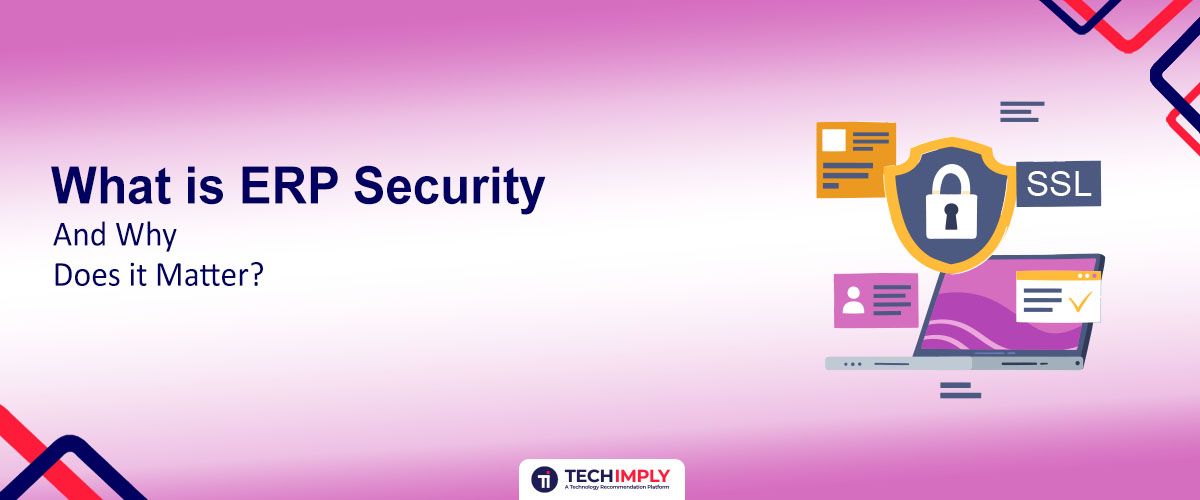
Having a strong digital infrastructure is the key to any successful modern enterprise. Erp security has become one of the major concerns of many business leaders who want to ensure that their most confidential organizational information is not accessed by unauthorized persons. Since an Enterprise Resource Planning system is the central point of all the financial records and other related information for the employees, it is the central nervous system of your company.

Looking for ERP Software?
Check out Techimply's List of the Best ERP Software in India. for your business.
The need to ensure the business can withstand advanced cyber attacks by developing an overall plan on erp cyber security. With erp security, you would secure your intellectual property and establish a culture of trust with your clients. Once you dive into the intricacies of system management, the ability to provide accessibility and simultaneously have a high level of rigor working to protect your systems becomes your greatest competitive edge.
What is ERP Security?
On the most basic level, erp security can be defined as the set of measures, tools, and protocols aimed at ensuring that an ERP system is not breached in data or illegally accessed by unauthorized individuals. It includes all that forms the physical hardware on which the software resides, up to the digital strata of erp application security. These systems are huge; therefore, security has to take into account different modules such as HR, finance, supply chain, and manufacturing.
Moreover, erp data security implies the maintenance of the accuracy, confidentiality, and availability of information stored in the database and accessible to authorized users. It does not concern only the blocking of hackers, it also touches on internal erp security and controls. An efficient security management allows a transparent and locked-down environment where data is allowed to flow to the relevant individuals without being seen by unauthorized ones.

Pro-tip
Carry out a standalone erp security audit at least annually. New professional eyes would also be able to pick up configuration errors or blind spots that your internal team may have missed.
Why ERP Security Matters More Than Ever?
The trend of interconnected business models has placed erp security management as one of the priorities of executives. ERP systems used to run on remote local servers and were more difficult to access remotely. Nevertheless, with the emergence of Cloud ERP, security and data privacy concerns, the situation has become different. Systems have become reachable through the web, and this makes the area that cybercriminals can attack even larger.
Failure to consider erp security and compliance may result in more than a short-term technical hitch. You are jeopardizing the very existence of your organization. New advanced ERP security threats are ransomware, which can encrypt all your supply chain, or man-in-the-middle attacks that intercept financial transactions. Thus, failing to consider security as a process, instead of as a one-time establishment, is a big Erp risk that any business in the present world cannot dare to risk taking.
The Critical Importance of Robust ERP Security
Investing in high-level erp security features provides a safety net for your daily operations. Let’s look at the core reasons why this protection is non-negotiable for your business.
1. Protecting Sensitive Data
Your ERP contains your crown jewels, trade secrets, customer credit card numbers, and strategic plans. ERP data security ensures that these assets stay within your digital walls. Without it, your proprietary information could end up in the hands of competitors or on the dark web.
2. Ensuring Business Continuity
A security breach often results in system downtime. If your ERP goes offline, your production stops, your shipments freeze, and your sales team cannot process orders. Robust erp cyber security acts as an insurance policy against these costly interruptions.
3. Complying with Regulations
Whether it is GDPR, HIPAA, or industry-specific mandates, erp regulatory compliance is mandatory. Failure to secure your data can lead to massive legal fines and government audits. Implementing an ERP security and compliance framework helps you meet these legal obligations automatically.
4. Preserving Reputation and Customer Trust
Customers share their data with you because they trust you to keep it safe. A public breach of your erp application security can shatter that trust instantly. Rebuilding a brand’s reputation takes years, whereas a single security failure takes only seconds.
5. Preventing Financial Losses
The direct costs of a breach, such as forensic investigations, legal fees, and ransom payments, are staggering. By focusing on erp security best practices, you avoid these astronomical expenses and keep your capital focused on growth.
Which are the Key Pillars of Effective ERP Security Strategy?
Building a secure environment requires a multi-layered approach. You cannot rely on a single firewall to do all the work. Instead, consider the essential pillars:
1. Strong Access Controls and Authentication
The first line of defense is erp access control. You must implement Multi-Factor Authentication (MFA) to ensure that users are who they say they are. Additionally, using the principle of least privilege ensures employees only have access to the data necessary for their specific roles.
2. Regular Updates and Vulnerability Management
Software providers frequently release patches to fix ERP security threats. If you delay these updates, you leave a back door open for attackers. Consistent ERP security management includes a strict schedule for testing and applying these updates.
3. Data Protection and Backup
Always encrypt your data both at rest (while stored) and in transit (while moving between users). Furthermore, maintain off-site backups so you can restore your system quickly if an Erp risk becomes a reality.
4. Continuous Monitoring and Incident Response
You need tools that monitor system logs for suspicious activity 24/7. An effective erp security and control strategy includes a clear plan for what to do the moment a threat is detected.
5. Employee Training and Awareness
Human error remains a leading cause of breaches. Regularly train your staff on how to spot phishing emails and the importance of ERP cybersecurity. A well-informed team is your strongest firewall.
6. Secure Integrations and Third-Party Management
Your ERP likely connects to shipping carriers, banks, and email platforms. Ensure these integrations follow strict erp security best practices so that a weakness in a third-party app doesn't compromise your main system.
7. Compliance and Regulatory Adherence
Map your security settings to specific legal requirements. Using erp security by industry standards ensures that a healthcare company meets medical privacy laws while a manufacturer focuses on supply chain integrity.
Do You Know?
Nearly 60% of ERP security breaches originate from internal sources, either through disgruntled employees or, more commonly, through accidental negligence and poorly managed erp access control.
Challenges in Implementing and Maintaining ERP Security
Achieving total security is a journey filled with hurdles. The global Enterprise Resource Planning (ERP) software market size was valued at USD 81.15 billion in 2024 and is projected to grow from USD 92.6 billion in 2025 to USD 229.79 billion by 2032, exhibiting a CAGR of 13.8% during the forecast period. Understanding these challenges allows you to prepare for them effectively.
1. Implementation Challenges
The initial setup phase is often where the most significant ERP application security vulnerabilities are born. If security is treated as an afterthought during implementation.
- Complexity of ERP Systems: Modern ERPs are massive ecosystems with thousands of configuration points. Navigating these complexities to ensure every module is locked down is a major hurdle. Often, the sheer volume of erp security features can overwhelm implementation teams, leading to default settings that are frequently exploited by hackers.
- Poor Software Fit and Inaccurate Requirements: If the chosen software does not align with your specific workflows, your team may implement workarounds that bypass standard ERP security and controls. When requirements are inaccurate, you might inadvertently grant too much access to certain roles, creating internal ERP security threats.
- Data Migration and Quality Issues: Moving data from legacy systems to a new Cloud ERP security and data privacy environment is a high-risk activity. If source data is dirty (containing duplicates or errors), it can corrupt the new system's logic. Furthermore, if the migration process itself isn't encrypted, sensitive information can be intercepted during the transfer.
- Insufficient Project Planning and Management: Without a dedicated focus on ERP security management, project timelines often squeeze out security testing in favor of meeting Go-Live dates. Poor management leads to scope creep, where new features are added hastily without a proper review of how they impact the overall erp cyber security posture.
- Lack of Testing: Testing is the most commonly skipped step. You must perform rigorous vulnerability assessments and penetration tests before the system goes live. Failing to test how the system handles unauthorized login attempts or SQL injection attacks leaves you flying blind against real-world ERP security threats.
2. Maintenance Challenges
Security does not end at launch; it is a continuous battle. Maintaining erp security requires a dedicated rhythm to combat the silent risks that grow over time.
- Outdated Software and Patch Management: One of the biggest maintenance challenges is keeping the system updated. Many organizations delay patches because they fear breaking their custom code. However, unpatched systems are the primary target for erp cyber security attacks.
- Inadequate Security Training and Awareness: Even the most advanced erp security management tools cannot stop an employee from clicking a phishing link. If your staff isn't regularly trained on erp security best practices, they remain your weakest link. Awareness must be treated as a recurring maintenance task, not a one-time orientation video.
- Managing User Access and Privileges: As employees change roles, get promoted, or leave the company, their ERP access control must be updated instantly. Privilege creep—where users accumulate access rights they no longer need, is a massive Erp risk. Regularly auditing these accounts is a tedious but vital part of erp security and controls.
- Evolving Threat Landscape: Cybercriminals are now using AI to find zero-day vulnerabilities in ERP platforms. This means your erp security strategy from last year might be obsolete today. Staying ahead requires continuous monitoring and a flexible response plan that evolves with new ERP security threats.
- Third-Party Integrations: Your ERP likely connects to external banks, shipping vendors, and CRM tools. Each of these connections is a potential entry point for attackers. Maintaining erp data security means you must constantly vet the security standards of every third-party application integrated into your hub.
Conclusion
To conclude, the erp security is not a luxury or an optional addition; it is the core need to do business in the year 2026. As much as you safeguard your finances, reputation, and future by giving erp data security a priority and remaining alert to ERP security threats. Although the difficulties of erp security management remain actual, the tranquility of having a secure system that is compliant with the regulations is worth the investment. Consistency is important whether you are examining your erp security as per industry-specific requirements or general ERP cybersecurity. Instead, take your ERP as a precious resource as it is, and it will keep your business running safely in the years to come.