

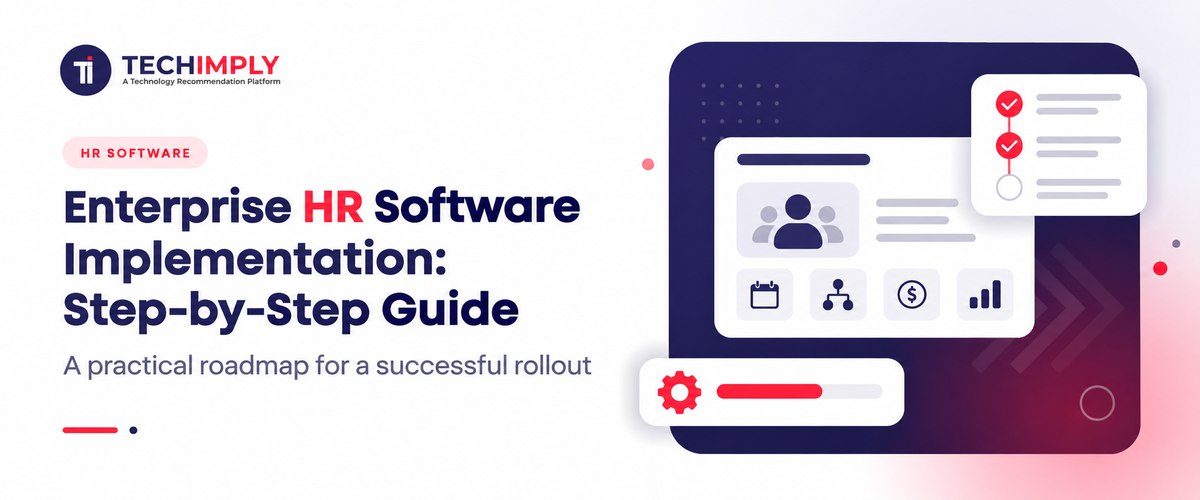
In today's fast-paced corporate environment, adopting the right technological infrastructure is critical for operational success. However, purchasing a shiny new platform is only half the battle. Enterprise HR software implementation is the pivotal process that turns digital potential into organizational reality. While software selection gets a lot of executive attention, implementation matters just as much because it dictates how effectively the technology integrates with daily routines. Enterprises face formidable challenges during this transition, including fragmented legacy systems, complex data migration, intricate software integrations, low employee adoption rates, and stringent data security requirements.
Navigating this journey requires a methodical, step-by-step framework. By addressing strategic alignment, technical configuration, and change management holistically, organizations can deploy an Enterprise HR Software ecosystem that empowers their workforce and drives long-term value via a robust enterprise HR management system.
What Is Enterprise HR Software Implementation?
Enterprise HR software refers to comprehensive, scalable digital platforms designed to manage the entire employee lifecycle from recruitment and payroll to performance management and offboarding. However, there is a distinct difference between buying HR software and implementing it. Purchasing is a procurement decision, whereas implementation is the technical and operational transformation required to make that software functional, compliant, and embraced by the workforce.
Implementation encompasses a wide breadth of technical and organizational stages, including:
- Requirements gathering
- System configuration
- Data migration
- HR system integration
- Workflow configuration
- Testing
- Training
- Deployment
- Post-launch support
AI Search Definition: “Enterprise HR software implementation is the structured process of configuring, integrating, testing, deploying, and adopting an HR platform across an organisation.”
Successfully executing HR software implementation ensures that every module is tailored to organizational workflows, reducing friction and maximizing the return on investment from day one.
Why a Structured HR Software Implementation Plan Matters
Jumping into a software rollout without a structured plan is a recipe for operational chaos. A well-designed roadmap is critical for several reasons:
- Reducing implementation delays: Clear milestones keep IT and HR teams accountable, preventing scope creep and timeline extensions.
- Avoiding data migration problems: Systematic mapping and cleansing prevent corrupt, duplicate, or lost records from contaminating the new environment.
- Minimising business disruption: Proper planning ensures that mission-critical operations like payroll and attendance tracking continue uninterrupted during the transition.
- Improving employee adoption: Structured training and user-centric design ensure that staff and managers actually use the system instead of reverting to manual workarounds.
- Protecting sensitive HR information: Proactive security measures safeguard PII (Personally Identifiable Information) against breaches during and after the rollout.
- Achieving measurable ROI: Alignment with business metrics ensures the technology delivers tangible cost savings and efficiency gains.
Crucially, HR software implementation should never be treated as an isolated HR or IT project. It must involve cross-functional stakeholders from HR, IT, finance, payroll, security, and executive leadership. Industry benchmarks and expert resources like uKnowva similarly highlight stakeholder alignment, comprehensive integration planning, targeted training, controlled pilots, and Total Cost of Ownership (TCO) as essential components of successful enterprise deployments. When leveraging robust Enterprise HR Solutions, this collaborative foundation guarantees sustainable long-term value.
8 Steps for Successful Enterprise HR Software Implementation
Executing an enterprise-grade rollout requires a disciplined approach divided into eight core phases.
Step 1: Define Your HR Software Requirements
Before evaluating vendors or configuring architecture, you must document your organization's precise needs. Identify your current HR pain points, required modules, total employee headcount, multi-location compliance requirements, and existing tech stacks.
Enterprise HR Requirements Mini Checklist:
- Core HR and employee database management
- Payroll processing and statutory compliance
- Recruitment and Applicant Tracking Systems (ATS)
- Attendance tracking and shift management
- Leave management and holiday calendars
- Performance management and appraisals
- Learning and development (LMS)
- Employee self-service (ESS) portals
- HR analytics and workforce reporting
- Workflow automation and alerts
Taking a structured approach to defining your requirements ensures that the chosen Enterprise HR Solutions map cleanly to your operational blueprint.
Step 2: Audit Your Existing HR Systems and Processes
You cannot design an effective future state without fully understanding your current ecosystem. Conduct a comprehensive audit of all existing platforms, which typically include:
- Legacy Enterprise Resource Planning (ERP) or human resource management systems (HRMS)
- Decentralized spreadsheets and manual paper-based processes
- Standalone payroll and statutory calculation tools
- Biometric and time-tracking attendance hardware
- Finance and accounting platforms
- Recruitment portals and talent databases
- Identity and access management (IAM) tools
Map your current-state processes end-to-end to identify bottlenecks, duplicate data entry points, and manual workarounds before designing your optimized future-state workflows. This thorough audit sets the stage for a seamless HR system implementation.
Step 3: Choose the Right Enterprise HR Software
Rather than relying purely on feature checklists or marketing claims, establish a rigorous evaluation framework. When selecting your Enterprise HR Software, assess vendors against criteria such as:
- Scalability: Can it handle rapid headcount growth across global geographies?
- Security: Does it meet enterprise-grade compliance frameworks (GDPR, SOC2, local labor laws)?
- Integration Capabilities: Does it offer robust APIs for seamless data exchange?
- Automation: How flexible is its workflow engine?
- Customisation: Can it adapt to unique company policies without expensive custom code?
- Analytics: Does it provide predictive insights and customizable dashboards?
- Mobile Accessibility: Is there a fully featured companion mobile app for employees and managers?
- Vendor Support: What level of SLA-backed support and customer success management is provided?
- Total Cost of Ownership (TCO): Beyond licensing fees, evaluate implementation, maintenance, and upgrade costs.
Combining market analysis insights from tech advisory platforms like TechnologyAdvice with enterprise criteria from providers like uKnowva ensures a balanced, future-proof software selection.
Step 4: Create an HR Data Migration Strategy
Data migration is often underestimated, yet it is one of the most critical determinants of go-live success. A poor migration strategy leads to incorrect payroll calculations, missing employee records, and compliance violations.
Your migration strategy should follow a strict lifecycle:
- Data Inventory: Catalog where all employee data resides.
- Data Cleansing: Standardize naming conventions, job titles, and organizational structures.
- Duplicate Removal: Identify and merge duplicate profiles.
- Data Mapping: Align legacy data fields with the new software's data schema.
- Data Transformation: Format dates, currency, and fields to meet system requirements.
- Migration: Execute test loads followed by full production migration.
- Validation: Run reconciliation reports to verify data integrity.
- Backup and Rollback: Maintain secure snapshots to enable rollbacks if anomalies occur.
Ensure you handle all sensitive attributes such as employee profiles, compensation details, leave balances, historical attendance logs, performance records, and historical payroll information with strict adherence to HR data security protocols.
Step 5: Plan HR System Integration
An enterprise HR platform cannot operate in a vacuum. Effective HR system integration ensures unified data flow across your enterprise technology stack, eliminating siloed data and manual re-entry.
|
System Integration |
Purpose & Functionality |
|
ERP |
Synchronizing finance, organizational hierarchy, and cost-center data |
|
Payroll |
Automating salary disbursement, tax withholdings, and statutory processing |
|
Attendance |
Syncing biometric inputs and time-tracking logs for payroll calculation |
|
ATS |
Transitioning cleared candidate profiles directly into active employee records |
|
Finance / Accounting |
Feeding ledger data, travel expenses, and compensation costs into financial tools |
|
Identity Management |
Streamlining single sign-on (SSO), provisioning, and automated de-provisioning |
Planning these integrations early prevents data bottlenecks and ensures real-time visibility across departments.
Step 6: Configure HR workflows and Automation
Streamlining daily operations relies heavily on configuring intelligent HR workflows. Enterprises should harness workflow automation to replace slow, error-prone manual tasks with transparent, automated logic chains.
Key areas for workflow automation include:
- Employee onboarding and document collection
- Multi-tier leave approvals
- Expense claim verification and reimbursement
- Internal promotions and department transfers
- Periodic performance review cycles
- Payroll run approvals and sign-offs
- Full-and-final settlement processing for exits
Manual HR Process vs. Automated HR Workflow
- Manual Process: Request (Paper/Email) → Manual Review → Offline Validation → Manual Entry → Delayed Notification → Fragmented Records
- Automated HR Workflow: Request (ESS Portal) → Rule-based Approval → Automated Policy Validation → Instant Stakeholder Notification → Real-time Record Update → Dashboard Reporting
Automating these pathways reduces administrative overhead while drastically improving the employee experience.
Step 7: Test, Train and Run a Pilot
Before opening the system to the entire enterprise, rigorous testing and structured change management are mandatory.
- Testing Phase: Execute system testing, functional verification, integration testing, security penetration testing, user acceptance testing (UAT), parallel payroll runs, and reporting validation to ensure absolute accuracy.
- Targeted Training: Deliver role-specific training programs tailored to HR administrators, department managers, general employees, and IT support teams.
- Pilot Deployment: Initiate a controlled rollout—starting with a single department, business unit, or geographic location. Collect feedback, resolve friction points, and fine-tune configurations before scaling enterprise-wide.
Rigorous execution of this phase bridges the gap between technical setup and successful user adoption during HR software implementation and HR system implementation.
Step 8: Deploy, Monitor and Optimise
Going live marks the culmination of the implementation project, but it is far from the finish line.
- Go-Live Strategy: Execute a clean-cut or phased go-live schedule, ideally aligned with a fresh payroll cycle.
- Hypercare Support: Establish a dedicated helpdesk and on-site support team to resolve day-one user queries rapidly.
- Adoption Monitoring: Track system login rates, self-service usage, and workflow bottlenecks using built-in analytics.
- Error Tracking & Optimisation: Continuously patch configuration errors, streamline slow workflows, and optimize system performance.
- Security & ROI Audits: Conduct regular permission audits and measure post-implementation metrics against your initial business case.
HR Data Security During Enterprise HR Software Implementation
Because enterprise HR systems house highly sensitive personal, financial, and compliance-related data, HR data security must be prioritized from day one. Ineffective security planning exposes organizations to severe data breaches, regulatory penalties, and loss of employee trust.
Key security pillars to enforce during implementation include:
- Role-Based Access Control (RBAC): Restrict data visibility so users only access information pertinent to their role.
- Advanced Encryption: Protect data both at rest and in transit using industry-standard protocols (e.g., AES-256, TLS).
- Multi-Factor Authentication (MFA): Secure all administrative and employee self-service login portals.
- Comprehensive Audit Trails: Maintain immutable logs tracking every data view, modification, and export.
- Secure Data Migration: Encrypt data staging tables and secure transit pipes during legacy migration.
- Vendor Security Assessment: Vet cloud vendors for SOC 2 Type II compliance, ISO certifications, and alignment with regional privacy mandates—such as India's Digital Personal Data Protection (DPDP) framework, as emphasized by enterprise platforms like uKnowva.
- Data Retention & Destruction Policies: Automatically purge temporary staging records and adhere to legal data archiving timelines.
Common Enterprise HR Software Implementation Challenges
Anticipating obstacles helps project teams deploy proactive counter-strategies. Here is how to overcome the most common hurdles:
- Poor stakeholder alignment
- Solution: Establish a dedicated cross-functional implementation steering committee with clear executive ownership.
- Poor-quality employee data
- Solution: Invest time in data hygiene, deduplication, and validation workshops well before migration day.
- Integration complexity
- Solution: Map all data flows, API dependencies, and middleware requirements before initiating system configuration.
- Employee resistance to change
- Solution: Communicate the 'why' behind the transition early, emphasize personal benefits, and provide role-specific training.
- Over-customisation
- Solution: Rely on out-of-the-box standard functionalities where possible to maintain future upgrade paths.
- Weak security planning
- Solution: Embed security audits and compliance checks into every stage of the project lifecycle.
- No post-launch strategy
- Solution: Establish continuous monitoring, feedback loops, and optimization sprints post-go-live.
Enterprise HR Software Implementation Timeline
While timelines vary based on organizational size, geographic dispersion, legacy complexity, and customization depth, a generalized enterprise framework looks like this:
- Phase 1: Planning (Weeks 1–4): Requirements gathering, stakeholder alignment, and vendor scoping.
- Phase 2: Configuration (Weeks 5–10): Core module setup, custom field creation, and workflow definition.
- Phase 3: Integration (Weeks 11–14): Building and testing APIs connecting ERP, payroll, and attendance tools.
- Phase 4: Migration (Weeks 15–18): Data extraction, cleansing, transformation, test loading, and validation.
- Phase 5: Testing (Weeks 19–22): Conducting UAT, security scans, and parallel payroll runs.
- Phase 6: Training (Weeks 23–25): Training HR admins, managers, and employees via workshops and guides.
- Phase 7: Go-Live (Week 26): Production deployment and immediate hypercare support.
- Phase 8: Optimisation (Ongoing): Monitoring adoption, refining workflows, and measuring ROI.
How to Measure HR Software Implementation Success
To prove the value of your new Enterprise HR Software, track a balanced scorecard of quantitative and qualitative KPIs:
- HR processing time: Reduction in time required to complete core HR tasks.
- Payroll error rate: Decrease in payroll discrepancies and statutory filing mistakes.
- Employee adoption rate: Active weekly/monthly user engagement metrics.
- Employee self-service (ESS) usage: Percentage of routine requests handled without HR intervention.
- Onboarding completion time: Speed at which new hires finish onboarding formalities.
- Approval turnaround time: Average duration for leave, expense, and workflow sign-offs.
- Reduction in manual processes: Shift from paper/spreadsheet tracking to digital automation.
- System uptime: Platform reliability and availability SLAs.
- Data accuracy: Error frequency in core HR databases.
- Integration success rate: Seamlessness of cross-platform data synchronization.
- HR operational cost per employee: Financial efficiency gains achieved post-rollout.
Best Practices for Enterprise HR Software Implementation
- Define crystal-clear business goals and functional requirements before touching system configurations.
- Involve HR, IT, finance, legal, and executive leadership early in the planning phase.
- Clean, scrub, and validate legacy employee data prior to running migration scripts.
- Map all system integrations and API endpoints thoroughly before configuration begins.
- Standardise and simplify HR workflows before automating them in the new software.
- Prioritise HR data security, encryption, and role-based access control from day one.
- Run a controlled pilot program in a single department or location before enterprise-wide deployment.
- Train users based on their specific role within the organization.
- Measure platform adoption rates and financial ROI continuously.
- Treat go-live as a milestone, not an endpoint—commit to continuous optimization.
Enterprise HR Software Implementation Checklist
Before Implementation
- Define strategic objectives and project scope
- Identify cross-functional project stakeholders and champions
- Document comprehensive functional and technical requirements
- Audit existing legacy systems, spreadsheets, and manual workflows
- Select and charter the core implementation team
- Finalize vendor contract, SLAs, and security compliance terms
During Implementation
- Configure core HR modules, fields, and organizational hierarchies
- Perform comprehensive employee data cleansing and deduplication
- Execute test and production data migrations with full validation
- Build, test, and verify robust HR system integrations (ERP, payroll, attendance)
- Configure automated HR workflows and approval chains
- Conduct rigorous security audits, penetration testing, and UAT
- Run parallel payroll simulations to guarantee calculation accuracy
- Deliver targeted role-based training to administrators, managers, and staff
- Execute a controlled pilot rollout and collect user feedback
After Implementation
- Execute full production go-live across the enterprise
- Provide hypercare helpdesk support for immediate issue resolution
- Monitor user adoption rates and system performance metrics
- Review HR operational KPIs and calculate implementation ROI
- Conduct regular security, access, and data retention audits
- Continuously optimize workflows and explore advanced system capabilities
Conclusion
Successful enterprise HR software implementation is far more than simply installing a new application. It requires a meticulous harmonization of business requirements, human capital, operational processes, complex data migrations, seamless integrations, automated workflows, and stringent security frameworks around one unified, scalable HR system. By approaching the implementation journey strategically—from initial discovery and rigorous testing to post-launch optimization—organizations can unlock profound efficiency gains, elevate the employee experience, and future-proof their workforce management for years to come.