Chennai-based store owner maintains a WhatsApp broadcast list of clients' birthdays, which she uses as her CRM. Three months later, the sales team is still operating off a spreadsheet since the platform was never designed for that function across the nation; a Bengaluru B2B services provider enrolls in a glossy marketing automation tool, expecting it also to run the sales process.
Though striving for more orderly development and a better customer experience, both companies are reaching for instruments meant to address two sides of the same issue. People often combine CRM software and marketing automation because both handle customer data and claim to increase sales. However, they are not interchangeable, and choosing the wrong one first is a common, avoidable error for a developing Indian company.
What Is CRM Software?
CRM Software is designed to put all of your relationship-related activity in one place, including information about prospects, customers, accounts, conversations, and deals. Customer relationship management, or CRM, is the application of technologies and processes used by companies to oversee customer relationships over the whole lifecycle.
A typical CRM platform can help a sales team:
- Store contact and company information
- Track leads and opportunities
- Manage sales pipelines
- Record calls, emails, and meetings
- Schedule follow-ups
- Monitor deal progress
- Manage account information
- Coordinate customer support and service activity
For instance, the CRM should provide the second employee enough background to carry on the relationship without beginning from zero, should a salesperson speak with a prospect on Monday and another employee pick up the discussion on Friday.
That is the central strength of CRM Software: creating a shared record of the relationship. CRM Software can give companies still running leads through spreadsheets, email, or distributed messaging apps a far more organized approach to handling client information.
What Is Marketing Automation?
The use of predetermined rules and customer actions automates repetitive marketing tasks in Marketing automation. Instead of a marketer physically sending out every email or incorporating every lead into swag, Marketing Automation Software can automate those tasks.
For example:
- A visitor fills out a website form.
- The system adds the contact to a specific audience.
- The contact receives a welcome email.
- Additional messages are sent based on engagement.
- A lead score changes after important interactions.
- A qualified lead can then be passed to sales.
This is where workflow automation becomes particularly useful. Once a marketing team develops a sequence, the system can run it automatically whenever the required conditions are met.
Furthermore helping with segmentation, email campaigns, landing pages, lead scoring, campaign tracking, and other tasks is marketing automation. Similarly, Salesforce defines automation around tasks like lead routing and email campaigns as a technique to trigger actions depending on consumer behavior.

Pro-tip
Before you start looking at different companies, find out how many new leads your business gets in a normal month and how many of them one person could actually follow up with on their own. Usually, that statistic alone helps you to decide if marketing automation is worthwhile adding now or if a decent CRM is still the greatest need.
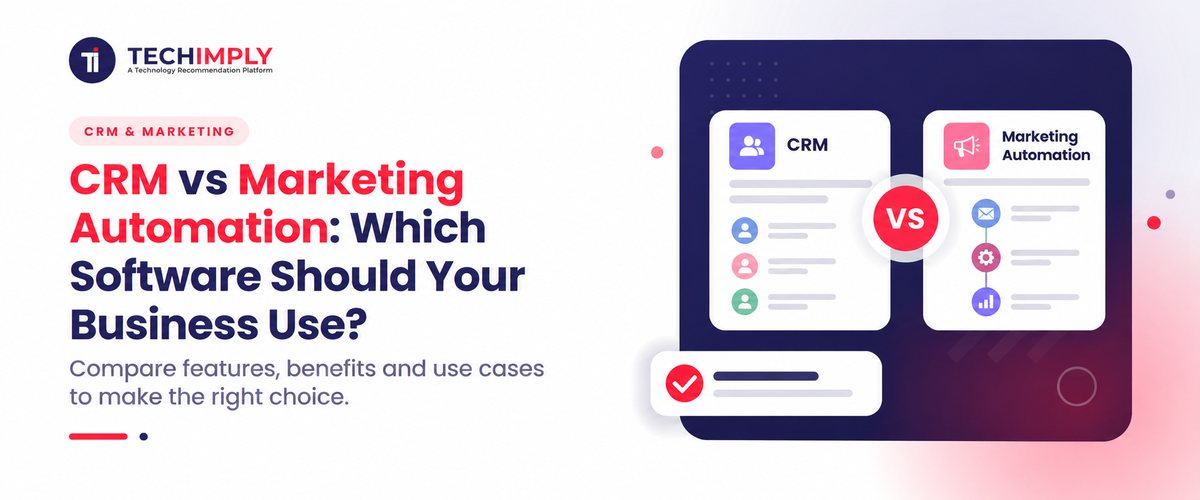
CRM vs Marketing Automation: What Is the Real Difference?
Comparing CRM vs marketing automation enables users to understand the intended use of each system in their respective fields.
|
Area |
CRM |
Marketing Automation |
|
Main focus |
Customer relationships and sales |
Marketing campaigns and lead nurturing |
|
Primary users |
Sales, service, account teams |
Marketing teams |
|
Core data |
Contacts, accounts, deals, interactions |
Campaigns, engagement, segments, responses |
|
Strongest stage |
Sales, retention, and ongoing relationships |
Lead generation and nurturing |
|
Common automation |
Follow-ups, task assignment, lead routing |
Email sequences, segmentation, lead scoring |
|
Main question |
Who is the customer, what has happened with them, and what should sales/service do next? |
Which prospects should receive what communication, when, and based on which behavior? |
A CRM Software platform generally becomes the operational record for a customer relationship. Marketing automation works more heavily around engaging prospects and moving them toward sales readiness. This distinction is also reflected in current CRM and marketing automation comparisons. They work best when information moves between them.
Why This Gets Blurrier for Indian Businesses Specifically
Most CRM vs marketing automation comparisons are created with a desk-based, email-first, one lead source at a time Western sales stack in mind. Most Indian small and medium-sized businesses don't operate that way. As the primary route for both attracting prospects and driving overall lead management, WhatsApp means that a single instrument connected to it might wind up handling parts of both tasks at once: automated broadcast messages resembling marketing automation and a shared inbox operating like a small CRM.
A small business really benefits from this, but it also blurs the line for decisions. A store that uses WhatsApp for holiday campaigns and keeps track of what customers like in the same tool may not need a different, devoted marketing automation platform for a while. A B2B firm selling into enterprise accounts, on the other hand, usually still needs a proper CRM for deal tracking even if marketing automation stays basic for longer.
When a Business Only Needs One of the Two
A very early-stage business with a short sales cycle and a small number of leads a month often does fine with just a CRM, sometimes even a free or low-cost one. There simply is not enough lead volume yet to justify a dedicated marketing automation software subscription. If a business is still focused primarily on awareness and has relatively few leads, it may not need a dedicated marketing automation platform yet. Basic CRM and email marketing capabilities may be enough until lead volume and campaign complexity increase.
When selecting a CRM solution for small businesses in India, considerations must be taken into account, such as its ability to handle WhatsApp on the phone, lack of fidelity desk connectivity, and the feasibility of setting up without an implementation partner. If that assessment points to needing support, outside implementation help can cover the setup instead.
How CRM and Marketing Automation Work Together
Most businesses that grow past a certain size eventually need both, connected rather than separate. Marketing automation attracts and nurtures a lead through content and campaigns, tracks marketing attribution back to the channel that actually generated it, and hands off a sales-ready lead to the customer relationship management system once it is qualified. The CRM then takes over for the one-to-one relationship, the negotiation, the actual close.
Done well, this handoff also strengthens customer experience and customer loyalty later, since a customer's marketing history is not lost the moment they become a paying customer, and repeat engagement, customer loyalty activity, or customer feedback collected after the sale can flow back into future campaigns. A sales CRM paired with an AI CRM layer can even flag which loyal customers are worth a personal check-in versus another automated email.
More and more systems now try to close this gap directly, either with an all-in-one marketing platform that combines lighter versions of CRM and marketing automation under one login or with a customer data platform that combines records across both tools. Though they occasionally give away depth in exchange for that convenience, these can be rather beneficial for a small team wanting to avoid two distinct memberships and two distinct logins.
Do You Know?
A lot of modern CRM and marketing automation platforms have included AI capabilities for tasks like lead scoring, content assistance, customer-data analysis, and interaction summaries. These tools are highly sought-after in the market today. The features of each product differ significantly.
How to Decide Which to Buy First
Buying the most programs is not the aim right now. It's to clear the roadblock right now slowing development. A basic decision structure will help to simplify the decision-making process.
Choose CRM first if your biggest problem is:
- Missed sales follow-ups
- Poor pipeline visibility
- Disorganized customer records
- Weak account management
- Inconsistent customer service
Choose marketing automation first if your biggest problem is:
- Too many manual campaigns
- Poor lead nurturing
- Large prospect databases
- Repetitive marketing tasks
- Limited campaign personalization
Consider both if:
- Marketing generates more leads than sales can manually manage
- Sales needs visibility into campaign engagement
- Multiple teams interact with the same customers
- You need better reporting from first touch to closed deal
If you are struggling to manage existing leads and customers, start with CRM. If you are struggling to manage a growing volume of prospects and campaigns, start with marketing automation.
A Practical Example for a Business
Imagine an Indian SaaS business providing accounting software to companies of modest to medium size. Its marketing staff manages search campaigns, email newsletters, webinars, and downloadable resources. Every month, the business gets hundreds of leads. Segmentation of these leads and care based on their interests can be done by marketing automation.
The system can then pass that information to the CRM when a potential customer views the pricing page several times, participates in a product webinar, and asks for a demonstration. Then, before getting in touch, the sales representative has a better sense of the prospect. The CRM can assist with account management following the transaction, and automation can help with onboarding and renewal correspondence. This arrangement sees marketing, sales, and service as linked activities rather than as distinct ones.
Conclusion
The problem you are aiming to fix will help you to choose between marketing automation and CRM. Start with CRM Software if your sales staff has to better handle relationships, opportunities, follow-ups, and client history. If your marketing team is having trouble with segmentation, lead nurturing, repetitive campaigns, and a large number of prospects, marketing automation could be a better beginning. Using both helps companies with more involved sales and marketing procedures to better link campaigns with income. The key thing is to stay away from purchasing software just because it boasts a lengthy list of features.
Related Reads :
- Top 5 Salesforce Consulting Partners in the USA for Smarter CRM Growth in 2026
- Best AI CRM Platforms in 2026: Features, Pricing & Tools
- 7 Best WhatsApp CRM Tools for Business in 2026
- B2B CRM Software: Features, Benefits & How to Choose
- What Is a Sales CRM in 2026? Features, Benefits & Guide
- CRM Automation Workflows to Increase Conversions in 2026