WhatsApp may begin as a simple customer messaging channel, but it becomes much harder to manage once a business has multiple salespeople, growing lead volumes, support requests, several accounts, and customers across different markets.
At that stage, WhatsApp CRM software can help turn scattered conversations into a more organized workflow. Instead of relying on individual chat histories, teams can connect WhatsApp conversations with customer records, lead ownership, follow-ups, automation, and collaboration.
The right platform depends on what a business actually needs. Some companies want to generate and follow up with international sales leads. Others need a shared customer service inbox, marketing automation, e-commerce workflows, or a way to connect WhatsApp with an existing CRM.
Here are seven WhatsApp CRM tools worth considering in 2026, including where each platform is strongest and where another approach may be a better fit.
What Is a WhatsApp CRM?
A WhatsApp CRM is a customer relationship management system designed to bring more structure to conversations happening through WhatsApp.
A basic WhatsApp Business setup may work well when one or two people handle a manageable number of chats. As the business grows, common problems start appearing:
- leads are forgotten;
- two employees contact the same customer;
- follow-ups happen inconsistently;
- customer information remains fragmented;
- managers cannot easily see who owns each conversation;
- staff switch between several WhatsApp accounts;
- sales and support teams lack shared customer context.
Depending on the platform, a WhatsApp CRM may add lead management, shared inboxes, automation, sales pipelines, AI assistance, customer assignment, integrations, analytics, or multi-account management.
The important point is that these products do not all solve the same problem in the same way.
7 WhatsApp CRM Tools to Consider in 2026
1. WADesk: Best for International Sales and Multi-Account WhatsApp Management
WADesk is an AI-powered WhatsApp CRM built around businesses that use WhatsApp as a major channel for overseas lead generation, sales follow-up, and customer management.
It is particularly relevant to exporters, manufacturers, cross-border companies, and B2B teams communicating with buyers across multiple countries and languages. The platform combines lead management, customer conversations, sales follow-ups, AI assistance, translation, and team collaboration.
One important distinction is its desktop client + Web team backend model.
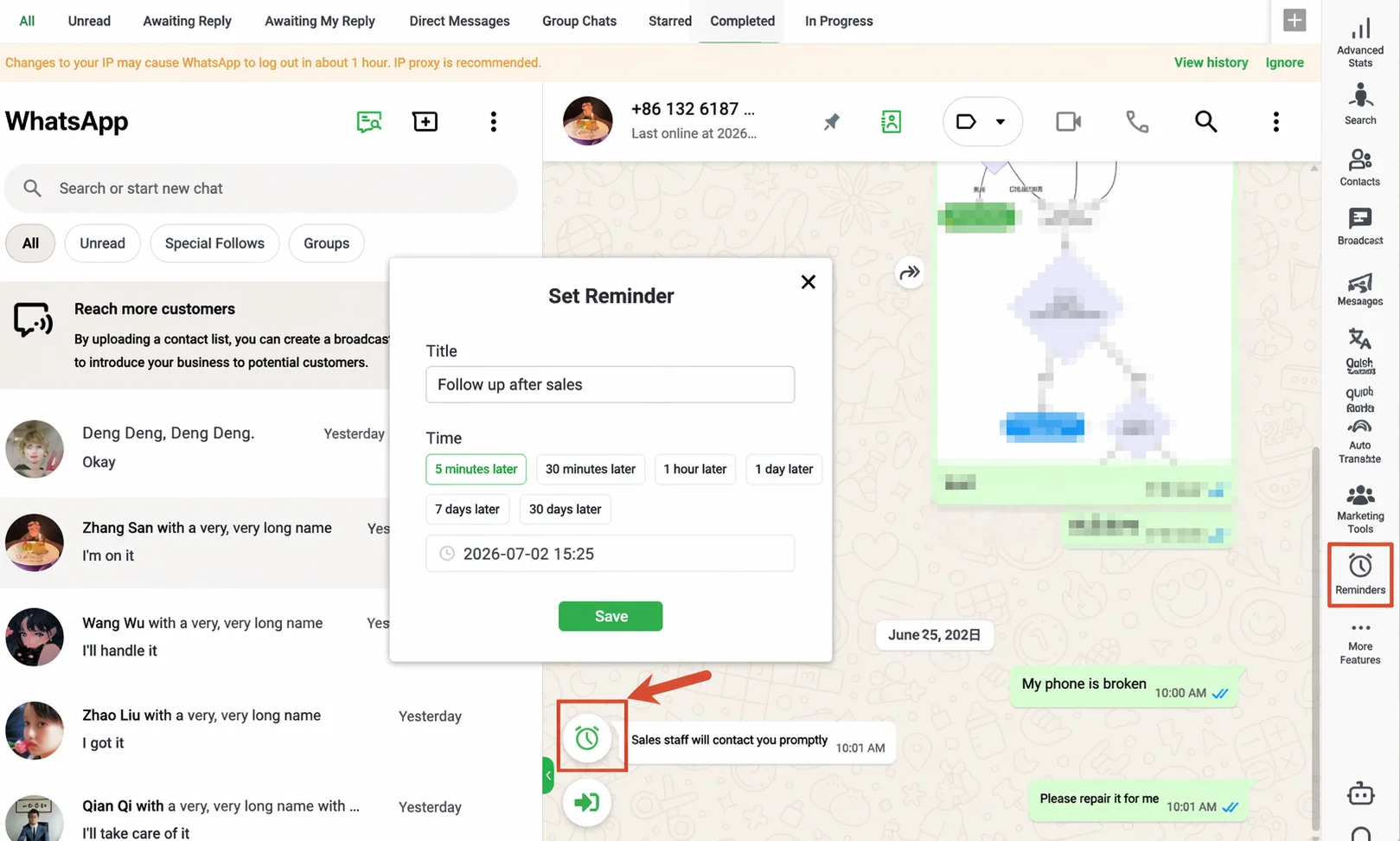
Sales and operations staff use the desktop client for day-to-day WhatsApp work, including customer conversations, multiple account management, translation, lead follow-up, and other sales activities. Managers can use the Web-based team backend to configure members, departments, roles, permissions, account resources, and other team-level controls. WADesk describes this as a dual-end architecture that separates daily execution from team management while keeping both within the same workflow.
Where WADesk Stands Out
Multi-account sales operations: Sales teams can manage multiple WhatsApp accounts without repeatedly switching between separate sessions.
International communication: Real-time translation can reduce friction when representatives communicate with buyers across languages.
AI-assisted sales: Reply assistance, automated responses, knowledge-based chatbots, and follow-up automation can reduce repetitive work.
Customer continuity: Centralized customer information and conversation history make it easier to transfer relationships when responsibilities or employees change.
Lead development: WADesk also supports prospect discovery and WhatsApp lead-development workflows, making it more sales-oriented than tools focused primarily on incoming customer conversations.
Potential drawback: WADesk is most suitable when WhatsApp itself sits at the center of a multi-account sales and customer-development workflow. A company whose main requirement is traditional customer service ticketing, formal help-desk queues, SLA management, or complex support escalation may prefer a platform designed more specifically around standard service-desk operations.
Best suited for: International sales teams, exporters, manufacturers, B2B companies, and organizations managing multiple WhatsApp accounts.
2. Respond.io: Best for Omnichannel Conversations Around an Existing CRM
Respond.io is better described as a customer conversation management platform than a traditional standalone CRM.
It connects WhatsApp with other communication channels while working alongside CRM systems such as HubSpot, Salesforce, and Zoho. The platform provides shared conversations, workflows, routing, lead qualification, AI Agents, and omnichannel communication. Respond.io itself explicitly states that it complements rather than replaces a full CRM.
This is useful for companies that already have customer and deal data stored elsewhere but need a stronger conversation layer.
Potential drawback: Because respond.io is designed to sit alongside an existing CRM, companies looking for one standalone system to replace both their CRM and messaging environment may still need additional integrations. Its architecture is also closely tied to WhatsApp Business Platform/API workflows, which can be more involved than lightweight WhatsApp Web-based setups.
Best suited for: Mid-market teams using multiple customer channels and organizations with an established CRM.
3. Wati: Best for WhatsApp API Automation and Shared Customer Communication
Wati focuses strongly on business communication and automation around WhatsApp.
Its platform includes a shared team inbox, assignments, chatbots, AI assistance, real-time translation, automation, campaign tools, and a built-in CRM with sales pipeline functionality. It has also expanded into additional messaging channels.
This makes Wati relevant when marketing, sales, and customer support all need to work around structured WhatsApp communication.
Potential drawback: Its increasingly broad engagement platform may be more functionality than a small team needs if the goal is simply to organize a few WhatsApp sales accounts. Some multichannel inbox capabilities are also tied to higher plan levels, so teams should compare required features and plan structure before adopting it.
Best suited for: Businesses using WhatsApp Business Platform for campaigns, automation, sales, and shared customer service.
4. Interakt: Best for Conversational Sales and E-Commerce
Interakt combines WhatsApp communication with sales CRM and commerce-oriented workflows.
Its Sales CRM supports lead capture, qualification, automatic assignment, customer records, pipeline management, follow-ups, broadcasts, and payments. The platform focuses heavily on moving prospects through a conversational sales journey across WhatsApp and Instagram.
This can work particularly well when customer conversations are closely connected to product enquiries, transactions, and repeat engagement.
Potential drawback: Interakt's strongest positioning is around WhatsApp and Instagram-driven sales and commerce. Companies requiring a broader enterprise CRM covering complex account management, extensive non-messaging workflows, or many unrelated communication channels may need additional systems around it.
Best suited for: E-commerce companies, SMBs, conversational sales teams, and businesses selling through WhatsApp and Instagram.
5. Kommo: Best for Combining WhatsApp With a Traditional Sales Pipeline
Kommo approaches WhatsApp from the perspective of a broader sales CRM.
It combines WhatsApp and other customer channels with lead management, pipeline stages, automation, AI responses, follow-ups, and a unified inbox. Teams can work from one number or manage multiple WhatsApp numbers and associate them with pipelines.
This can be useful when the company wants opportunities, pipeline stages, and deal management to remain at the center of the sales process.
Potential drawback: Kommo is more CRM-centric than WhatsApp-centric. A sales team whose employees spend most of their time working directly across many WhatsApp accounts may need to adapt its workflow around Kommo's pipeline structure rather than simply extending its existing WhatsApp working habits.
Best suited for: Sales teams that want traditional pipeline management combined with WhatsApp and messaging automation.
6. SleekFlow: Best for Omnichannel Sales and Customer Engagement
SleekFlow brings WhatsApp, Instagram, Facebook Messenger, and other communication channels into a centralized environment.
Its platform combines a shared inbox, built-in customer profiles, automation, broadcasts, AI, conversation assignment, and CRM integrations. Its WhatsApp offering also includes functions such as shared inboxes, WhatsApp Flows, drip campaigns, and integrations with platforms such as Salesforce, HubSpot, and Shopify.
This makes it relevant for businesses whose customer journeys regularly move between messaging, commerce, sales, and support.
Potential drawback: The omnichannel approach can be more extensive than necessary for a business that operates almost entirely through WhatsApp and mainly needs straightforward multi-account sales management. Teams should consider whether they will actually use the additional channel and customer-engagement infrastructure.
Best suited for: Retail, e-commerce, sales, and support teams managing customers across several digital channels.
7. WAPlus: Best for Lightweight WhatsApp Web CRM Productivity
WAPlus takes a browser-focused approach.
It adds CRM and productivity functionality directly around WhatsApp Web, including chat and contact organization, notes, labels, team workflows, automation, bulk messaging, and CRM integrations.
For individual salespeople and smaller teams, this can provide a relatively direct way to add structure without implementing a larger customer engagement platform.
Potential drawback: Its WhatsApp Web and browser-extension orientation makes it particularly convenient for lightweight workflows, but organizations requiring more centralized enterprise governance, formal service operations, or a larger API-first communications architecture may prefer a more centrally managed platform.
Best suited for: Individuals and smaller teams looking to add CRM and productivity tools around WhatsApp Web.
Quick WhatsApp CRM Comparison
|
Platform |
Best For |
Product Approach |
Main Strength |
Potential Limitation |
|
WADesk |
International and B2B sales |
Desktop client + Web team backend |
Multi-account sales, translation, AI, customer control |
Less focused on traditional help-desk ticketing |
|
Respond.io |
Mid-market omnichannel teams |
Conversation layer + existing CRM |
CRM connectivity, messaging and AI |
Often relies on an existing CRM/API setup |
|
Wati |
WhatsApp API teams |
Customer engagement platform |
Automation, campaigns and shared inbox |
Can be broader than lightweight sales teams need |
|
Interakt |
E-commerce and SMB sales |
WhatsApp/Instagram Sales CRM |
Conversational selling and commerce |
Less suited to complex enterprise-wide CRM use cases |
|
Kommo |
Pipeline-driven teams |
Full sales CRM |
Pipeline and messaging automation |
More CRM-centric than WhatsApp-native |
|
SleekFlow |
Omnichannel sales and support |
Omnichannel engagement platform |
Multi-channel customer journeys |
May be more platform than WhatsApp-only teams need |
|
WAPlus |
Smaller WhatsApp Web teams |
Browser-based CRM tools |
Lightweight adoption and productivity |
Less oriented toward centralized enterprise operations |
How to Choose the Best WhatsApp CRM for Your Business
The best platform depends less on how many features it offers and more on the operating problem the business is trying to solve.
Start With Your Primary Use Case
An export company may use WhatsApp to find buyers, answer enquiries, send quotations, and manage long B2B follow-up cycles.
An e-commerce company may care more about product enquiries, campaigns, payments, and repeat purchases.
A customer service organization may prioritize shared queues, assignment, escalation, response monitoring, and support history.
These are different requirements even though all three businesses use WhatsApp.
Separate Sales Requirements From Support Requirements
Sales teams often prioritize:
- lead ownership;
- follow-up;
- pipeline visibility;
- prospect qualification;
- quotations;
- customer handovers.
Support teams may prioritize:
- shared conversations;
- assignment;
- response standards;
- escalation;
- workload distribution;
- ticket or case management.
A WhatsApp-first sales CRM and a formal help-desk platform should not automatically be evaluated as if they were interchangeable.
Consider the Product Architecture
Architecture affects the daily workflow.
WADesk separates salesperson execution and management through its desktop client and Web team backend.
Respond.io operates primarily as a conversation-management layer around an existing CRM.
Kommo places messaging inside a broader CRM pipeline.
WAPlus works closely with WhatsApp Web.
API-focused platforms such as Wati can provide centralized business communication and automation.
The best architecture is the one employees will actually use consistently.
Consider Multiple WhatsApp Accounts
Managing one WhatsApp number is very different from operating many accounts across representatives, regions, or business units.
International sales teams should pay particular attention to:
- account visibility;
- customer ownership;
- conversation continuity;
- permissions;
- handovers;
- manager controls.
For these teams, multi-account operations may matter more than traditional support features.
Evaluate AI Based on Real Work
AI should be assessed by what it removes from the team's workload.
Can it suggest useful replies?
Can it answer repetitive questions?
Can it qualify enquiries?
Can it support follow-ups?
Can it translate customer conversations?
Can a human take over when the conversation becomes more complex?
AI creates more value when it removes repetitive work from an existing workflow rather than simply adding another feature to the product list.
When Should a Business Move From WhatsApp Business to a CRM?
Not every business using WhatsApp needs a CRM.
WhatsApp Business may be enough when one employee manages one account and a manageable number of customers.
Additional structure becomes more useful when:
- leads are regularly forgotten;
- several representatives work with the same customers;
- employees manage multiple WhatsApp accounts;
- ownership is unclear;
- managers cannot see follow-up activity;
- customer information is fragmented;
- customer history becomes difficult to transfer when staff leave;
- spreadsheets are being used to compensate for missing customer-management functions.
At that point, the company is no longer solving a simple messaging problem.
It is managing a customer workflow.
Final Thoughts
There is no single WhatsApp CRM that fits every company.
WADesk is particularly relevant when WhatsApp sits at the center of multi-account international sales, with salespeople working through a desktop client and managers controlling the wider team through a Web backend. Respond.io is stronger when an existing CRM needs an omnichannel conversation layer. Wati emphasizes API-based customer engagement and automation, while Interakt focuses on conversational sales and commerce. Kommo provides a broader pipeline-oriented CRM, SleekFlow targets omnichannel customer journeys, and WAPlus offers a lighter WhatsApp Web approach.
The trade-offs matter as much as the strengths.
A company that needs formal customer service tickets should evaluate support-focused systems differently from an exporter managing ten WhatsApp sales accounts. A retailer operating across several social channels has different needs from a B2B manufacturer developing overseas buyers.
The best choice ultimately comes down to a simple question: what part of the current WhatsApp workflow is becoming difficult to manage?
Choose the platform that solves that problem first, rather than the one with the longest feature list.



.jpg "How to Create a High Converting Website Landing Page")