The era of manual bookkeeping and loads of paperwork has gone by. A Computerized accounting system allows companies to handle their finances with a few clicks instead of digging through the paperwork. Due to the innovative computer accounting companies have the capability to receive instantaneous reports with little or no cost and save time in a big way by automating calculations. Does it sound like a smooth trip only? Despite the fact that accounting systems can provide great speed and accuracy, there will be challenges such as security risks and system breakdowns. When choosing to switch over, you should have a comfortable awareness of both the advantages and disadvantages of computerized accounting.
What is Computerized Accounting?
Computerized Accounting relates to Accounting Software which is designed to list, dealing, and hold records of monetary transactions in the digital mode. A Computerized Accounting System, unlike manual bookkeeping, does the automatic calculation, reduces errors, and makes the financial reporting simple.
Accounting systems are equipped with functions such as ledger management, invoicing, tax calculations, and real-time financial analysis, which are indispensable for companies, regardless of their size. Firms using computer software can become more precise, economize time, and make more empowered choices by having updated financial information at hand.
Types of Computerized Accounting Systems
A Computerized Accounting System streamlines financial management, ensuring accuracy, efficiency, and compliance. Here are the main types:
-
General Accounting
This type is a bookkeeping and invoicing application that also handles financial reporting, tax calculations. It is aimed at all business sizes and industry applications, providing fundamental accounting tools that are user-friendly. FreshBooks and Sage are some of the most popular programs that fall into this category.
-
Enterprise Resource Planning (ERP) Systems
ERP systems make possible the integration of accounting systems with such other business operations as inventory management, procurement, and HR. These eminent solutions assist big corporations in the ruling of the financial part, the refinement of decision-making, and the rise of the efficiency of the business as a whole. SAP and Oracle NetSuite are among the renowned ERP software that are highly demanded.
-
Small Business Accounting
This computer software not only automates daily financial tasks such as expense tracking, payroll, and tax management but also is designed for startups and small businesses. It is an affordable solution for businesses that are rapidly growing due to the fact that it offers user-friendly dashboards and cloud accessibility. Examples include QuickBooks, Otto AI and Zoho Books.
-
Nonprofit Accounting
Nonprofit organizations are in need of particular accounting systems that would enable them to facilitate the tracking of donations, grants, and fund allocations while making sure that they are financially transparent. In this software, there are functions like donor management, compliance reporting, and budget tracking, which help organizations preserve their accountability and the proper use of funds. Blackbaud and Aplos are popular choices.
-
Industry-Specific Accounting
A few specific sectors demand special accounting to be made according to their individual needs. For instance, construction businesses need to have the tools for job costing, retailers have the need to track inventory. These support the adherence to specific industry dictates and provide tailored financial reporting possibilities. A few examples are as follows: Xero for the commerce sector and Viewpoint for the construction sector.
Advantages of Computerized Accounting System
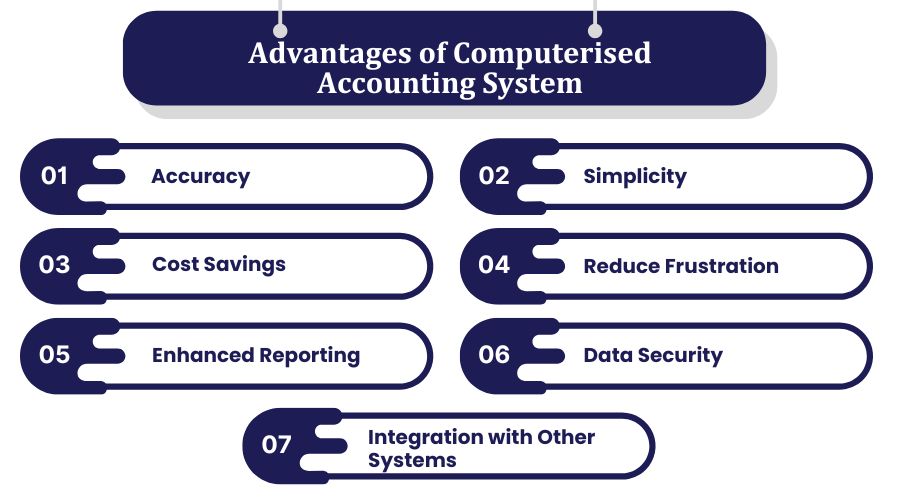
A computerized accounting system instantly manages finance by automating, improving accuracy, and boosting productivity. Here's in what way this is an advantages of computerized accounting:
-
Accuracy
Manual bookkeeping frequently incurs mistakes by humans, but Accounting System secures accuracy through computation automation, reducing errors and tracking reliable financing statements.
-
Simplicity
People with no or minimum background in accounting are able to use accounting systems without any additional help. These systems are designed to be used without too much struggle by the users. Some of the procedures these systems do include easy data input, which simplifies financial management through automation and are furnished with user-friendly interfaces, such that even the users who are not technically skilled pitchers can still make their.
-
Cost Savings
Computerized accounting lowers costs by reducing paperwork, manual calculations, and the need for extra staff for repetitive tasks, leading to long-term savings in time and money.
-
Reduce Frustration
Manual accounting can be a headache. A Computerized Accounting System simplifies processes, automates entries, and minimizes errors, making daily accounting tasks much less stressful.
-
Enhanced Reporting
Want quick insights? With computerized tools, you can generate detailed financial reports instantly. Whether it’s profit-loss statements or balance sheets, enhanced reporting helps in faster decision-making.
-
Data Security
Paper records are easy to lose or damage. A computerized accounting system keeps your financial data secure through backups and encryption—giving you peace of mind.
-
Integration with Other Systems
Modern Accounting system is one of the business tools that you can seamlessly integrate with. Directed towards the payroll software, inventory management software, and tax software. Such interrelationships permit a frenzied flux of activities and an abridgement in verbose, manual interventions.
Disadvantages of Computerized Accounting System
Even though it is efficient and accurate, a Computerized Accounting System can not escape facing several problems as well. Here are some drawbacks businesses should consider:
-
Work Disruption
Transitioning to digital systems from manual ones can initially hinder productivity. Implementing a Computerized Accounting System may involve training and configuration, causing temporary interruptions in routine activities.
-
Potential Job Displacement
Automation reduces the need for some traditional roles. Over time, a Computerized Accounting System might replace certain manual jobs, which can be a concern for staff working in data entry or basic bookkeeping.
-
Lack of Expertise
Not everyone is comfortable Some individuals may struggle with technology and If the team lacks the skills to operate the system properly, it can result in errors or underutilization of its features.
-
Data Loss
Technology has weaknesses too, and without regular backups and security measures, there is a danger of data loss due to system failures or cyberattacks, which is why adopting immutable backup solutions is critical to ensure data cannot be altered or deleted by malicious actors.
-
Technical Errors
Even with the help of automation, Accounting system can still fail because of system crashes, bugs, or data corruption errors. A technical insufficiency can result in the disappearance of certain documents that may necessitate the companies to make investments in backups and get IT support.
-
Expensive Installation & Maintenance cost
To assemble a Computerized Accounting System, you will need funds for resources like software licensing, the latest hardware, and personnel training. Even though the maintenance crew quickly takes care of the system, the expenses are increased by regular updating.
-
Online Threat
When it comes to finance, data is kept in electronic format, businesses must deal with cybersecurity problems such as hacking, phishing, and the possible attack of malware. Protecting sensitive financial information, which is a matter of investing in high-security precautions, is highly important.
-
Customization Limits
Though automation simplifies accounting, initial setup, software training, and data migration can be time-consuming. Employees must also adapt to updates and troubleshoot technical issues when needed.
Features of Computerized Accounting System
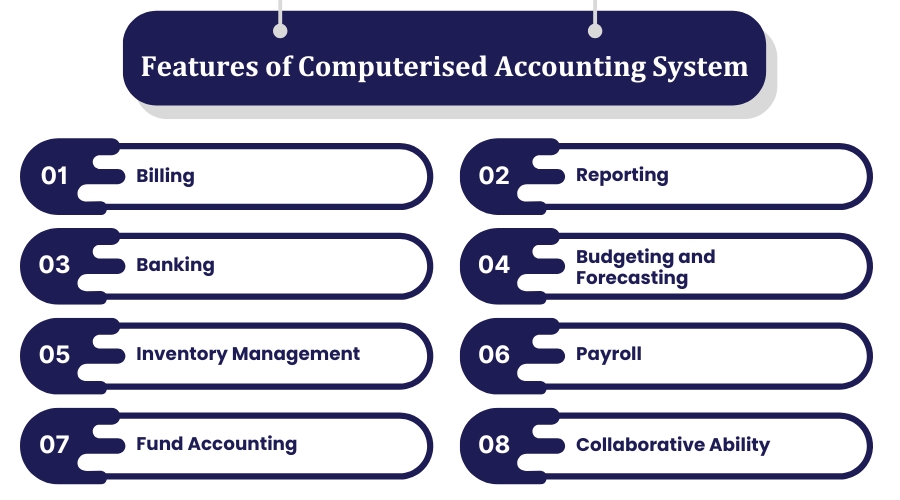
The automated accounting system, called a Computerized Accounting System, improves financial management by making automation of procedures, ensuring accuracy, and increasing efficiency. Let us take a closer look at the main functions of this automated system:
1. Billing
Automated invoicing and payment tracking are some of the tasks which help businesses generate, send, and efficiently manage their bills. It not only ensures the due payments are received in time but also lowers manual errors, as well as maintains a clear record of transactions. Additionally, many accounting solutions can help by allowing the creation of recurring invoices and implementation of multiple payment methods for customer convenience.
2. Reporting
A Computerized Accounting System contains built-in reporting tools that supply the present economy situation. The business is able to maintain financial balances and profit and loss accounts, and prepare tax returns with the aid of these tools. By giving necessary information, companies could be able to make strategic and legal decisions.
3. Banking
When bank accounts are integrated into it seamlessly, businesses are able to reconcile their transactions, automate direct deposits as well as transfer funds securely. Real-time bank feeds are also provided by many accounting systems, which allow to track cash flows and reduce discrepancies in financial records.
4. Budgeting and Forecasting
The analysis of past financial data is a way for companies to determine their desired financial future and predict how much money they will earn in future. This function of the ERP helps companies sustain their financial discipline and make investments which are supported by data.
5. Inventory Management
For companies that carry tangible goods, inventory management within their Accounting system guarantees that a smooth stock turnover is orderly maintained. It monitors the flow of goods in stock, avoids both overstocking and stockouts, and notifies when restocking is needed. Some software even links up with supply chain systems for a perfect coordination of the operations.
6. Payroll
Payroll automation streamlines salary calculations, tax deductions, and employees' benefits management. It secures precise payroll processing, lowers the compliance risks, and, in turn, saves HR teams precious time. A few computer software solutions likewise hold employee self-service platforms in which employees can easily obtain their payslips and tax documents.
7. Fund Accounting
This feature is helpful for nonprofits, government agencies, and organizations to monitor and properly allocate fundings. This option gives financial and accounting transparency reporting and compliance with the donor or grant requirements.
8. Collaborative Ability
Modern accounting systems computer software have now made it possible for several users to reach the financial data in real time. This has made easy collaboration between accountants, finance teams, and business owners. Also, remote access is allowed, there is no need to worry about security, and it is quite flexible to be managed financially.
What are Some Benefits of Using Computers for Accounting Purposes?
To support the accounting process, using computers for accounting purposes is a great choice, thus managing this will be easier and more accurate. A Computerized Accounting System calculates the necessary data thus makes it simplifies staying away from possible mistakes made by humans resulting in the exact financial records. It is beneficial for invoice creation, payroll calculation, and tax calculation which are some work accounting apps that have streamlined, this saves companies both time and energy. Through a more advanced accounting system, the report computing and views, as well as the cost tracking process, is enveloped by automated processes which allows companies to make better decisions.
Moreover, the latest accounting systems harmonize with the banking services, which in turn result in parallel payment settling processes with real-time monitoring: Security can be seen as the other advantage, because computer software offers protecting data by encryption and backup, thus losing financial data or attacks from the cyberspace cannot affect the normal functioning of those sensitive data, so it is the fact that it checks ideally. Besides, the use of computers for accounting reduces processing time, in addition to decreasing the number of errors in inscriptions and it gives companies control over their finances.
Conclusion
A Computerized Accounting System is a tool that will completely change the game because it makes financial management quicker, automatic, and more blissful. There is no absolutely perfect application—cybersecurity risks, maintenance expenses, and software bugs can be disadvantages. The issue is in the selection of the Right Accounting Software that meets your business needs and maintains a trade-off between efficiency and security. Being a startup or a big business, rightly using accounting systems computer software can help you get the best results from today’s competitive market.