Running a business approach involves managing quite a few distinct obligations each day. But one that constantly takes up loads more electricity and time than it ought to is dealing with human beings: hiring, onboarding, monitoring overall performance, and coping with payroll. For most commercial enterprise owners, HR work is vital but not often their strength.

Looking for HR software?
Check out Techimply's List of the Best HR Software in India for your business.
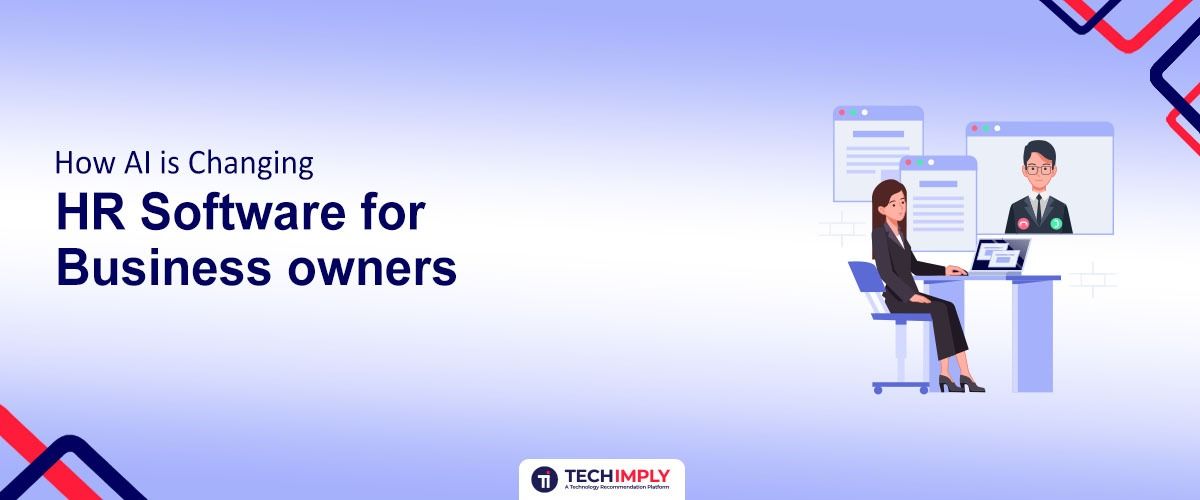
That's precisely where AI in HR is beginning to make a real distinction. You can virtually see it in everyday operations. Right now, in 2026, small and mid-length commercial enterprise proprietors are using AI-powered HR equipment to reduce admin time, make smarter hiring choices, and actually recognize what's occurring with their team of workers.
In this newsletter, we’ll observe how AI is being utilized in HR, the actual benefits, and the challenges you must know about earlier than diving in.
What is AI in HR?
Artificial intelligence in human resource management refers to the usage of machine learning, natural language processing, and predictive analytics inside HR software programs to automate repetitive obligations and find insights that might take humans hours to assemble manually.
Think of it in this manner: a conventional HR software program shops and organizes statistics. AI in HR genuinely does something with that information. It can display screen loads of resumes in minutes, flag overall performance tendencies earlier than they emerge as issues, expect which employees are probably to go away, or answer worker questions without absolutely everyone out of your group getting pulled far away from actual work.
The role of AI in HR has grown from primary automation (like sending onboarding emails automatically) to something tons greater, concerned systems that learn your organization's styles and adapt over the years. That shift is what makes the modern-day technology of HR tools well worth taking note of.
How is AI in HR useful for business owners?
Most business owners are not HR professionals. They care about whether or not their business runs properly, whether or not their crew is appearing, and whether they're compliant with employment laws. AI and HR running together addresses all three.
-
Hiring moves faster: Posting a task, sorting through programs, and scheduling interviews are time sinks. AI equipment for HR can screen candidates based totally on criteria you define, rank applicants, and even take care of initial outreach. You spend time at the pinnacle 5, no longer in the first fifty.
-
Onboarding becomes consistent: New hires often get a scattered level of satisfaction in relying on who's available to help them. AI-pushed onboarding sequences ensure each new employee receives an equal excellence of facts, checklists, and compliance follow-ups without you manually tracking them.
-
Compliance gets easier: employment laws trade. AI in HR gear can flag while your rules need updating, remind managers of required documentation, and preserve audit trails mechanically. That's simply beneficial for any enterprise proprietor without a committed prison crew.
-
People data becomes readable: Most commercial enterprise owners have a few HR software but hardly ever have a look at the information in them. AI surfaces the applicable stuff: who is disengaged, where the chance of turnover is excessive, and which groups are always overloaded. That visibility changes how you control.
Top AI Tools for HR Software
There's no shortage of options here, however some gear has earned actual traction among commercial enterprise owners in 2026.
1. Rippling
Rippling connects HR, IT, and payroll software in one platform, and its AI layer does the connective tissue work, robotically triggering movements across departments while a worker's status is modified. Hire a person, and Rippling can set up their laptop, get admission to it, add them to payroll, and sign them up for blessings simultaneously. For enterprise proprietors dealing with multiple systems, that form of coordination saves proper hours. It's one of the most complete examples of agentic AI in HR, where the machine takes multi-step action on its own instead of just surfacing information.
Pros:
- Connects HR, IT, and payroll in a single location reduces tool switching significantly
- Agentic workflows implement much less manual follow-up after key events like hiring or offboarding
- Strong automation for compliance management and get entry to control
Cons:
- Pricing can get steeply-priced after you add modules past middle HR
- Setup takes time; getting workflows configured successfully calls for an advance attempt
2. Eightfold AI
Eightfold is built mainly around skills and intelligence. It uses AI in human resource management to suit candidates to roles primarily based on skills and ability, not simply resume keywords. For commercial enterprise proprietors who've struggled to find the proper match through traditional activity boards, Eightfold's method to ascertain what human beings can do (versus what their task titles say) is an actual differentiator. It additionally enables internal mobility so that you can discover existing employees equipped to grow into new roles before you put money into outside hiring.
Pros:
- Skills-primarily based matching surfaces stronger applicants than keyword filtering by myself
- Internal mobility capabilities lessen the cost of external hiring
- Useful for agencies looking to construct extra numerous, functionality-centered teams
Cons:
- Better proper for agencies with steady hiring extent occasional hirers may not get complete cost
- Requires satisfactory statistics for your current group of workers to make internal mobility hints work well
3. HiBob
HiBob is famous for developing businesses that need current, worker-first HR software. Its AI functions with attention on engagement and retention, identifying styles that invite burnout or disengagement before they show up as resignations. The platform is properly designed and less intimidating than corporate HR structures, which makes it a practical preference for business owners coping with teams of 30 to 300.
Pros:
- Clean, contemporary interface that personnel surely use adoption is normally excessive
- AI-pushed engagement insights assist trap retention issues early
- Good stability among capabilities and simplicity of use for developing groups
Cons:
- Analytics intensity is much less than enterprise-grade equipment for large orgs
- Some integrations require third-party celebration connectors instead of native connections
4. Metaview
Metaview is a targeted tool that solves one precise trouble properly: it fact-checks, transcribes, and summarizes hiring interviews routinely. The AI pulls out key themes, flags inconsistencies across candidate evaluations, and helps hiring managers make more dependent selections. For enterprise proprietors who have made an awful lease because the interview system turned casual or inconsistent, Metaview provides a layer of area without adding system complexity.
Pros:
- Removes the need for guide be aware-taking at some point of interviews
- Makes candidate comparisons extra goal and consistent
- Easy to apply minimum setup, low mastering curve
Cons:
- Narrow awareness it's an interview device, now not a full HR platform
- Works quality whilst incorporated together with your current ATS standalone use has limits
5. Moveworks
Moveworks sits at the intersection of HR and IT support. Its AI can solve worker questions about guidelines, benefits, or equipment through a talk interface, pulling from your internal documentation and responding in seconds. For enterprise owners, this means fewer interruptions from employees asking basic questions. It's mainly useful during onboarding when new hires have a steady stream of "Where do I locate this?" questions.
Pros:
- Reduces repetitive HR and IT help queries substantially
- Works through existing chat gear like Slack or Teams no new interface to learn
- Gets extra accurate over the years as it learns your inner documentation
Cons:
- Requires properly-organized internal documentation to work nicely terrible doctors imply poor answers
- Initial setup and training the AI in your knowledge base takes meaningful time
Benefits of Using AI in HR
The realistic benefits of AI in HR cross past what any unmarried device does on its very own.
-
Time savings are real and measurable: Administrative HR work, scheduling, data access, and report monitoring are where maximum business owners' time is absorbed. HR AI tools automate the majority of this without requiring you to study complicated workflows.
-
Hiring quality tends to improve: When you are screening based totally on AI-analyzed skills and capability as opposed to gut instinct and resume keywords, you tend to discover better candidates faster. The benefits of AI in HR are especially visible right here in agencies: the usage of AI-assisted hiring documents, a shorter time to fill, and better retention in the first year.
-
Employee experience gets more consistent. Whether it's answering policy questions, running performance check-ins, or managing leave requests, AI ensures employees get accurate, timely responses regardless of whether their manager is available.
-
Decisions become data-backed. The role of AI in HR isn't always simply automation it is perception. Business owners who use AI-enabled HR software programs have a tendency to make higher staff decisions because they're running from actual styles, not assumptions.
Problems Business Owners Face with AI in HR
It's not all clean. There are authentic friction points well worth understanding in advance.
-
Cost can be a barrier: Most stable HR AI tools aren't reasonably priced. For agencies underneath 20 personnel, the ROI case is more difficult to make. Many structures are priced in keeping with workers in line with the month, and people's earnings add up.
-
Data quality matters a lot: AI in HR is handiest as well because of the data it's working with. If your existing worker statistics are messy or incomplete, AI pointers will mirror that. "Garbage in, garbage out" is a vintage hassle that hasn't gone away.
-
Bias isn't eliminated by automation: This is a sincere problem. Artificial Intelligence systems skilled in ancient hiring information can perpetuate the equal biases that existed in human decisions. Business proprietors using AI tools for HR have to understand how their gear is designed to handle bias and what auditing they do.
-
Employee trust requires communication: Some employees feel uncomfortable knowing AI is evaluating their overall performance or engagement. Being obvious about what your HR software tracks and why topics for maintaining belief internally for your team.
-
Over-reliance is a real risk: AI and HR work excellently collectively when human beings leave concerns in the very last decisions. Business owners who delegate too much to automation miss the context that the best direct verbal exchange with their group can offer.
Conclusion
AI in HR is no longer something simple massive organizations need to think about. The gear is handy, increasingly cheap at mid-marketplace tiers, and without a doubt useful for the varieties of problems enterprise proprietors face each day finding desirable people, preserving them, and spending less time on admin. The key is going in with sensible expectations. These tools won't replace exact management judgment. But they'll save you hours each week, surface information you would in any other case pass over, and help you construct a greater, constant experience for your crew. If you have not looked at what's available lately, 2026 is a superb time to start. The gap between organizations using AI tools for HR and those that are not is developing, and those leaning in are constructing real operational benefits.