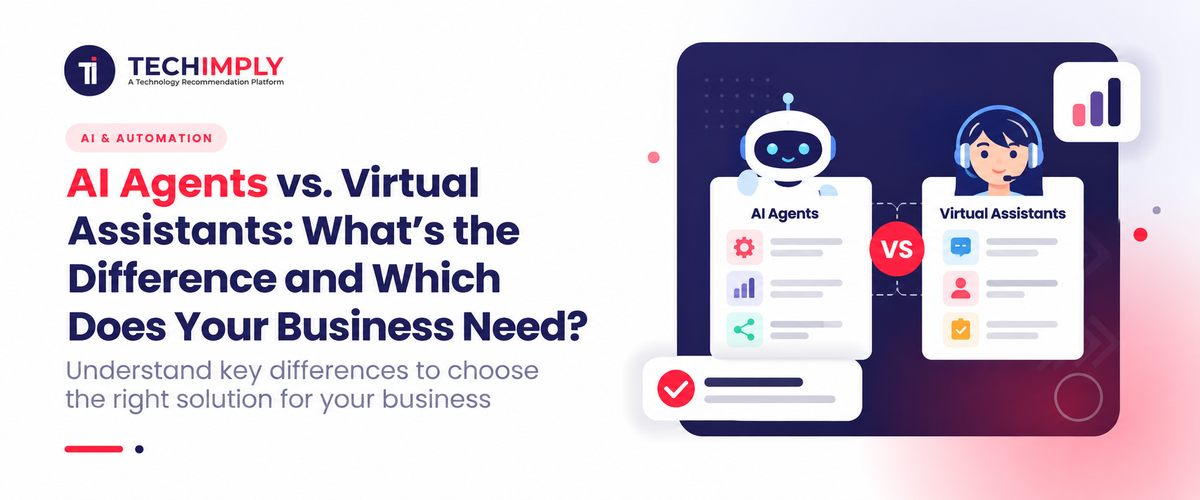
India's digital public infrastructure is one of the best in the world, and it has pushed investment in enterprise AI up by 119% over the last year, greatly exceeding the growth rate around the world. In the entire country, various startups and traditional companies are quickly implementing modern technologies to satisfy the demands of millions of consumers who prefer digital products rather than traditional ones. But as Indian companies continue to grow in the digital area, they face an important decision about which AI technologies to choose: AI Virtual Assistants or fully autonomous AI Agents. It is important to know the difference between these two forms of AI, as they can help Indian companies minimize costs and automate their operations.
Why is Everyone talking about AI Agents and Virtual Assistants?
People are using conversational AI and artifical intelligent assistants a lot these days since the nature of software has changed from a passive device into an active collaborator that can do a lot of things. Before, automation was only about basic traditional rules and procedures; but nowadays, complex AI can learn nuances, use its judgment, and do complicated tasks in a sophisticated software environment. More than that, this change represents a revolution in programming since it is the first time software plays the role of a worker instead of just being a user interface.
This is yet more visible in India, where people enjoy the positive effects of such changes because of the extraordinary pace of progress. Thanks to huge investment and a unique Indian audience, companies ranging from financial technology start-ups to three-decade-old brick-and-mortar shops are inventing new ways of using conversational agents. More than half of Indian companies are employing AI-bots today to cope with specific conditions of local operations.
Do You Know?
India is now the No. 2 market for generative AI tools worldwide. They do not let the systems run on their own. Because of this, hybrid setups are rising fast. In these setups, virtual assistants talk to customers. At the same time, human-led agents manage the harder tasks in the background.
What Exactly is a Virtual Assistant?
The definition of a Virtual Assistant (VA) is an advanced computerized program that has the capability to understand human instructions and perform a series of operational actions through the use of the verbal or spoken medium. NLP technology has provided VAs with the ability to work like a two-way communication device that can provide answers to questions asked by users, fetch information, and bring them through scheduled processes; for example, VAs can set reminders and check the status of orders. However, unlike autonomous AI systems, which can devise their actions with no human input, traditional VAs only react to user requests, relying on their clues, minding the fact that they should follow strict operational restrictions that limit their operations.
1. Accelerating Hyper-Scale Customer Service Infrastructure
AI-driven virtual assistants have emerged as the first layer of customer support by automatically addressing requests for high-volume industries in India: BFSI, retail, and telecom. These assistants take care of high-frequency transactional tasks (like querying updates for bank balances, instantly generating insurance quotes, or processing fast commerce delivery updates) that, every day, handle millions of requests with traditional operational costs. Indian enterprises are leveraging virtual assistants to efficiently scale their customer operations across a large and growing user base, filtering out queries that can be addressed automatically before customers reach the human call centres.
2. Bridging the gap of Vernacular and Multi-Channel
While the native nature of Indian virtual private assistants provides them an edge, it can hardly be called their most defining trait. Given that India has a highly diverse and multilingual demographic, Indian businesses deploy virtual assistants natively on such ubiquitous platforms as WhatsApp (which supports both voice and text) in English, Hindi, Tamil, Telugu, and several other regional languages. This ability to talk in local colloquialisms eliminates digital literacy roadblocks to help brands offer seamless self-service financial and retail experiences into tier-2, tier-3, and rural markets.
3. Streamlining the Modern Enterprise Internal Workforce
Inside big firms, and also in Indian IT services and startups, companies are putting Enterprise Virtual Assistants to work for day-to-day productivity. These tools work more like team members in places such as Microsoft Teams or Slack. They can handle requests from staff, approve leave forms for HR, process expense submissions, and assist when people have IT problems. Instead of making someone jump between separate company systems, the assistant brings it all into one chat window. That removes a lot of back and forth for staff. Employees then spend more time on their main work and strategic priorities.
What Exactly is an AI Agent?
An actual AI agent is a software system that can take in what is around it, pick a next move, and then do tasks step by step until a business goal is reached. This is not the same as a basic chat helper. A chat helper mainly answers questions or carries out a single request after a person asks. With a clear end goal, such as fixing unpaid bills from vendors, the agent turns that goal into smaller jobs. Then it picks a route to complete those jobs, connects to outside tools through APIs, and works with company platforms like ERP software and CRM systems. As it runs, it checks what is happening and adjusts when something goes off track. Most of the time it can do this with little human oversight.
1. Running Autonomous Work in India at Enterprise Scale
More than half of Indian companies have started using AI agents to deal with back-office work that piles up fast. In fast-moving areas such as logistics, quick-commerce, and BFSI, teams use agents to handle tasks that happen out of sight. These systems watch live data instead of waiting for a person to give a new instruction. They can spot likely supply chain slowdowns during monsoon peaks. They can also shift delivery stock to other routes. In some cases, they can raise alerts about pricing rules that change on the fly. The goal is steadier operations across many regions, without the usual delays.
2. Fixing Hard Tasks Across Different Systems in IT and Finance
India’s large IT and finance world is changing from simple automation to agent-led coordination. Banks and other financial firms use AI agents for loan review, fraud checks, and compliance work. These tasks often touch several systems and separate databases. The agents do the handoffs that humans used to do, like moving data from older tools into cloud platforms. They also read documents that are not neatly structured. Then they verify rule checks based on Indian requirements, including DPDP-related rules. After that, they can carry out steps on their own.
3. Managing the Move to Hybrid Autonomy
More Indian companies are rolling out AI agents, but they are not jumping in blindly. Many leaders follow a step-by-step plan for how agents are used. In many cases, the agents do the heavy work first. They can research, pull together information, and run parts of workflows for much of the process, up to around 90%. Even then, people still review and sign off on the final choices that affect strategy. This mix helps firms move faster and work more efficiently. At the same time, it keeps stronger control over risk.
-
So what's the Real Difference Between the Two?
|
Dimension |
AI Virtual Assistants |
Autonomous AI Agents |
|
Execution Architecture |
The system gets the note. It reviews what the user asked for. Then it finds the correct entry in the database. After that, it makes a reply. The reply can be sent as plain text or as audio speech. |
When loop mode is on, it uses a reasoning step. First, it looks at the target. Then it maps out what it plans to do. After that, it calls out to tools and APIs to fetch the data it needs. When the data comes back, it checks the results. If they do not fit, it revises the steps and tries again, going over it until the target is met. |
|
Initiation Trigger |
Reactive: Executes purely upon an explicit human request or single button click. |
Proactive: Can be triggered by events, webhooks, system alerts, schedule timers, or data anomalies. |
|
Tool Calling & API Use |
Deterministic: means the system follows fixed steps and hits one known API every time, like a call to get an account balance. |
Dynamic Orchestration: Chooses and sequences dozens of software tools dynamically depending on the task at hand. |
|
Error Handling & Adaptability |
Failsafe Escalation: If a route isn't mapped, it gives a fallback response ("I didn't understand") or hands off to a human agent. |
Self-Correction: If an API call fails or a step yields unexpected data, the agent re-evaluates its plan and tries an alternate method. |
|
Primary System Interface |
Conversational: Chatboxes, voice interfaces, messaging apps (e.g., WhatsApp, Teams). |
System-to-System / Ambient: Operates in the background within databases, ERPs, CRMs, and API meshes. |
Which Indian Businesses are Already Using them?
1. Google Workspace
Indian businesses are moving fast to Google Workspace plus Gemini. They want AI help built into daily work. Firms such as Adani Group and Reliance Industries, along with many local IT vendors, use Gemini in Docs, Sheets, Gmail, and Meet. The aim is to have chat-style support right inside normal office tasks. These setups can shorten long email chains, draft proposals in multiple languages, and list meeting tasks as the call ends. Some groups go further than basic assistant features. They use Gemini Enterprise and Vertex AI. With these tools, they set up custom agent systems that run inside Workspace. Those agents can work in the background. They pull current details from Google Sheets. They can review inventory and then start approval steps in ERP workflows. This happens across teams, and it is described as doing so with little need for manual follow-up.
2. MuleRun
MuleRun is a newer platform that supports always-on AI agents. It is being taken up by Indian startups, digital agencies, and SMBs. The pitch is different from simple chatbots. MuleRun offers dedicated VM setups. In those spaces, agents can carry out longer workflows on their own. Indian teams use these agents to watch rival pricing, gather market notes, and create localized marketing assets. They also help produce new web pages without requiring hand coding. In cities like Bengaluru and Gurugram, freelancers and tech shops run these agents around the clock. The agents handle research work and also manage routine back-office steps. MuleRun includes ready-made skill packs for areas like marketing, software work, and daily operations. That is meant to help small teams grow without adding many extra people.
3. Activepieces
Activepieces is an open-source automation and multi-agent tool. Many Indian tech teams and startups use it. It is also a choice for groups that want less dependence on closed products. The project is privacy-minded. Teams can link it with 700 or more APIs. They then run AI agents inside their own software systems. Engineering and IT teams often use it to watch their servers. They can scan logs, spot unusual events, and create short summaries with AI. After that, the agents can run fix steps automatically. This happens before bigger outages start. In finance and online retail, some brands use it for work that spans multiple apps. For example, they pull details from GST invoice PDFs. They align those details with payment gateway records. Then they update internal accounting data. Because it can run on a company server, Activepieces fits well in regulated work. That is why many teams in BFSI use it. They point to Digital Personal Data Protection rules, including DPDP compliance.
Which One Does Your Business Actually Need?
1. Many Languages, Many Places
You may be dealing with a huge number of customer questions, from big cities to smaller towns. A virtual assistant can help you manage that load. You can put it on WhatsApp, on voice bots, and on your website chat. It can answer usual questions, check order status, and show balance details fast. It also supports regional languages such as Hindi, Tamil, Telugu, and Marathi. A lot of firms see this as a lower-cost option compared with using a call center.
2. Fast Help for Staff Teams
HR, IT, and admin groups often spend time on repeat requests. Examples include checking leave balance, resetting an IT password, or clarifying a company policy. A virtual assistant can handle these questions quickly. It can sit on top of tools like slack, microsoft, so staff get answers without waiting.
3. Get to market fast with low integration risk
Virtual assistants are easier to launch. They cost less at the start too. You do not have to rewrite your backend database setup. They act like an extra layer between your existing tools and the user. From there, they turn data lookups into a plain conversation.
-
Choose an AI Agent If You Need:
1. Back-office and logistics work that runs itself
If your team has to link several tools, deal with shifting rules, and finish tasks that usually need many steps, then you may want AI agents. For instance, you can update quick-commerce stock during monsoon spikes, match what the supply chain reports, and trigger vendor payments across ERPs without waiting for a person to push each button.
2. Money checks and rule compliance at scale
In India’s banking, finance, and fintech space, a lot of the work is strict and data-heavy. An agent can sort through billing and invoicing software as they come in, confirm vendor details, spot odd UPI or FASTag activity, and then post the results to your accounting system without repeated manual entry.
3. Cutting labor time in busy processes
Virtual assistants can help, but AI agents go further by taking over full job flows. They can handle things end to end, like finding leads, pushing code, or working through a chargeback dispute, while the work happens in the background.
Conclusion
Picking the right AI option can be tricky. Some teams need reactive virtual assistants that talk with users right away. Others want autonomous AI agents that can handle work from start to finish. The decision should fit how your company runs day to day. In India, the B2B tech space is crowded. That makes it hard to choose a tool without wasting time. Techimply helps with this by acting as a B2B software discovery site for India. Businesses can search, compare, and buy software that matches their budget and their current size. Whether you look at chat-style tools or agent-driven automation, companies use Techimply to get clear side-by-side results. They also get guidance from experts. This helps them commit to a software choice with more confidence.