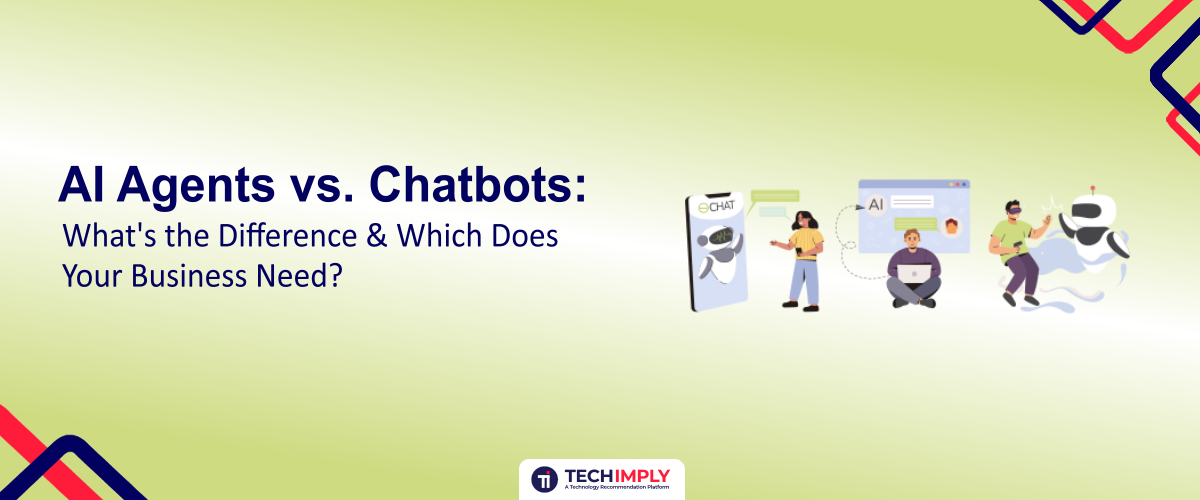
A Bengaluru-based D2C brand swapped its old customer support chatbot software for something the vendor called an "AI agent" a few months back. Support tickets dropped. But so did the team's grasp of what was actually happening behind the scenes; nobody could quite explain why the new tool sometimes issued a refund on its own, or rebooked a delivery slot without checking first. That kind of confusion is common right now, mostly because "chatbot" and "AI agent" get thrown around almost interchangeably in sales pitches, when the two run on genuinely different logic underneath.
Especially for Indian companies seated across the table from suppliers in 2026, getting this correct is more important than it appears. Pick the wrong category- a chatbot when the work calls for an agent, or an agent when a chatbot would have done just fine- and you end up paying for skill that either falls short of the mark or goes far beyond it. This piece clarifies what actually sets the two apart, where each is appropriate, and how to reach the one your business needs instead of the one that sounded more appealing in the presentation.
Why the Terms Get Mixed Up So Often
Part of it comes down to how the market talks about these tools. Vendors selling basic rule-based bots started calling them "AI agents" the moment agentic AI turned into a buzzword it sells better, plain and simple. Some genuinely agentic products, meanwhile, still get marketed as "chatbots," just because that's the word customer service already know.
From a pitch deck alone, business owners often can't tell which one they're actually being sold. The safer move is to stop asking what a tool is called and start asking what it does when something goes off script.
What a Chatbot Actually Is
A chatbot, at its core, follows a conversation flow. Older ones ran on strict decision trees; refunding consumer categories "refund," show refund options; anything the tree doesn't recognize fall back to a generic line or hand off to a human. Though the underlying workthat of grasping what's being asked, answering with knowledge, or guiding the conversation somewhere usefulhasn't substantially changed, more recent chatbots draw on major language models to sound more realistic and span a greater range of wordings.
Chatbots are reactive by design. They wait for input, then answer. Even the sharper LLM-based ones the kind you'll now find across Indian e-commerce and banking sites don't take independent action beyond the conversation itself. A chatbot will tell a customer their order status without blinking. It generally won't decide, on its own, to reroute that order because the delivery partner flagged a delay somewhere upstream.
What an AI Agent Actually Is
An AI agent is built to finish tasks, not just field questions. It breaks a goal into steps, works out which tools or systems each step needs, and carries out actions across those systems without a human clicking through every stage. Platforms like SleekFlow are designed for this kind of agentic work, helping teams deploy AI agents that can manage conversations and complete tasks across channels such as WhatsApp. With the right AI agent development, a genuinely agentic support tool can handle a delayed order by checking the logistics API, spotting that the shipment is stuck, rebooking a delivery slot, and notifying the customer all without anyone approving each individual move along the way. For teams evaluating these capabilities, comparing the top AI customer service agents can help identify the right solution for their support workflows.
The defining trait here isn't really intelligence. It's autonomy paired with the ability to act across systems. A chatbot converses; an agent executes. That's more or less the entire distinction, even if the marketing around both terms dresses it up as something far more complicated.
What's Happening Under the Hood
The technical difference tracks the practical one pretty closely. A chatbot, even a sophisticated LLM-based one, is basically a single loop receive input, generate a response, wait for the next input. No persistent memory of goals beyond the conversation at hand, and no built-in way for the tool to decide, unprompted, that a task needs a second or third system involved.
An AI agent typically runs on something closer to a plan-act-observe loop instead. It takes a goal, splits it into smaller steps, executes a step through whatever tool or API applies, checks what came back, and adjusts the next move accordingly. That's the reason an agent can recover from a failed step in a way a chatbot simply can't if a delivery slot isn't available, the agent goes looking for the next best option and tries again, while a chatbot just reports the failure and stops.
This is also why agents demand more careful design work. Every extra system an agent can touch is one more place a mistake can happen, one more set of permissions that needs scoping properly. It's not that agents are inherently riskier they're just doing more, and more surface area means more that has to be gotten right before anyone flips the switch.
Where the Two Genuinely Overlap
Worth being upfront: the line between an advanced chatbot and a simple agent isn't always crisp. Some tools sold as chatbots now trigger basic actions of their own sending a password reset link, updating a delivery address which technically counts as agentic behavior, just at a small scale. And no shortage of AI agents still sit behind conversational interfaces that look and feel exactly like a chatbot from the user's side.
The test that tends to hold up in practice: how many independent decisions is the tool making, across how many systems, without a human signing off on each one? A tool handling one narrow action inside one system sits closer to an advanced chatbot. A tool juggling multiple actions across multiple systems, adjusting its plan mid-course that's an agent, whatever label the vendor slaps on it.
A Side-by-Side Look
Here is the comparison between a Chatbot and an AI Agent organized into a clean table:
|
Feature / Criteria |
Chatbot |
AI Agent |
|
Primary Job |
Answers questions, guides conversation |
Completes multi-step tasks |
|
Takes Independent Action |
Rarely, if at all |
Yes, across connected systems |
|
Typical Setup Effort |
Low to moderate |
Higher—needs integrations and permissions |
|
Risk if It Makes an Error |
Usually minor, easily corrected |
Can be operationally significant |
|
Best Suited For |
High-volume, repetitive queries |
Cross-system workflows and coordination |
|
Oversight Needed |
Periodic review of conversation quality |
Ongoing monitoring of actions and permissions |
This table isn't here to crown one option as universally better. It's here to show the two solve different problems and it's only actually useful once you already know which problem you're solving.
Common Use Cases in Indian Businesses
Chatbots still carry the bulk of routine, high-volume interactions across Indian businesses FAQs on an e-commerce site, PNR status checks for a travel booking, walking a customer through a return policy, collecting basic details before handing off to a human agent. In these situations the conversation is the whole job. Nothing needs to happen beyond giving the right answer.
AI agents tend to turn up where a task spans multiple systems and needs actually completing, not just explaining. A logistics company running an agent that automatically re-routes shipments the moment a delay's flagged. A finance team pulling data from Tally through an agent, cross-checking it against bank statements, flagging mismatches without anyone manually reconciling entries line by line. An HR software team using one to screen resumes, schedule interviews across calendars, and fire off confirmation emails coordinating three or four systems that would otherwise mean someone bouncing between tabs all day long.
How to Decide Which One Your Business Needs
It usually comes down to one question: does the interaction end with information, or does it end with an action that needs to happen somewhere else?
If customers mostly want answers order status, policy details, product specs, account information a well-built chatbot covers that without unnecessary complexity. Plenty of businesses assume they need an agent because it sounds more advanced. In practice, a chatbot handling 80% of routine queries accurately beats an agent that's overbuilt for a job that never needed autonomous action in the first place.
If the work involves coordinating across systems approvals, bookings, data reconciliation, multi-step workflow automation currently needing a person switching between five different tools that's where an agent starts earning its cost. Teams usually spot this need only after noticing how much time goes into manually executing tasks a chatbot has already helped surface. The chatbot handles the conversation. The agent handles what comes after.
Common Mistakes Businesses Make
One mistake shows up early and often: buying an agent for a chatbot's job. A company drops money on an expensive agentic platform just to answer FAQs, when a fraction of that spend on a well-configured chatbot would've done the same work less complexity to manage, fewer things that can go sideways unsupervised.
The opposite mistake happens just as often, though. A business keeps stretching a chatbot to handle work it was never built for trying to get it to process refunds, update inventory, coordinate between departments and ends up with something that behaves unpredictably, simply because it's being asked to act rather than respond.
Smaller companies tend to overlook something more basic: skipping the groundwork before deploying either one. Agents in particular need well-structured data and clearly defined permissions before being handed autonomy across systems. Connect an agent to a messy CRM software, or an ERP full of inconsistent records, and it won't clean anything up. It'll just act on top of the mess, faster often in ways nobody catches until something's already gone wrong.
What Autonomy Actually Costs
Autonomy isn't free, and this is the part vendor pitches conveniently skip. An agent taking action across systems needs oversight audit logs, permission boundaries, some way to catch it when it gets a call wrong. A chatbot giving someone a bad answer is a minor annoyance at worst. An agent taking a wrong action cancelling an order that shouldn't have been cancelled, sending a payment to the wrong account is a real operational problem.
That's exactly why plenty of Indian businesses start with a chatbot even when an agent might eventually make more sense. It buys the team time to build confidence, tidy up the underlying data and systems, and figure out where automation genuinely help desk before handing over real autonomy. That sequencing rarely comes up in vendor demos, but it's usually the difference between a rollout that goes smoothly and one that creates more firefighting than it eliminates.
When Neither Might Be the Right Fit
If a business is small enough that one person can field every customer query personally an early-stage operation with a handful of daily interactions investing in either a chatbot or an agent might be premature. The setup and upkeep can easily outweigh the benefit until volume actually justifies automating anything.
And for interactions that genuinely need human judgment or empathy a serious complaint, a sensitive dispute, anything where the customer needs to feel heard rather than processed neither a chatbot nor an agent is really the right first response. Both work best clearing out the routine and repetitive so human attention lands where it's actually needed.
Conclusion
The real distinction isn't which tool sounds more advanced. It's whether the job in front of you ends with an answer, or ends with an action. A chatbot that converses well will always beat an agent that's autonomous but unnecessary. And an agent capable of coordinating real tasks will always outperform a chatbot stretched past what conversation alone can solve. Get clear on what the task actually requires before choosing based on whichever label the vendor happens to be using this year.