Managing employee salaries, tax deductions, leave balances, and compliance can get overwhelming—especially as your team grows. That’s why many businesses now rely on a payroll management system to bring structure, speed, and accuracy to this essential HR function.
So, if you asked yourself what is payroll in HR or wondered how contemporary payroll tools can make the HR department's life easier, rest assured you are in the right. With digital transformation restructuring work, understanding what payroll processing is and how it functions proves more important than ever.

Looking for Payroll Software?
Check out Techimply's List of the best Payroll Software for your business for your business.
In this blog, we’ll walk you through the basics—what a payroll management system is, how it functions within HR, the benefits it brings to organizations, and the must-have features every business should look for.
What is a Payroll Management System?
A Payroll Management System is a tool that helps businesses handle everything related to paying their employees—on time and without stress. Think of it as your behind-the-scenes helper that calculates salaries, deducts taxes, manages bonuses, and keeps records—all in one place.
Using payroll software means you don’t have to worry about manual errors or messy spreadsheets. It automates the entire process, making it faster and more accurate. Whether you’re a startup or a growing business, an employee payroll management system saves you time and keeps you compliant with tax laws.
Some companies even go for payroll management services—outsourcing the job to experts—so they can focus on what really matters: running the business. For companies expanding internationally, working with a global partner like INS Global.
ensures compliant and efficient payroll operations across borders.Looking for Payroll Outsourcing Software?
Check out Techimply's list of best Payroll Outsourcing Software in India for your business.
How Payroll Management Works For HR?
For HR, payroll management isn’t just about paying salaries—it’s about making sure everything runs smoothly behind the scenes. From tracking attendance and leaves to calculating pay, taxes, and deductions, payroll management in HR handles it all.
Using an employee payroll system, HR teams can easily manage salary slips, compliance, bonuses, and employee records without juggling spreadsheets. It saves time, reduces errors, and keeps everything organized. In short, a smart payroll system helps HR focus more on people—and less on paperwork.
Looking for HR Software?
Check out Techimply's list of the best HR Software for your business for your business.
Benefits of Using Employee Payroll Management System in Organizations
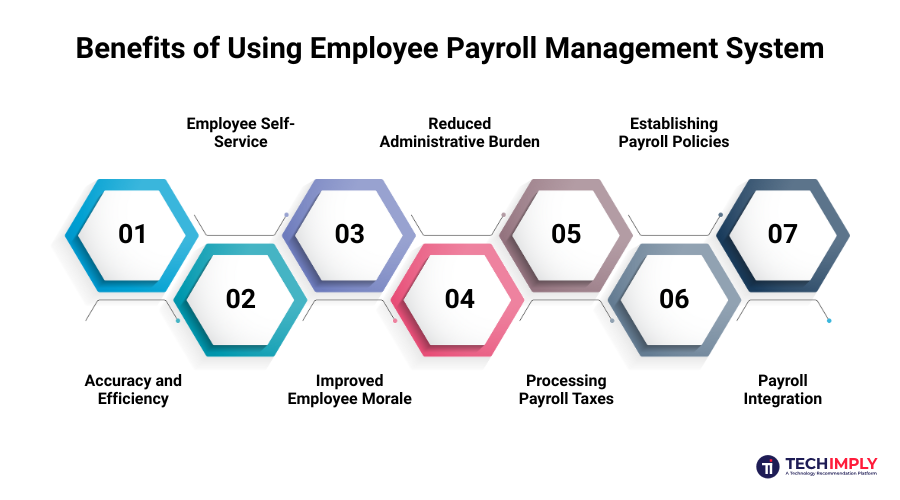
Managing payroll manually can lead to mistakes, delays, and frustration. That’s where an employee payroll management system comes in. Here’s how it makes your work easier and better:
1. Accuracy and Efficiency
With an automated employee payroll system, salary calculations, deductions, bonuses, and tax withholdings are handled with precision. No more Excel sheet errors or last-minute paycheck fixes. The system runs calculations based on updated rules and data, ensuring faster processing with zero guesswork.
2. Employee Self-Service
Modern payroll management tool often comes with employee portals. This means your team can access payslips, tax documents, and leave balances on their own—anytime. It cuts down HR queries and empowers employees with transparency and control over their payroll information.
3. Improved Employee Morale
Timely and accurate pay is more than just money—it’s trust. When your employee payroll management system ensures consistent, error-free payments, employees feel valued. Happy teams are loyal teams, and that morale boost leads to better productivity.
4. Reduced Administrative Burden
HR teams spend a huge chunk of time on repetitive tasks. By using payroll management services, you reduce manual entries, spreadsheet headaches, and routine follow-ups. This lets your HR staff focus on strategy, not just salary.
5. Processing Payroll Taxes
Tax compliance can be complex, but your employee payroll system can handle it. From calculating TDS and other deductions to generating tax reports, the system keeps everything compliant and audit-ready. You avoid penalties and save hours during tax season.

Do You Know?
In India, late or incorrect TDS filing can lead to penalties of ₹200 per day until the default is fixed. That’s why automation is a lifesaver.
6. Establishing Payroll Policies
Want to apply consistent rules across departments? A payroll management system helps you define and enforce policies like leave encashment, bonus structures, and shift-based pay. Everything is streamlined, and there’s no room for confusion or bias.
7. Payroll Integration
A good employee payroll management system plays well with others. It integrates smoothly with HRMS, attendance systems, and accounting software. That means one source of truth, fewer mismatches, and more cohesive operations across the board.
Pro Tip:
Before finalizing any payroll management system, check if it integrates with your current attendance or HRMS tools. It’ll save you hours later.
Key Features of Payroll Management Software
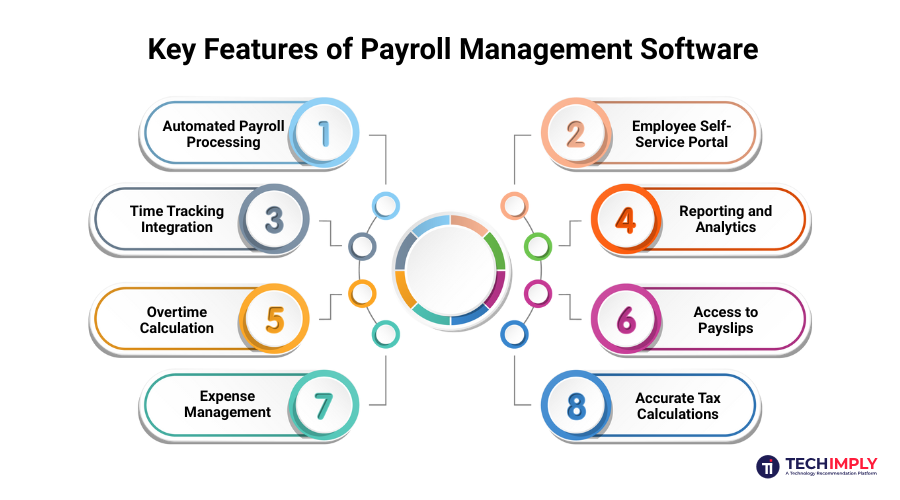
Good payroll management systems do more than provide for the payment of your employees; it’s the whole payroll process under HR that’s simplified. Easy to manage for small growing companies with features embedded for ease and accuracy in managing proper payroll.
1. Automated Payroll Processing
Automation is the backbone of any reliable payroll management software. It calculates salaries, deductions, taxes, and bonuses automatically based on predefined rules. This puts most of the work to be done just automatically and takes human error out of the loop during payroll processing. Whether you are running weekly, bi-weekly, or monthly payroll, each and every employee is precisely and timely paid by the system. India's HR technology market is expected to grow from USD 1,120 million in 2024 to USD 2,300 million by 2033, driven by increased digital adoption and automation.
2. Employee Self-Service Portal
A strong employee payroll system supports your team. A self-service portal allows employees to look up their payslips, tax documents, leave days and change their personal information. Not only does it help people communicate, but it also makes HR’s work in payroll easier and more organized.
3. Time Tracking Integration
Integrate time and attendance systems with the employee payroll management system so that hours worked, leaves taken, overtime worked, and shift differentials can be calculated accurately. This will ensure that there are no discrepancies and that an employee is paid for each our worked, which is of prime importance for organizations where most of the work is done on an hourly basis or is done on varying shifts.
4. Reporting and Analytics
Having built-in reporting and analytics, a strong payroll management system would give you detailed insights into payroll costs, tax liabilities, and employee compensation trends. These reports help the HR make better decisions and ensure financial transparency, being an integral part of the modern payroll management service.
5. Overtime Calculation
Calculation of overtime has in many instances proved to be manual; thus, there are possibilities of errors, leading to employee dissatisfaction. The majority of systems shall have a payroll processing module that will take the overtime hours uploaded into the system and process them in line with the parameters that you have defined along with the laws of labor applicable to your country. This makes the employee payroll system fair and compliant, especially for roles with irregular hours.
6. Access to Payslips
One of the most appreciated features by employees is easy access to digital payslips. Through the payroll management system, employees can view and download their payslips anytime, without having to email HR. This adds transparency and professionalism to the process of payroll in HR.
7. Expense Management
Handling reimbursements and employee expenses can be messy without the right tools. A good payroll management software includes an integrated expense management feature to track claims, approvals, and payouts. This ensures employees are reimbursed accurately and keeps your financial records clean.
8. Accurate Tax Calculations
Tax compliance is a big part of any payroll management service. The software handles things like tax, TDS, EPF, and ESI on its own. It also keeps up with rule changes, so filings stay on time and penalties don’t pile up. This makes tax management an easy, error-free task for HR and finance teams.
Key Takeaways
A payroll management system automates and simplifies HR tasks.
It ensures timely payments, tax compliance, and employee satisfaction.
Features like self-service portals and real-time tax calculations make it a must-have.choose
Payroll management in HR reduces administrative load and boosts accuracy.
Conclusion
An effective payroll management system goes well beyond issuing paychecks. It’s a central tool in allowing HR to remain compliance-savvy, sidestep costly errors, and get employees paid accurately and on time. In other words, it keeps operations running easily behind the curtain.
After knowing what is payroll processing and how it fits into the day-to-day of HR, it is very easy to understand why automation brings such an ample difference. With the right tools, your HR team can finally break away from repetitive admin work and really put more focus on what drives the business: your people.
Related Read -
- How to Choose the Right Payroll Software for Your Industry?
- Why Every Business Needs Payroll Software: Key Advantages for 2024
- Compliance Made Easy: How Payroll Software Helps Avoid Penalties
- Comparing Payroll Software Options for Different Business Sizes and Needs
- The Ultimate Guide to Choosing the Best Payroll Software for Your Business
- Finding the Perfect Fit for Your Enterprise Payroll Software Needs
- HR Software Statistics Trends
- Finding the Right Enterprise HR Software for your Business
- Best HR software to Manage Your Remote Workforce
- Cultivating Success: The Latest Advancements in Enterprise HR Software for 2024


![What is ERP? Why Do We Need It? [Small Businesses, Companies, and Startups]](https://cdn.techimply.com/uploads/blog/2122/1847229680564799.jpg "What is ERP? Why Do We Need It? [Small Businesses, Companies, and Startups]")