Cloud computing has quietly become the backbone of the way organizations and people store, configure, and access data. From streaming your favorite show to running a global corporation application, nearly everything digital these days runs on cloud infrastructure. And a surprising variety of people, nonetheless, are not completely clear on what cloud computing surely is or why it topics.

Looking for a cloud computing platform?
Check out Techimply's List of the Best Cloud Computing Platforms in India for your business.
This guide breaks it all down: what cloud computing is, how its structure works, the different sorts available, and where it is simply used in the real world.
What is Cloud Computing?
Cloud computing is the delivery of computing services, which include servers, storage, databases, networking, software, and analytics over the internet, normally referred to as the cloud. Instead of owning and keeping physical hardware, you lease and access those resources from a cloud provider and pay only for what you operate.
To explain cloud computing certainly: imagine you are renting office space instead of buying a building. You get what you want, when you want it, without the burden of upkeep or long-time period dedication. That is essentially the model cloud computing follows for IT infrastructure.
The term became widely adopted within the mid-2000s, however the concept of shared computing resources goes even further. Today, principal providers like AWS, Microsoft Azure, and Google Cloud supply cloud computing technology at a scale that became unthinkable too many years ago.
What is Cloud Computing Architecture?
Cloud computing architecture refers to the complete structure of systems and components that make up a cloud environment. It covers both the customer-facing side and the back-end infrastructure.
1. Front-End Architecture
The front-end is what users engage with immediately.
-
User interface: Dashboards, manage panels, and web portals that allow customers manipulate their cloud services
-
Web browsers and mobile apps: Most cloud systems are accessed thru a general browser or a committed cellular software no special software wished
-
Client device: Desktops, laptops, tablets, and smartphones that hook up with cloud services over the internet
2. Back-End Architecture
The back-end is in which the real work takes place. Users in no way see it, however it is what makes cloud computing function reliably.
-
Servers: Physical or virtual machines that manner requests and run applications
-
Databases: Structured storage structures that keep and organize application information
-
Virtual machines: Software-based totally computers that run on physical hardware , allowing a couple of remoted environments on a unmarried server
-
Storage structures: Object storage, block storage, and record Storage systems that handle information endurance and retrieval
3. Components of Cloud Computing Architecture
Beyond front-quit and back-quit, a few extra additives are really worth knowing:
-
Cloud servers: Virtualized computing system that cope with workloads on demand
-
Networking: The infrastructure connecting records facilities, inclusive of load balancers, CDNs, and digital personal networks
-
Security systems: Firewalls, encryption software, identity management and access controls
-
APIs: Interfaces that permit specific services and packages communicate with every different
-
Management software program: Tools for tracking overall performance, handling assets, and automating duties
4. Cloud Computing Architecture Diagram
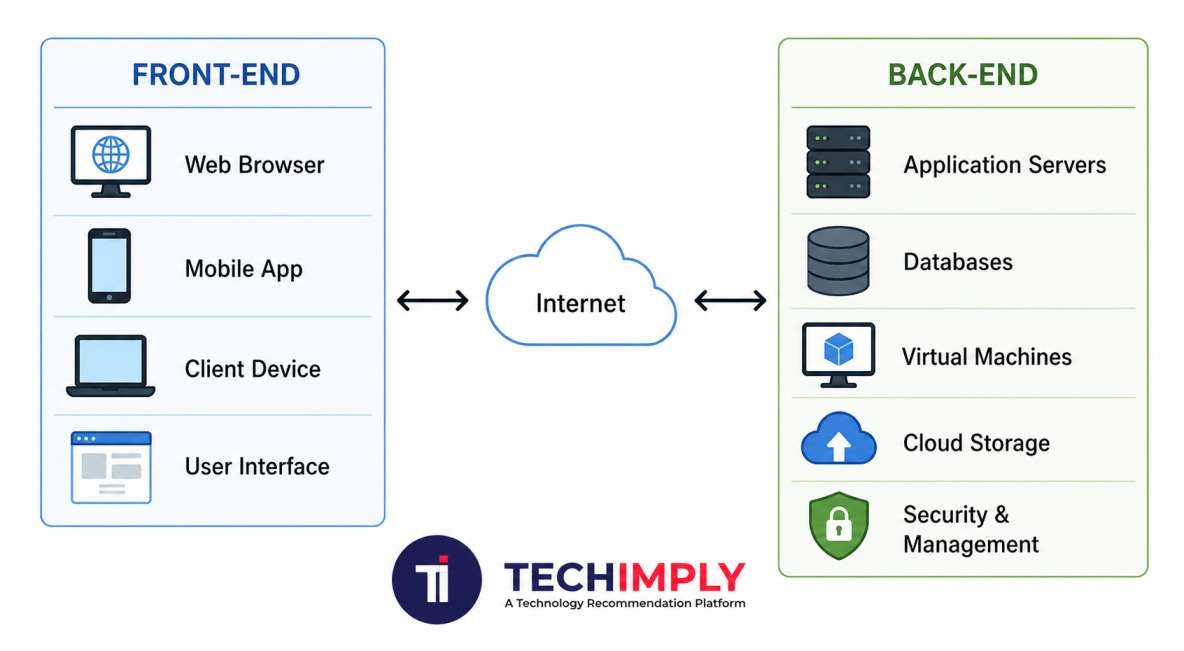
Cloud computing architecture is normally divided into fundamental components: the front-end and the back-end. These components work together through the net to supply cloud-based totally services such as storage, applications, and computing power.
Basic Structure Explanation
-
Front-End
-
The component users interact with immediately
-
Includes web browsers, mobile apps, dashboards, and patron device
-
Sends requests to cloud services
-
-
Back-End
-
The cloud infrastructure that methods requests
-
Includes servers, databases, virtual machines, storage systems, and protection controls
-
Managed by means of the cloud carrier provider
-
-
Internet / Network
-
Connects users to cloud sources
-
Enables verbal exchange between Front-end and again-end systems
-
Front-End and Back-End Diagram
How Many Types of Cloud Computing Are There?
There's no unmarried kind of cloud computing the term covers several deployment fashions and provider categories. Here's how they damage down.
1. Types of Cloud Computing Based on Deployment
-
Public Cloud: A public cloud is owned and operated with the aid of a third-party company and made available to any organization or character over the internet. AWS, Google Cloud, and Microsoft Azure are the most well-known examples. It is cost-effective and easy to scale, however you proportion infrastructure with different customers.
-
Private Cloud: A non-public cloud is devoted to a single corporation. It may be hosted on-premises or through a managed issuer, but the key distinction is exclusivity. It gives more management and protection, which makes it attractive for regulated industries like finance and healthcare.
-
Hybrid Cloud: A hybrid cloud combines public and private environments, allowing data and programs to be transported among them. It gives groups the ability to keep touchy workloads on private infrastructure while using the general public cloud for the whole thing else. Most huge corporations perform a few models of a hybrid model nowadays.
2. Types of Cloud Computing Based on Service Models
-
IaaS (Infrastructure as a Service): IaaS affords raw computing infrastructure, digital machines, storage, and networking on a pay-as-you-go foundation. You manipulate the operating device and applications; the issuer handles the hardware. Amazon EC2 is a conventional example.
-
PaaS (Platform as a Service): PaaS sits one layer above IaaS. It gives developers a platform to assemble and set up programs without handling the underlying infrastructure. Google App Engine and Heroku fall into this class.
-
SaaS (Software as a Service): SaaS delivers fully practical programs over the net. There is no setup or maintenance in your lease you certainly log in and use it. Gmail, Salesforce, Slack, and Zoom are all SaaS products.
-
FaaS (Function as a Service): FaaS, additionally referred to as serverless computing, we could build and run individual functions in response to occasions without dealing with any servers. You pay only when the code virtually executes. AWS Lambda is the most extensively used instance.
3. Other Cloud Computing Models
-
CaaS (Container as a Service): CaaS gives box control infrastructure, letting groups install and scale containerized packages. Kubernetes is a not unusual underlying generation right here.
-
BaaS (Backend as a Service): BaaS gives mobile and net developers ready-made backend infrastructure, databases, authentication, and push notifications so that they will be aware of constructing the front-end . Firebase is a superb instance.
Which Cloud Computing Type Is Best?
The honest solution: it relies upon who uses it and what it's for.
-
Best for startups: Public cloud with SaaS software. Low in advance price, smooth to scale, minimal IT overhead.
-
Best for organisations: Hybrid cloud. Allows manage over sensitive statistics at the same time as the use of public cloud for flexibility.
-
Best for developers: PaaS or FaaS. Less infrastructure to manage way quicker improvement cycles.
-
Best for scalability and fee savings: Public cloud IaaS. Pay for what you operate, scale right away while call for spikes.
Benefits of Cloud Computing
The benefits of cloud computing are not just theoretical — they may be the purpose adoption has grown so rapid.
-
Cost financial savings: No want to shop for and hold bodily servers. You pay for capability as you operate it, which removes massive capital expenditures.
-
Scalability: Need extra storage or computing power? You can provision it in minutes. Cloud systems scale up or down routinely based on demand.
-
Accessibility: Authorized customers can access data and programs from anywhere with an internet connection. Remote work have become some distance greater sensible due to this.
-
Reliability: Major cloud vendors preserve a couple of records centers with redundancy built in. Service uptime is commonly 99.9% or higher.
-
Security: Leading cloud companies make investments closely in safety more than most character groups may want to come up with the money for. That consists of encryption, identification management, and compliance certifications.
-
Automatic updates: The provider handles software updates, patches, and renovation. Your team does not have to .
-
Collaboration: Teams can work on shared files, data, and programs in real time, irrespective of region.
One underappreciated characteristic of cloud computing is the velocity it brings to innovation. When you are not spending time managing hardware, your IT crew can concentrate on constructing matters that actually count to the business.
Use Cases of Cloud Computing
The use cases of cloud computing span almost every enterprise and enterprise feature.
-
Data storage and backup: Businesses keep files, databases, and backups inside the cloud as opposed to on nearby drives. It is inexpensive and a ways easier to get over in a disaster.
-
Application development and checking out: Developers use cloud environments to build, test, and deploy packages without needing committed hardware for each assignment.
-
Big data analytics: Cloud platforms offer the processing of huge datasets, consumer conduct, sales patterns, and sensor data in near actual time.
-
Streaming services: Netflix, Spotify, and YouTube all run on cloud infrastructure. Cloud computing handles the big, unpredictable spikes in traffic those systems revel in.
-
Artificial intelligence and system getting to know: Training AI models requires large computational assets. Cloud providers provide GPU clusters and specialized ML services on demand.
-
Healthcare: Hospitals and healthcare providers save patient data, share medical pictures, and run diagnostic equipment inside the cloud with strict compliance controls in location.
-
E-commerce: Online shops use cloud computing to address visitor surges for the duration of occasions like Black Friday without making an investment in year-round extra potential.
-
Education: Virtual classrooms, gaining knowledge of control structures, and collaboration software all rely upon cloud platforms to serve students across exclusive device and locations.
The actual global breadth of these use cases suggests why cloud computing technology has emerged as infrastructure rather than just a trend.
Conclusion
Cloud computing has changed how companies construct and run technology and there is no going back-end . Whether you are a startup using SaaS software to function lean or an organization walking workloads across hybrid environments, the cloud is nearly absolutely already part of how you figure things out. Understanding what cloud computing is, how its architecture fits together, and which type fits your scenario is just useful expertise it is almost vital for all people making generational choices these days. Start together with your real wishes, healthy them to the proper deployment and provider model, and you will be in a far stronger position to get actual cost out of what the cloud offers.