

AI can summarize a 90-page contract or a full patient history in seconds. Yet many lawyers, doctors, and compliance officers still keep it away from their most important files. The hesitation isn’t a lack of interest. Most AI tools ask users to upload a PDF full of client or patient data and simply trust that nothing goes wrong on the backend.
Today we’re launching Vera X-Ray, a new feature built to close that gap. This article covers the problem it solves, how “privacy before prompting” works, and what it means for the B2B decision-makers, software buyers, and IT managers who approve these tools.
The Problem: Sensitive PDFs Meet Standard AI Tools
For legal and healthcare professionals, a standard PDF is rarely just a document. It is a highly confidential file. Case files contain names, addresses, financial information, and privileged strategy. Medical records contain dates of birth, medications, and diagnoses. Protecting that information is not an option; it is a strict legal and ethical duty.
Uploading such a file to a standard AI tool raises real concerns:
- Confidentiality duties: Professionals must prevent unauthorized disclosure of client and patient information, and sending raw files to a third-party server complicates that.
- Regulatory exposure: Rules like HIPAA and GDPR strictly restrict how personal and health data can be shared and processed.
- Loss of control: Once a file leaves the device, it may be stored, logged, or reused in ways the user can’t easily verify.
- Breach risk: Any external server holding readable personal data is a prime target for cyberattacks.
For IT managers and compliance teams, the safest answer has often been a blanket “no.” The productivity gains are lost, and some staff turn to unapproved tools anyway (Shadow IT).
Introducing Vera X-Ray
Vera X-Ray takes a completely different approach. Instead of asking users to blindly trust a vendor’s servers, it moves the protection step to the very start of the workflow, before anything is sent.
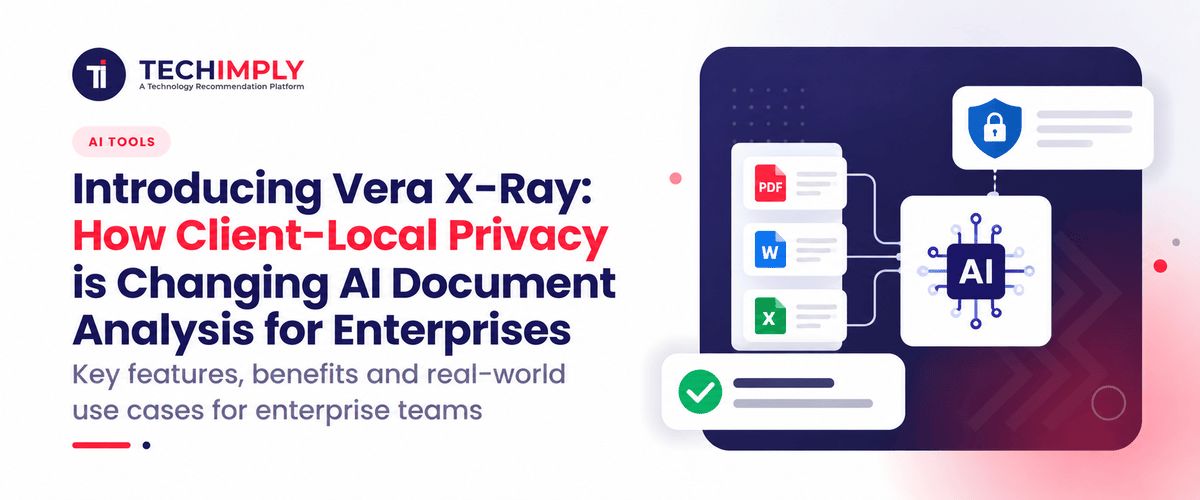
This is the core of Vera X-Ray client-local privacy: X-Ray runs locally on the user’s device, identifies sensitive data in a document, and anonymizes it right there. Only the cleaned, synthetic version goes to the external AI. The LLM can read and analyze the context, but it never sees the true identities behind it.
We call this principle privacy before prompting. Protection isn’t an afterthought applied on someone else’s server. It’s the first step, and it happens exclusively on the user’s own machine.
How Privacy Before Prompting Works
The workflow is seamless for the end user:
- Open the document: The user loads a PDF on their own device.
- Anonymize locally: Vera X-Ray finds sensitive data and anonymizes it directly in the browser/client.
- Send only the clean version: The external AI receives the de-identified content only.
- Get the analysis: The user receives highly accurate AI results without raw identities ever leaving their device.
The order of operations is critical. There are tools that offer to delete sensitive information after it is uploaded, but the original file has already been sent over the internet. In a client-local design, it is the exact opposite: the sensitive data is secured prior to any movement.
Why Client-Local Changes the Risk Profile
Where the privacy step runs determines what an outside AI provider can ever expose. If identifying details never reach the external AI, there is simply nothing for that service to leak, store, or misuse.
For enterprise software buyers, this shifts the conversation in three ways:
- A clearer answer for privacy officers: The question “what leaves our environment?” has a much more straightforward response when anonymization happens first.
- Lower breach exposure: An external cloud service can’t leak identities it never received.
- Fewer shadow-IT risks: When an approved, safe tool is provided, staff are less tempted to paste sensitive text into public consumer chatbots.
Who Benefits from Vera X-Ray?
- Law firms and legal departments can analyze contracts, discovery documents, and case files while keeping client identities strictly off external systems.
- Healthcare organizations can work with patient records and clinical documents without sending protected details (PHI) to an outside AI.
- IT managers and security teams gain an approach they can explain, document, and audit, rather than a tool they have to block.
What Buyers Should Still Ask
No feature replaces due diligence. When evaluating any AI document analysis tool, ask the following questions:
- Where is the data processed, and what exactly leaves the device?
- What gets anonymized, and how is it verified?
- What are the data retention and deletion terms?
- Is data used for LLM model training?
- What contracts apply, such as a BAA (Business Associate Agreement) or DPA (Data Processing Agreement)?
Also, remember that anonymization protects identities but doesn’t make AI output infallible. Important results should still be reviewed, and a qualified professional should make the final call. Clean inputs and human oversight must work together.
Conclusion
AI document analysis will only reach regulated professions if privacy is built-in from the start. Vera X-Ray’s client-local approach addresses the main reason lawyers, doctors, and their IT teams hold back: sensitive data should be protected before it travels, not after.
If you’re evaluating AI tools for a legal, healthcare, or other data-sensitive team, begin with one question: where does the identifying data go? With privacy before prompting, the answer is that it safely stays on the device.