Due to the rapid speed of economic development, both the manufacturing and distribution sectors have seen a shift in their strategic perspective. While vertical integration has been promoted in the manufacturing and product development industries, the idea has been relegated to the background as businesses increasingly focus on enhancing their core strengths.
In the meanwhile, regional segmentation of total product demand has resulted in a substantial reduction in the product life-cycle. All of these Big Data analytics solutions have increased the difficulty of managing the supply chain. Customers, on the other hand, have grown more demanding in the distribution industry. Therefore, features such as dynamic shipment routing, just-in-time supply, same-day delivery, and other similar concepts have become critical components of logistics operations.
The enormous effect of e-commerce on conventional brick-and-mortar shops is just one prominent example of the data-driven revolution that is sweeping numerous sectors and business processes at the moment, according to Gartner. Few businesses, on the other hand, have been able to use to the same extent the "big analytics" methods that have the potential to revolutionize the way corporations design and manage their supply chains.
What Is Large Supply-Chain Analytics, And How Does It Work?
Data and quantitative techniques are used to enhance decision-making for all operations across the supply chain, as a result of big supply chain analytics. In specifically, it introduces two novel features. As a first step, it broadens the dataset available for analysis to include information other than the conventional internal data stored in ( enterprise resource planning ) ERP software and supply chain management (SCM) systems. Second, it uses sophisticated statistical techniques for both new and old data sources, resulting in a more complete picture.
This generates fresh insights that may be used to enhance supply chain decision-making at all levels, from improving front-line operations to making strategic decisions, such as selecting the most appropriate supply chain operating models for a given situation.
Implementation Of Big Data Services For Logistics Business:
- It is true that the implementation of big data analytics is the way ahead for logistics businesses, and in reality, when it comes to embracing big data analytics, logistics companies have an advantage over companies from other sectors.
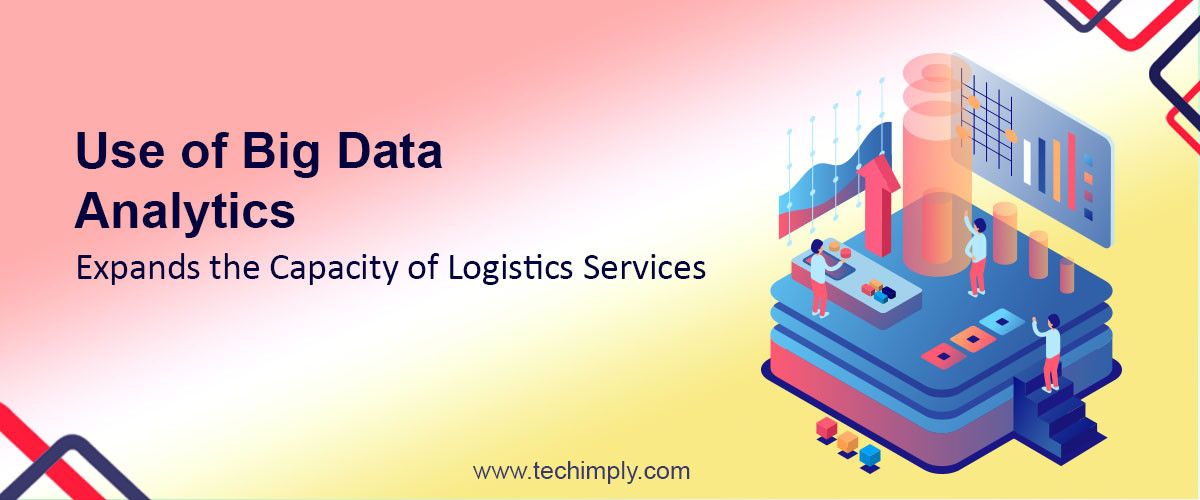
- The operational framework of a logistics operation produces a large amount of data while handling the flow of consignments across geographical boundaries – both domestic and international. Big data analytics solutions assist decision-makers in extracting value from the avalanche of data that is being generated. Big data analytics is the process of processing and refining data in order to generate value. Insights gained from this data contribute to improved customer experience, better resource management, and a more productive company model overall. The logistics sector is rapidly seeing the transformative effect of big data analytics, which is becoming more widespread.
- On the surface, logistics activities seem to be concerned with the movement of consignments from one location to another. One may wonder how much in-depth knowledge of big data software analytics is needed in this case. It is really the sheer volume of consignments and destinations that transforms what seems to be a straightforward process into a gigantic undertaking, and it is here that big data analytics comes into play.
- The logistics businesses depend on fast and correct information in order to maximize resources and delivery times, as well as to increase service delivery coverage and coverage. Big data analytics, combined with cutting-edge prediction methods and real-time processing, provides actionable information that may be used to improve capacity forecast and resource allocation.
- When it comes to making last-mile deliveries more efficient, big data analytics may make a significant difference. Logistics firms may improve the overall performance of their delivery fleets by optimizing delivery routes in real-time. Real-time data collected by big data analytics may be used to change delivery routes based on the current traffic situation, according to the company. Companies, on the other hand, can make accurate capacity demand projections and sensible investments in storage and fleet capacity by evaluating historical capacity usage data.
- It is expected that big data analytics would completely change operations management, whether it is warehousing or first mile, mid-mile, or last-mile deliveries, by increasing the efficiency of operational decision-making. The real-time monitoring made possible by big data analytics makes the transportation process clear and efficient, and it helps to reduce costs. Big data analytics is at the heart of the smart warehouse idea, which is redefining performance and efficiency in the process.
- The logistics industry is primarily a data-driven industry. The advent of big data analytics has shown to the industry how to sift through massive amounts of data in order to uncover valuable insights. It has been successful in addressing operational constraints in order to increase operational efficiency while also improving customer-centricity. Big data analytics solutions consider data as an asset, and it makes use of the data to assist businesses in making differentiated contributions.
Conclusion
Integrating big data analytics into the logistics enterprise has ushered in a transformative generation of efficiency, precision, and competitiveness. As economic dynamics evolve unexpectedly, logistics companies navigate an increasingly complex landscape. Big Data analytics has emerged as a pivotal tool, enabling these businesses to live on and thrive in these new surroundings.
Big supply chain analytics, characterized by its expansive facts units and superior statistical techniques, gives selection-makers exceptional insights. These insights empower logistics experts to optimize operations at every stage, from the strategic selection of supply chain models to real-time path adjustments for ultimate-mile deliveries. The logistics area's heavy reliance on facts, coupled with the sheer quantity and complexity of its operations, makes Big Data analytics an essential best friend.