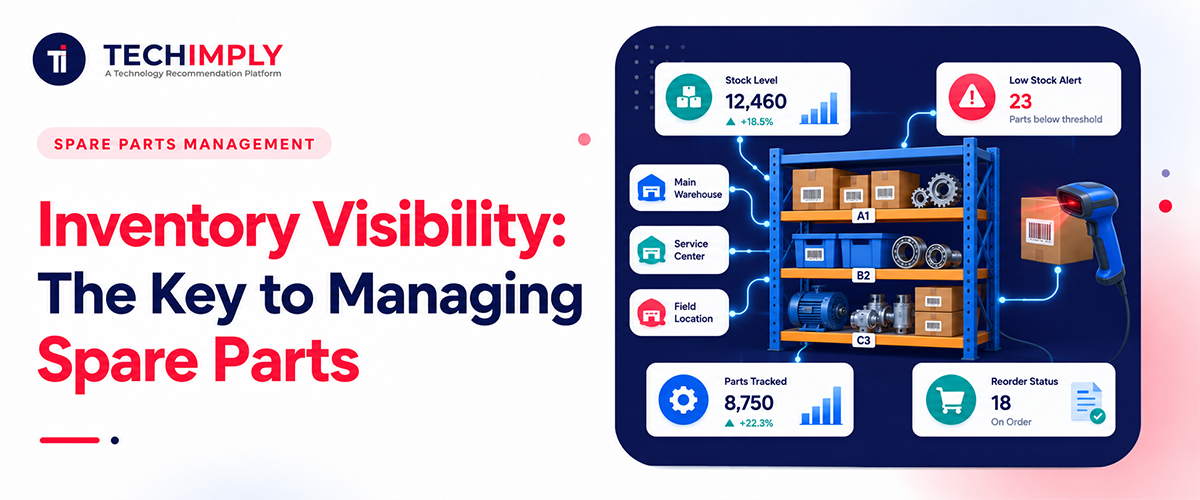
Inventory visibility is standard practice in retail and e-commerce. Demand patterns in those sectors are predictable, replenishment follows a defined cycle, and stock moves at a relatively consistent pace. Spare parts in operational environments follow none of those patterns. Their consumption is linked to equipment failure and scheduled maintenance. A single unavailable component can take a production line offline for hours or extend a planned repair into days of unscheduled downtime.
Despite this, many organizations still manage spare parts with tools and assumptions designed for finished goods inventory. The result is poor visibility into what is actually on hand, where it is stored, and whether it will be available when a maintenance event requires it. Effective spare parts management depends on a visibility framework built around the irregular, high-stakes nature of operational inventory.
What Inventory Visibility Means for Spare Parts
In retail and e-commerce inventory management, visibility typically refers to knowing how many units of a product are in stock and their position within the supply chain. For spare parts, that definition is insufficient. Operational inventory visibility involves tracking not only quantity and location but also the condition of each part, the assets it supports, and the lead time required to replace it. Parts inventory management software connects this data to active maintenance workflows so that stock information is current at the moment a technician needs a component.
Spare parts carry three visibility dimensions that finished goods typically do not:
- Location: A part recorded in the system but stored at the wrong facility is functionally equivalent to a stockout. Organizations operating across multiple sites need a consolidated view of inventory at every location to avoid unnecessary purchases and to enable transfers between facilities when stock is available elsewhere.
- Condition: Components can degrade over time due to shelf life limitations, humidity, temperature exposure, or corrosion. Visibility must extend beyond whether a part exists in the catalog to whether it is fit for installation.
- Criticality: Parts that support a primary production asset and have a lead time of several weeks require strict stock thresholds and safety stock. Assigning criticality ratings allows teams to concentrate monitoring and investment on the parts where a stockout carries the highest operational consequence.
Why Spare Parts Create Unique Tracking Challenges
Spare parts consumption is event-driven. A specific bearing might remain on the shelf for 18 months, then three units are needed within a single week following a series of equipment failures. This irregularity makes demand forecasting based on historical averages unreliable. Standard reorder models built for steady-state consumption generate either excess stock or repeated shortages when applied to spare parts.
Lead times compound the problem. Commodity parts from general suppliers may arrive in days, but specialized or OEM components can take weeks or months to manufacture and ship. When a stockout is discovered at the moment a repair is needed, there is no quick recovery if the lead time extends beyond what the operation can absorb. The gap between discovering a shortage and receiving the replacement part is where downtime accumulates.
The second major challenge is data integrity. Without standardized naming conventions, the same component often appears under multiple catalog entries. The result of these inconsistencies is inflated stock counts that do not reflect actual availability, procurement teams ordering parts that already exist under a different name, and usage reports too unreliable to inform reorder decisions. Cleaning up these records becomes progressively more difficult the longer it is deferred, because each duplicate entry generates its own transaction history and supplier associations.
The Operational Cost of Poor Spare Parts Visibility
Poor spare parts visibility produces two opposite and equally expensive outcomes at the same time. Parts that are needed are often missing or unordered, while unneeded ones accumulate in storage. Both problems trace back to the same root: the organization does not have reliable, real-time data on what it owns, where those parts are, and how quickly they are consumed.
-
Downtime
When a critical part is unavailable at the moment a repair is required, the affected equipment remains idle. In manufacturing environments, unplanned downtime costs vary by industry and asset type, but production losses measured in thousands of dollars per hour are common for primary line equipment due to the resulting idle labor, halted output, and cascading delays to downstream processes.
-
Emergency Procurement
Expedited shipping, small-quantity surcharges, and out-of-contract purchasing from alternative suppliers can drive procurement costs to three to five times the standard rate. When emergency orders become a recurring pattern, the cumulative financial impact over a fiscal year is substantial.
-
Overstocking
Without consumption data connected to actual maintenance activity, procurement teams default to overordering as a hedge against uncertainty. Over time, this approach locks capital in parts that may never be used. Storage space fills. Carrying costs increase with every additional unit that sits on a shelf without a corresponding work order.
-
Obsolete Inventory
The problem worsens when equipment is decommissioned or replaced. The spare parts associated with those assets often remain in inventory indefinitely and distort valuations because no process flags them for review. Without a systematic link between asset status and parts records, obsolete inventory accumulates silently.
Features That Support Spare Parts Visibility
The practical value of inventory visibility depends on the capabilities of the system supporting it. Several functional features directly address the tracking gaps described in earlier sections.
With real-time stock tracking, the count adjusts the moment a technician records a part against a work order. This prevents outdated counts from showing parts as available when they are already installed. It removes one of the most common sources of inventory inaccuracy: the delay between consumption and recording.
Low-stock alerts notify procurement teams when a part falls below a predefined minimum threshold. Some systems generate purchase orders automatically at that point, so reordering does not require staff to check a spreadsheet or inspect the storeroom.
Barcode and QR code scanning links each transaction to a specific part number, quantity, and work order at the point of use. A technician scans instead of typing, which removes the miskeyed part numbers and quantity errors that accumulate in manual entry systems, especially across multiple shifts.
Organizations with parts spread across several facilities need a way to see what is available at each location. Multi-location inventory views provide that from one screen. If a part is out of stock at one site but available at another, a transfer between locations costs less and arrives faster than a new purchase order.
Usage reports broken down by asset, location, and work order type show which parts are consumed most frequently and where. That data feeds directly into reorder point calculations, making each cycle of purchasing more accurate.
Building a Spare Parts Visibility Strategy
Before selecting or configuring any software, the inventory data itself has to be accurate. This involves:
- identifying and merging duplicate entries
- standardizing naming conventions across all locations
- correcting quantity discrepancies between physical stock and what the system shows
If these problems carry over into a new platform, the same stockouts and phantom inventory counts continue regardless of the tool.
With clean records in place, each part needs a criticality rating and a minimum and maximum stock level. A part with a 12-week lead time that supports a primary production asset requires a higher safety stock threshold than a commodity fastener available from local suppliers within 48 hours. Setting the same reorder logic for both results in either excess spending on low-risk parts or repeated shortages on high-risk ones. The thresholds have to match both the operational importance of the part and the time it takes to get a replacement on site.
The last structural requirement is a connection between inventory data and maintenance workflows. When parts consumption is recorded at the work order level, the system accumulates usage data over months. That data shows which parts are consumed most frequently and which assets account for the highest parts spend, and whether consumption follows seasonal or condition-based patterns. Procurement teams can then set reorder points using documented consumption rates for each part instead of using estimates carried forward from previous years.
Final Thoughts
Inventory visibility for spare parts is a structural requirement for any operation that depends on equipment uptime. The difference between a scheduled repair and an emergency shutdown often comes down to whether the right part was available at the right facility when the work order was created. Accurate data, standardized records, and software that connects inventory to maintenance activity provide this visibility. Organizations that treat spare parts inventory as an operational discipline can reduce downtime, control procurement costs, and extend the useful life of their assets.