Your relationships with customers is everything. From the first click to the final support ticket, the experience you provide shapes their loyalty.
No longer use unstructured spreadsheets and systems! It is that inefficiency that is actively harmful to your essential relationship with your clients.
The solution? A unified, strategic approach: Customer Relationship Management (CRM).

Looking for CRM Software?
Check out Techimply's List of top CRM software in india for your business.
This paper is your guide to the reasons why this technology is the only way to grow in the present day. We are going to elaborate the reason behind CRM, why Customer Relationship Management is Important, and demonstrate the 9 benefits of CRM which will crush your business. Ready to cease to process transactions and to create profitable relationships? Let's dive in.
What is Customer Relationship Management (CRM)?
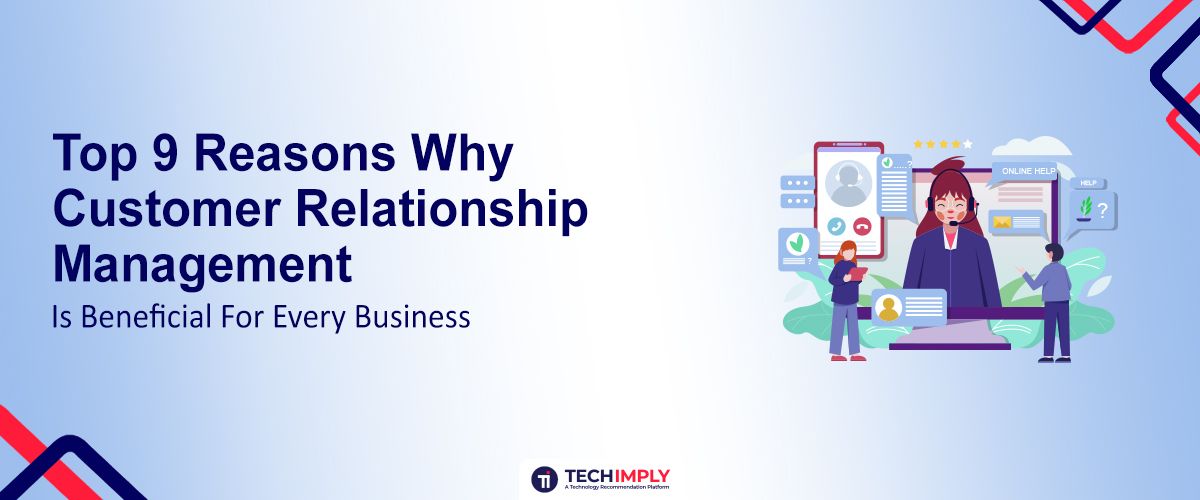
Customer Relationship Management (CRM) is a technology and strategy that is applied to control all communication and relationship between the organization and the customer and the potential customer. In essence, Company CRM System is an effective database that consolidates and structures all the data points about your customer base.
CRM software gathers information at all touchpoints such as sales, marketing, customer services, and even social media and combines all of it into one comprehensive customer profile.
How Does CRM Work?
CRM work by providing a single source of truth:
-
Data Capture: It records every call, email, meeting, purchase history, and web visit.
-
Organization: It structures this data into clear, actionable profiles and visual sales pipelines.
-
Automation: It handles repetitive tasks (like sending follow-up emails or scheduling tasks) so your team doesn't have to.
-
Insight: It generates reports and dashboards, turning raw data into predictions and strategic insights.
The ultimate purpose of CRM is to enable all the employees who engage with the customer to possess the entire context that they require to provide a relevant, efficient, and highly personalized experience to turn the first-time buyer into a loyal advocate.
No wonder, the CRM market is growing at an exceptionally rapid rate; it is currently valued at USD 101.41 billion in 2024 and is projected to reach USD 112.91 billion in 2025 and USD 262.74 billion in 2032, with a CAGR of 12.8 over the forecast period.
Why Customer Relationship Is Important
Before diving into the mechanics of the software, it's vital to grasp the importance of Customer Relationship itself. Your relationships with clients are your most valuable, non-tangible asset.
-
Financial Resilience: The importance of Customer Relationships is directly tied to profitability. Retaining an existing customer is significantly cheaper and easier than acquiring a new one.
-
Maximizing Value: Strong relationships increase the Customer Lifetime Value (CLV). Customers who trust you buy more often, spend more, and stay with you longer. This is the ultimate benefits of relationship management.
-
Competitive Edge: In markets where products are similar, the quality of your service becomes the primary differentiator. Providing benefits of good customer relationship practices creates a moat around your business.
A successful business understands that the importance of Customer Relation lies not just in the sale, but in the long-term partnership that follows. A Customer Relationship Management system is the strategic tool that enables this essential philosophy at scale.
9 Reasons Why Crm Is Beneficial For Every Business
The transition to a unified Customer Relationship Management system offers far-reaching, measurable benefits of CRM software across every single department.
1. Improved Customer Service And Satisfaction
This is the most immediate and visible of the benefits of CRM. When a customer contacts your support team, the CRM provides the agent with an instant, complete history: what they bought, when they called last, and what issues they've reported.
-
Seamless Support: No customer has to repeat their story. The service is fast, personalized, and efficient.
-
Proactive Help: By analyzing ticket patterns stored in the CRM, you can anticipate common failures and address the underlying cause before it impacts more customers. This dramatic improvement leads directly to higher customer satisfaction.
2. Increased Sales And Revenue
CRM transforms the sales process from guesswork into a data-driven engine. This delivers powerful advantages of CRM.
-
Optimized Sales Pipeline: Sales teams can visually track every single prospect, ensuring no lead falls through the cracks and focusing effort on the highest-potential deals.
-
Targeted Opportunities: The system flags existing customers who are ideal candidates for an upsell or cross-sell based on their purchase history, directly increasing the average order value and overall revenue.
3. Improved Efficiency And Productivity
One of the most valuable benefits of CRM is the time it gives back to your team.
-
Automation of Admin: The software takes over repetitive, time-consuming administrative tasks—logging phone calls, scheduling follow-ups, sending meeting confirmations, and updating contact details.
-
Focused Work: Through automation of such activities, the sales reps and support agents would be able to save time on manual data entry and more time on direct interactions with the customers and increase team productivity.

Quick Insight:
It is reported that sales representatives who actively utilize their CRM system dedicate up to 15 percent less time to administration and 25 percent to sales. This direct efficiency gain often pays for the software subscription many times over.
4. Enhanced Marketing Strategies
Marketing in the absence of CRM information is akin to shooting blindly. CRM offers the intelligence to have very effective campaigns.
-
Hyper-Segmentation: Marketers can segment audiences based on deep behavioral data (e.g., website activity, purchase cycles, last interaction date), moving far beyond simple demographics.
-
Personalized Campaigns: This segmentation allows for the creation of truly relevant, personalized content, significantly increasing email open rates, click-through rates, and lead quality. The result is better ROI on every marketing dollar spent.
5. Stronger Customer Retention And Loyalty
Loyalty is the real indicator of a great customer experience. High retention is finally is attained through CRM.
-
Nurturing the Relationship: CRM allows you to track key customer milestones and automate check-ins, birthday greetings, or anniversary messages, reinforcing the benefits of Customer Relationship Management over time.
-
Churn Prevention: By monitoring usage data and support history, the system can flag customers who show signs of dissatisfaction, allowing account managers to intervene proactively before they decide to leave.
6. Improved Collaboration And Communication
Siloes between departments are major killers of customer experience. ERP and CRM Systems often work together to ensure seamless hand-offs.
- Unified View: Every team—sales, marketing, and support—works from the same, real-time customer record. A customer's conversation with a service agent is immediately visible to their account manager.
- Smoother Handoffs: The transition of a new customer from the sales team to the service team is instant and fully documented, ensuring the client receives continuous, high-quality attention.
7. Data-Driven Decision-Making And Insights
CRM replaces intuition with hard numbers, providing the foundation for strategic business growth.
-
Actionable Reporting: Management gains access to dynamic dashboards showing real-time KPIs—sales pipeline health, conversion rates, customer acquisition costs, and time-to-resolution.
-
Forecasting Accuracy: Sales leaders can use CRM data to generate highly accurate revenue forecasts, enabling smarter decisions about hiring, inventory, and budgeting.
Do You Know?
Research suggests that businesses leveraging CRM for data analysis and reporting see an average increase of 10% to 15% in accurate sales forecasting, drastically improving strategic budgeting and resource management.
8. Scalability And Flexibility’
A key benefit of Customer Relationship systems is their ability to support growth. The CRM you choose today should handle your success tomorrow.
-
Easy Expansion: CRM software is built to scale easily, allowing you to add hundreds of new users and manage exponentially larger volumes of customer data as your business expands..
-
Adaptability: Most CRMs are highly customizable, allowing you to tweak sales stages, add custom fields, and create new automation rules as your products or services evolve, ensuring the system always aligns with your unique business processes.
9. Data Security And Privacy
For businesses, protecting sensitive customer data is a legal and ethical imperative. Modern CRM vendors provide robust security infrastructure far superior to local storage.
-
Centralized Security: Data is stored in secure, cloud-based data centers protected by high-level encryption, redundancy, and continuous monitoring.
-
Compliance Support: CRM tools help businesses adhere to strict global privacy regulations (like GDPR) by centralizing data access controls and providing comprehensive audit trails, reinforcing the Importance of Relationship Management built on trust.
Conclusion
Customer Relationship Management (CRM) is not another software tool that your sales team will use. It is the biggest investment you can make on the way your entire business will work.
When you adopt a CRM system, you're not just buying features. You are buying:
-
Immediate Returns: Better service, faster money, and an easier workday.
-
Lasting Trust: The kind of loyalty that keeps customers coming back.
Whether you're hunting for the perfect benefits of CRM software for your tiny startup or trying to fine-tune a massive corporation, the rule is simple: You have to know your customers.
So, stop managing spreadsheets and start building genuine, profitable connections. Your competitive advantage is waiting in the strength of your relationships—and your CRM is the engine you need to drive it.
Suggested Read:
- What to Consider When Choosing CRM Software for Your Business
- Maximising Sales and Customer Loyalty: How CRM Software Can Transform Your Business
- Top CRM Software Trends To Watch In 2024 For Business Success
- Why Your Business Needs a Real Estate CRM Software: The Benefits Explained
- CRM Software Development for Healthcare: Why Use It and Its Benefits
- 7 Top Features to Consider When Buying a Real Estate CRM Software
- The Evolution of CRM Software: What Businesses Need to Know
- Choosing the Perfect Real Estate CRM Software: What Indian Real Estate Agents Need to Know