A proof of concept is critical in the testing of the viability of an idea before committing much time or resources to the idea. It enables the teams to identify the technical issues, determine the possible risks, and estimate the chances of success. The knowledge of the POC full form will illuminate the fact that it is not only a prototype but a targeted experiment to show viability. An effective proof of concept will save money, help develop a strategy, and create confidence in proceeding with full-scale implementation.

Looking for Product Management Software?
Check out Techimply's List of the Best Product Management Software in India for your business.
What Is A Proof Of Concept(POC)?
A proof of concept is basically a small-scale trial that is done to check if an idea can actually be put into practice. It makes people think about whether a project is feasible before they go on and use their time and money for its full development. Simply, POC means to prove the concept. It is not the end product but a little experiment that will look at whether the main idea is feasible.
Proof of Concept is the POC full form of a project in the corporate or IT world. It assists companies and teams in establishing the fact that a new idea, product, or feature is possible to create. A POC is commonly applied in software development to test new technology or functions early in the development process. It will minimise risk, save money, and offer a good indication that the idea is a working one. The project management software market size was valued at USD 8.72 billion in 2024 and is projected to grow from USD 10.33 billion in 2025 to reach USD 40.12 billion by 2033

Data Insight
Within B2B marketing, a thoroughly planned POC generally resulted a return on investment from 300% to 600% as per a company study, that is, every unit put into the POC gave back several units.
When And Why To Use A Proof Of Concept (POC)
A proof of concept can come in handy in cases where you wish to test something new or add a new feature. It helps determine whether you have a realistic understanding of your plan or not.
Creating A New Project Idea
- Whenever you venture into something you have never done before, you are always skeptical about whether it will be successful. Doing a POC helps you:
- Determine whether the idea can be done technically.
- Test whether it is useful to the users.
- Make clients or managers invest.
Adding A New Feature To A Project
- POC can assist you when you are adding something new to the current software by:
- Test the new capability without impacting existing work.
- Find technical issues early.
- Save time and avoid rework.
Top Benefits Of Creating A Proof Of Concept (POC)
A proof of concept is an exercise that can assist a business in determining that a particular idea is viable before committing all resources. It is aimed at establishing the real-life value and technical feasibility of the idea. In simpler terms, proof of concept meaning is to ensure that something can actually work before engaging in large-scale work.
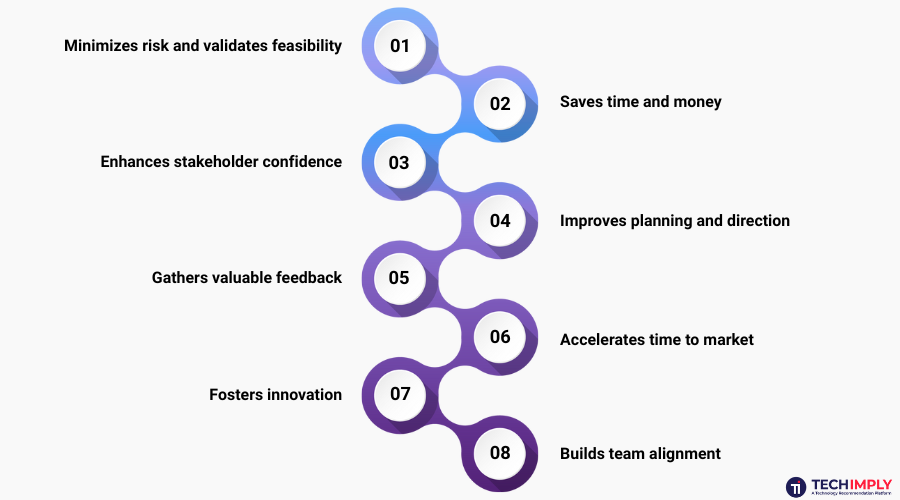
1. Minimizes Risk And Validates Feasibility
A POC minimizes the risk in a project because it will demonstrate that the main idea is possible. It assists in identifying technical and business problems at an early stage. This would help in making the decisions. In project management systems in India run smoothly and reduce the risk of making costly errors.
2. Saves Time And Money
A POC is time and cost-saving by emphasizing the most important functions. Teams do not work on features that can fail or are not useful. This facilitates the effective management of resources and budgets in complicated projects.
3. Enhances Stakeholder Confidence
Whenever you present a working POC model, it creates confidence among the clients and investors. The stakeholders are able to view evidence of outcomes, but not only propositions. This openness enhances trust and wins over the entire project.
4. Improves Planning And Direction
A POC provides a clear picture of what works and what does not. It assists the teams in planning the ultimate development with realistic objectives. POC in the project is also associated with enhanced knowledge of time, tools and talent requirements.
5. Gathers Valuable Feedback
Operating a POC enables the teams to receive user feedback early. Such insights can be used to create improved features and prevent user dissatisfaction of users in the future. This action contributes to the easier process of development and better outcomes.
6. Accelerates Time To Market
Ahead of time testing creates less trouble when it comes to the actual launch. As the challenges are predetermined, a team can work faster and give the product to the users faster.
7. Fosters Innovation
A POC promotes experimentation. Developers are not scared to test new ideas and technologies. It assists businesses in embracing the current practices without fear. This is one of the reasons why POC in corporate matters is an important part of an innovation culture.
8. Builds Team Alignment
A functional POC maintains an agreement between all. The vision is the same among designers, engineers, and managers. This clarity enhances teamwork and minimizes confusion in the project.
Fun Fact
Various organisations emphasize that a thoroughly implemented POC is the main factor that raises the confidence level of all stakeholders, as the concept is supported by data, not just trust.
How To Write A Proof Of Concept(POC): Step-By-Step Guide
A proof of concept is developed in small, proper stages to validate the feasibility of the idea. The stages will ensure that you are sure that this project has potential and is ready to develop. Knowing what a is POC and having a systematic approach is a guarantee of success.
-
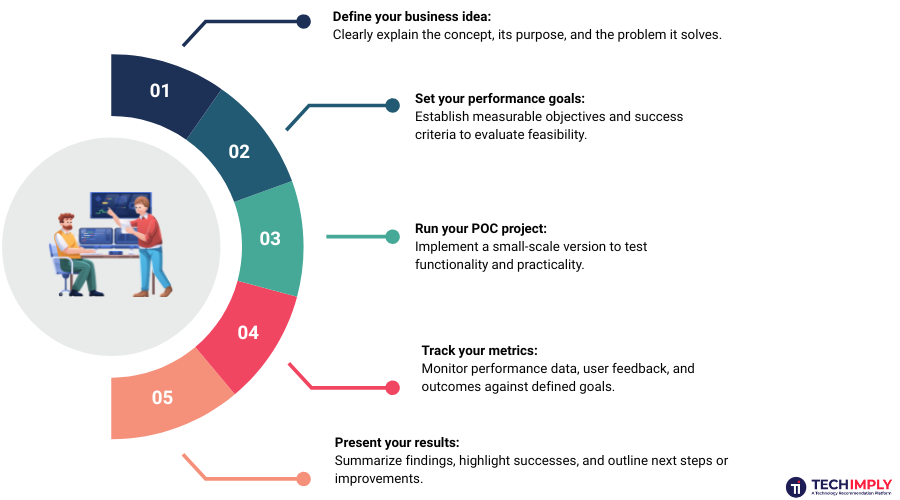
Define Your Business Idea
Begin by stating what issue will be addressed by your project. Identify your primary idea, target audience, and purpose. Such is clear enough to enable one to design a strong foundation before the commencement of the test.
-
Set Your Performance Goals
Write down specific and quantifiable objectives. It may be speed, efficiency, or standards of accuracy. The set goals should be defined at the very beginning of the process to compare the real results with the expected ones and monitor the progress.
-
Run Your POC Project
Create a miniature of your project. Test just the main functionality or concept. This will make sure that you are gathering workable information regarding feasibility at the time when construction of the full system has yet to be done.
-
Track Your Metrics
Note down everything and monitor their achievement in relation to your objectives. Examine success and identify issues using minimal tools or dashboards. In business, a POC (Proof of Concept) is a business initiative that involves the use of metrics in order to demonstrate whether a project is really progressing as expected.
-
Present Your Results
Create a brief proof of concept document example with a summary of findings, results, and the next steps. Provide images, schedules, and technical descriptions. This report is used in poc means in software, to enable teams to determine whether the idea is worth proceeding with its development.
Real-World Examples Of Proof Of Concept (POC)
A proof of concept is used to assist companies in testing the concepts and methods before they plunge in. Mostly, it is applied in business and software to minimize the risks and test the feasibility. Proving the meaning of proof of concept assists the teams in applying it in real-life situations.
Here are Proof of Concept (POC) examples employed across various sectors to assess viability and reduce potential hazards prior to comprehensive deployment.
-
POC In Business Development
POC in business is usually employed by companies to test a new business idea or strategy. It enables them to check the response of the market and its profitability before they indulge in huge investments. Early testing in business is a way of reducing risk and enhancing decision-making.
-
POC In Project Management
POCs are a tool that project teams can use to determine whether their technical plan or workflow is feasible. Such a method will make resources, timelines, and tools adequate. Another way that a poc in a job assists the employees is to realize the responsibilities and viability during a project position.
-
POC In Product Development
The teams make a small prototype or test module before making a complete product. It shows the functionality of features and determines technical difficulties. poc in software, developers may undertake tests on new functionalities to facilitate the implementation.
-
POC In Marketing And Sales
POCs are applied by marketing teams in order to test campaigns or new sales strategies. A pilot campaign is done to indicate possible engagement and ROI before a full launch. Companies can go further to rely on a proof of concept template where results are outlined and insights shared with stakeholders.
POC Vs. Prototype: Key Differences Explained
POC (Proof of Concept)
- A proof of concept is an initial experiment to prove whether an idea or solution can be completed technologically before it is actually developed.
- In a POC in business, the primary objective is testing feasibility, not design nor performance. It assists businesses in making decisions on whether an idea is worth pursuing or not.
- POC within a company, small tests or pilot projects are carried out in order to find out the risks, approximate costs, and technical compatibility.
- The full form of POC in the IT industry is Proof of Concept. It is frequently applied to IT projects to determine whether a new technology, integration, or software tool can work in reality or not.
- To keep the process organized, teams tend to develop a POC document template where they will document goals, success criteria, resources utilized, and the results of the tests.
- The result of a POC is normally either a “Go” or a “No-Go” decision, depending on the viability of the concept.
Prototype
- A prototype is a working model or a visual representation of a product that is developed into existence following the proof of concept phase.
- It is primarily intended to demonstrate the appearance of the end product and how it works in practice.
- Prototypes are less technically feasible and more user-oriented, design and interface-oriented.
- They enable teams to receive responses, whether positive or negative, from clients or users and implement design changes before mass production.
- A prototype is more interactive as opposed to a POC; it assists the stakeholders in visualizing and trying the product in terms of usability.
- A prototype does not need to be documented in detail as a POC document template, but rather, it is aimed at smoothing the appearance and functionality.
Conclusion
A Proof of Concept (POC) is an essential part of a concept that is feasible, functional, and may be successful before going all the way. It helps teams identify technical problems at the initial stage, test the viability of the market, and optimize their strategies with minimum risk and costs. A POC, regardless of whether it is used in business, software, or product development, is the difference between theory and implementation, to make an informed decision. A POC is different from a prototype; it is not so much about the design and usability, but rather to demonstrate that the technology can work. Ultimately, a proper POC is the one that leads to innovation, wins the confidence of stakeholders, and lays down a solid foundation for a successful project inception and implementation.