The job market is constantly evolving, and with it, the methods companies use to screen top talent. Traditional phone screens and in-person interviews are increasingly being supplemented, or even replaced, by innovative digital solutions. This self paced video interview format is now a standard part of the recruitment process for companies looking to streamline their initial screening, offering both speed and flexibility.

Looking for Video Interview Software?
Check out Techimply's List of the Best Video Interview Software in India for your business.
As we move into 2026, proficiency in this digital format is essential. For candidates, this means mastering a new format: the one way video interview. This comprehensive guide will equip you with the knowledge, strategies, and tips you need to confidently navigate and succeed in your next one-way video interview, ensuring you stand out to recruiters and secure the next step in the hiring process.
What is a One-Way Video Interview?
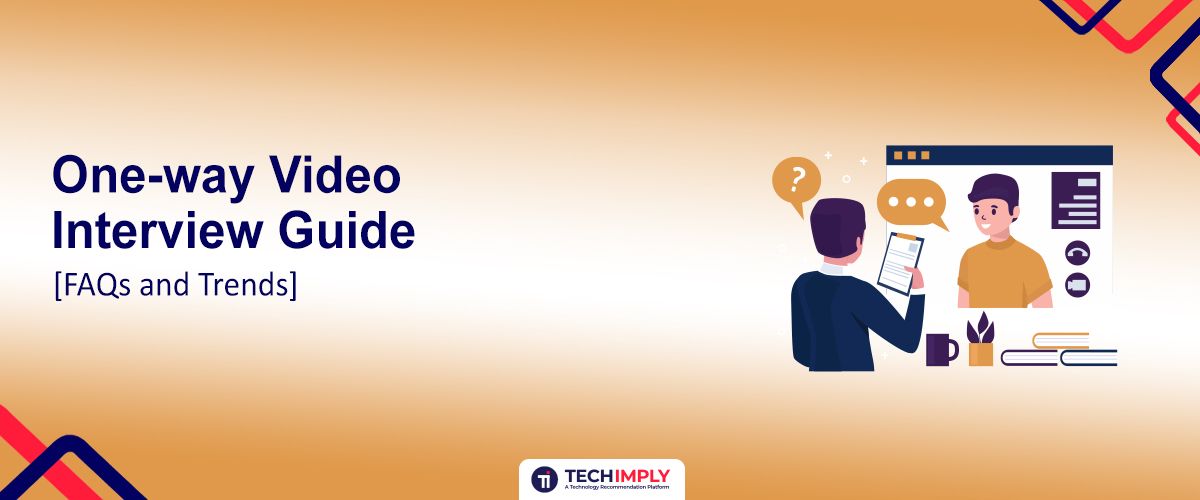
A one-way video interview, often referred to as an on-demand interview or asynchronous interview, is a non-live screening tool where a candidate records their answers to a set of predetermined questions. Unlike a traditional two-way (live) video interview where you interact in real-time with an interviewer, the one-way format involves no live human interaction.
Here's how it generally works:
- The employer sends you a link via a dedicated one way video interview platform or software.
- You log in, often within a specific timeframe (e.g., 48-72 hours).
- The questions, which may be presented as text on the screen or as a prerecorded video by a hiring manager, appear one by one.
- For each question, you are typically given a brief preparation time (e.g., 30-60 seconds) followed by a set recording time limit for your response (e.g., 1-3 minutes).
- You record your answer and move to the next question until the session is complete.
- The employer then reviews your recording at their convenience.
This format is primarily used by companies for high-volume roles to quickly and consistently screen candidates, giving you an early opportunity to showcase your communication skills and personality beyond your resume. Understanding what is a one way interview is the crucial first step to preparing effectively.
Why Do Candidates Use One-Way Interviews?
Another question that many candidates are left asking after an interview is why employers prefer this type of interview. As a matter of fact, one way video interviews are not only beneficial to the recruiters but also to the applicants.
A one way interview is used by the candidates since they are able to demonstrate their capabilities without facing the pressure of an on-the-spot interrogation. You have a chance to find a peaceful setting, think over your answers, and speak with assertiveness. One way video interviews save on traveling, time pressure, and stress on scheduling among the freshers and remote applicants.
 Do You Know?
 In 2026, over 70% of mid-sized companies are expected to rely on one way video interviews for initial screening.
List of Sample One-way Interview Questions and Answers
A one-way video interview often features a mix of common and behavioral questions. Your goal is to deliver concise, structured, and job-relevant answers. We recommend using the STAR Method (Situation, Task, Action, Result) for behavioral questions.
1. Tell me about yourself
This is your elevator pitch. It must be business-like, short (60-90 seconds) and to the point.
Answer Strategy: The Present-Past-Future.
- Present: What is your position and one of your most important tasks/recent successes?
- Past: Briefly mention relevant experience that led you here.
- Future: Try to tie together your experience to the job and what you are excited about in this position.
2. What are your Strengths?
Focus on 2-3 strengths that are critical to the job description and support them with brief, specific examples.
Answer Strategy: Pick job-relevant skills and follow up with a quick example of the skill in action.
-
Example: "My greatest strength is my ability to quickly adapt to new technologies. In my last role, when the company switched to a new CRM system with only a week's notice, I took the initiative to master the platform over the weekend and then created a quick-start guide that helped my entire team transition smoothly and maintain productivity."
3. Where do you see yourself in 5 years?
The interviewer wants to gauge your ambition and, more importantly, whether your goals align with a long-term future at their company.
Answer Strategy: Show realistic, industry-aligned ambition that could be fulfilled within the company's growth trajectory.
-
Example: "In five years, I see myself as a subject matter expert in [relevant area] and potentially leading a small team focused on [specific function]. I am drawn to your company's commitment to internal professional development, which I believe would allow me to take on increasing responsibility and contribute to your long-term goals in [mention a company goal]."
4. Why Should We Hire You?
This is your final sales pitch. Be confident and clearly state your unique value proposition. Avoid simply restating your resume.
Answer Strategy: Combine your unique skills, passion for the company, and specific impact you can make.
-
Example: "You should hire me because I offer the ideal blend of three things: five years of hands-on experience in [skill 1], a proven track record of [achievement], and genuine excitement for your company’s mission. I believe my ability to [unique value proposition, e.g., "streamline processes"] aligns perfectly with your immediate need for a highly efficient [Job Title]."
5. How Do You Handle Feedback?
This question assesses your coachability, self-awareness, and professionalism.
- Answer Strategy: Use the STAR method to structure your behavioral response.
- Situation: Briefly describe a time you received constructive criticism.
- Task: Explain what you were trying to achieve.
- Action: Detail the specific steps you took to process the feedback and implement changes.
- Result: Conclude with the positive outcome and what you learned.
Looking for Applicant Tracking System?
Check out Techimply's List of the Best Applicant Tracking Systems in India for your business.
List of Tips for Acing a One-Way Video Interview:
Success in your next one-way video interview hinges on preparation and presentation. Follow these one way video interview tips to ensure you are at your best.
1. Technical Setup Checklist
A polished video is your first impression. Treat this as seriously as the in-person interview attire.
- Internet: Use a wired connection if possible, or ensure your Wi-Fi signal is strong.
- Audio: Use a quality external microphone or a headset with a clear mic. Audio quality is arguably more important than video.
- Video: Position the camera (laptop or external) at eye level. Look directly into the camera lens when speaking, this mimics eye contact with the reviewer.
- Lighting: Sit facing a window or use a ring light. The light source should be in front of your face, not behind you.
- Background: Use a clean, professional, and clutter-free background. A plain wall is ideal. Disable all non-essential desktop notifications.
2. Body Language
You will not have a live interviewer so you have to be more deliberate with nonverbal cues.
- Posture: Sit straight up, and make a slight forward bend in order to demonstrate interest.
- Energy: Smile! Express interest in the opportunity.
- Hands: Natural hand gestures should be used, but they have to be within the camera and must not fidget too much.
3. Communication Cues
Mastering your spoken delivery is vital for a positive self paced video interview experience for the reviewer.
- Pace: Use a slow and clear pace of speaking. Do not hurry, particularly when the timer is on.
- Tone: Be very warm, appealing and professional. Change your tone so as not to appear monotonous or robotic.
- Look at the Camera: It is easy to stare at your own image on the screen, but being in constant motion of staring at the camera lens is the only way to achieve eye contact.
4. Practice with Mock Questions
Practice is what turns a good answer into a great one.
- Record yourself answering potential one way interview questions using a timer. This will reveal if your responses are too short or too long or if you fidget or ramble.
- Review the recordings, focusing on your clarity, time management, and nonverbal communication.
5. Use the STAR Method:
For behavioral questions, the STAR method is your map to a structured, complete answer.
|
Phase |
Description |
What to Include |
|
Situation |
Set the scene. |
What was the context? Who was involved? |
|
Task |
Explain your goal. |
What was your responsibility or objective? |
|
Action |
Detail your steps. |
What specific, measurable actions did you take? (Use "I" not "We") |
|
Result |
Describe the outcome. |
What was the positive result, and what did you learn? |
Pro-TipBefore beginning your one-way video interview, wear the professional attire you plan to use for your next live interview. Dressing the part will mentally put you in the right frame of mind, boost your confidence, and translate into a more professional on-screen presence.
Benefits of One-Way Video Interviews:
As a candidate, it is important to see the benefits of this format and is possible to rethink the experience as an opportunity instead of a chore. Being aware of what a video interview is under this context makes you know that you are up-to-date and ready.
1. Flexibility
The option to document your answers when it is most convenient to you, be it late at night, early morning, etc., is unquestionably superior to traditional scheduling. This eliminates the pressure of having to coordinate with the calendar of a recruiter.
2. Control over your Environment
You get rid of the high-stakes stress of a boardroom. By interviewing in your cozy, pre-vetted environment, you can give 100 percent attention to your responses, as opposed to being lost in a new office.
3. Ability to Rerecord Responses
This is a safety valve that cannot be used in a live interview. In case you fall or lose your flow or there is a small technical malfunction on the platform that offers re-records, then you can reset and post the best work you have.
4. Time to Prepare Your Answers
The asynchronous format also gives you time to do in-depth research about the company and practice your responses to the questions you expect in the interview, which increases the quality and depth of the responses you would give if you were on the spot.
Latest Trends in One-Way Video Interview in 2026
The landscape of recruitment technology is rapidly advancing, and in 2026, the one way video interview is integrating sophisticated features that impact how you should prepare. The video interviewing software market size was valued at USD 250.05 million in 2023 and is projected to reach USD 891.85 million by 2030, growing at a CAGR of 17.1% during the forecast period 2024-2030. Many companies also use best webinar platform for virtual recruitment events and candidate presentations.
1. AI-Powered Analysis and Scoring
Modern one way video interview software platforms are increasingly using Artificial Intelligence to analyze candidate submissions. The AI may transcribe responses, flag keywords from the job description, assess communication clarity, and even analyze speech patterns (pace, tone) and facial expressions. Your preparation must now focus on clarity, keyword inclusion, and measured pacing.
2. Deep Integration with ATS
Expect seamless transitions. The Applicant Tracking System (ATS) used by a company will be deeply integrated with the one-way video platform. Your video submission immediately connects to your profile, automating the scoring and shortlisting process. This means your responses are reviewed faster than ever before, speeding up the time-to-hire.
3. The Rise of Scenario-Based Questions
Moving beyond generic questions, more companies are presenting candidates with role-specific, scenario-based challenges (e.g., "A client sends an urgent, complex request; how do you prioritize this with your existing workload?"). This measures practical problem-solving skills in a high-fidelity environment. Prepare by thinking of specific, relevant project examples from your career.
4. Focus on Diversity and Inclusion (D&I)
Platforms are being developed with bias-reduction features. By standardizing the questions, time limits, and initial evaluation criteria, the goal is to assess all candidates on a level playing field, reinforcing the fairness inherent in a structured, asynchronous process.
Looking for Free Video Interview Software?
Check out Techimply's List of the Best Free Video Interview Software in India for your business.
Conclusion
The one-way video interview is here to stay, evolving into a sophisticated tool for both employers and candidates. By understanding what is a one way video interview and strategically preparing your technology, environment, and content, you transform this screening step from a nerve-wracking hurdle into a unique opportunity. In 2026, success lies in your ability to present your authentic, professional self with technical polish and structured communication. Focus on your delivery, master the STAR method, and use the provided flexibility to your advantage. Your next great career step is just a confident recording away.
Suggested Read:
Video Interview Software: Definition and Key Features
Why Your Company Needs Video Interview Software Today
Video Interview Software: Guide for Recruiters & Hiring Managers
Picking the Right Applicant Tracking System in the Market
Top 10 Ways of Using Applicant Tracking System to Save Efforts