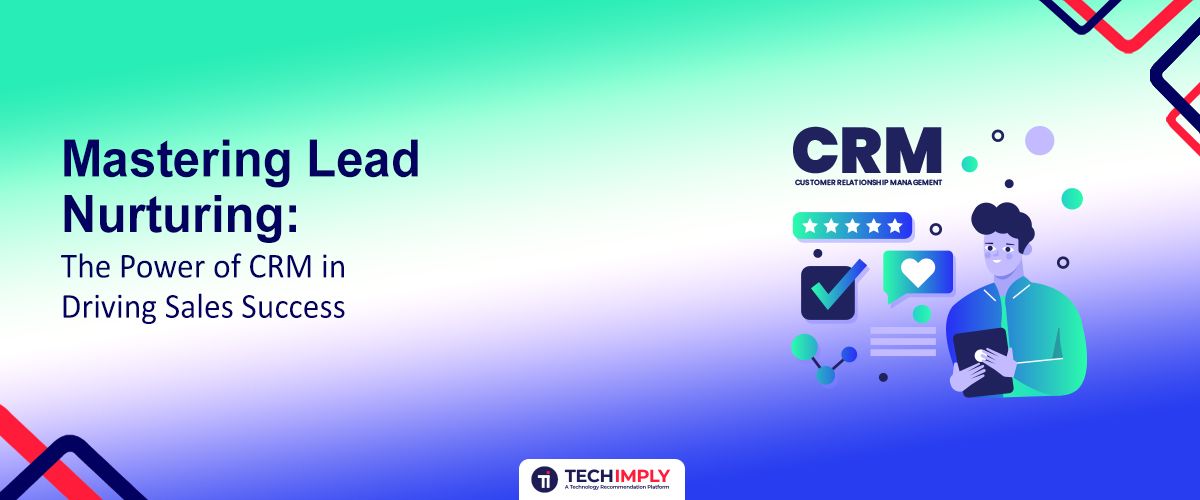
In sales or marketing, you are aware of the frustrating fact: most leads are not prepared to purchase the initial contact. Actually, according to the research, only approximately 25% of leads are sales-ready, i.e., a huge 75% of your pipeline requires time, nurturing, and coaching before turning into a customer. Here is where the CRM and lead nurturing assistant come in as the strategic art. It is not merely the case of a few emails that will help in the successful conversion of these non-ready leads into actual sales.

Looking for CRM Software?
Check out Techimply's List of the Best CRM Software in India for your business.
It is a case of forming a relationship, adding value, and being able to time the engagement perfectly. And in the very center of all this activity is one technology that cannot be ignored: your CRM. This blog will explain the basics of successful lead nurturing, why it is the most effective lead nurturing method to grow your revenue, and how you can use your CRM to manage and nurture your leads to reach unmatched sales.
What is Lead Nurturing?
Lead nurturing is the process of building relationships with qualified prospects at every stage of the sales funnel. It focuses on providing leads with the information they need, when they need it, with the goal of guiding them toward a purchase decision. It’s an ongoing process that is personalized, educational, and trust-building.
-
Lead nurturing builds relationships with qualified prospects across all stages of the sales funnel.
-
It is an ongoing, personalized, educational, and trust-building process.
-
Acts as a strategic dialogue moving prospects from awareness to buying intent.
-
Effective CRM tools automate and personalize nurturing at scale.
-
Ensures no lead is left behind or forgotten.
-
Focuses on credibility and trust rather than immediate sales.
-
Provides educational value through insights and resources tailored to lead needs.
-
Personalizes communication based on lead behaviour, interests, and stage.
-
Scales engagement across thousands of leads without losing the human touch.
Think of it as the strategic dialogue you have with a potential customer, moving them from "I've heard of you" to "I want to buy from you." A truly effective crm and lead nurturing assistant is one that allows you to automate and personalize this journey at scale, ensuring no lead is ever left behind or forgotten
Why Lead Nurturing is So Important:
If you’ve ever experienced the struggle of high-volume lead generation with low conversion rates, you’ve likely suffered from inefficient crm and lead nurturing assistants. The cost of acquiring a lead is substantial; failing to nurture them represents a significant loss of marketing investment and potential revenue.
Lead nurturing is not a luxury; it is a fundamental business necessity that directly impacts your bottom line.
1. Increased Conversion Rates:
Nurture leads typically make larger purchases, and nurturing campaigns can generate a significant percentage more in sales-ready leads than non-nurtured campaigns. When you use your CRM with lead nurturing capabilities to deliver timely and relevant content, you dramatically increase the likelihood of a prospect choosing you over the competition.
2. Improved Sales Efficiency
By implementing a structured lead-nurturing process, your sales team receives prospects who are already warm, informed, and closer to a purchase decision. This means they spend less time on cold-calling and introductory conversations and more time on closing deals. The sales team can trust that every lead in CRM has been properly qualified and engaged.
3. Enhanced Customer Relationships
The entire nurturing process is centered on providing value before asking for the sale. This consistent, helpful engagement builds trust and credibility, the bedrock of any lasting customer relationship. Prospects view your company as an informed partner, not just a vendor.
4. Higher Customer Lifetime Value (CLV)
A customer whose lead has been cultivated well will be a loyal, satisfied customer. This will result in lower churn, higher repeat business, and Higher Customer Lifetime Value (CLV). The secret of following these long-term engagements lies in your CRM for lead nurturing.
5. Better Understanding of Customer Needs
Each contact of a lead with your nurturing content (opening an email, downloading an e-book, visiting a landing page) gives valuable data. This behavioural data is captured by your CRM, which enables you to gain deeper insights into their areas of pain, interests and purchase intention, which enables you to further streamline your content strategy.
6. Cost-Effective Marketing
Conversion of an existing lead is much less costly than obtaining a new one. An effective lead-nurturing plan will transform your marketing process into a more efficient one, and low-cost content will convert into a high-value one.
Also Read: How to manage your CRM system in 2025
What Are the Best Practices for Nurturing Leads with CRM?
A well-developed CRM system is inseparable from the strategy that it is based on. In order to turn your lead list into a revenue engine, you need to employ a systematic strategy on your crm lead nurturing software. Here is a guide on how do I use crm to nurture leads effectively:
1. Define Clear Goals
Every nurturing campaign must have a measurable objective. Is the goal to move a subscriber to a free trial? To encourage an MQL (Marketing Qualified Lead) to become an SQL (Sales Qualified Lead)? Define specific, measurable, achievable, relevant, and time-bound (SMART) goals. Your crm lead records should reflect these goals by tracking progress accurately.
2. Develop Buyer Personas
You cannot nurture everyone the same way. The first step is to create detailed buyer personas, semi-fictional representations of your ideal customers based on real data and educated guesses about demographics, behaviour patterns, motivations, and goals. Your CRM data provides the foundation for building and refining these personas.
3. Map the Customer Journey
Next, you need to map out the entire customer journey, from initial awareness to post-purchase advocacy. Divide this journey into key stages (e.g., Awareness, Consideration, Decision) and identify the specific questions and pain points a lead has at each stage. This map is the blueprint for your lead nurturing software campaigns.
4. Utilize Targeted Content
Once the journey is mapped, assign relevant content to each stage:
-
Awareness Stage: Blog posts, infographics, and checklists (content addressing the problem).
-
Consideration Stage: E-books, guides, webinars, and case studies (content offering solutions).
-
Decision Stage: Product demos, free trials, testimonials, and pricing sheets (content comparing options).
The power of an integrated crm for lead management and nurturing is its ability to automatically deliver this highly targeted content based on a lead’s stage and behavior.
5. Leverage Automation
This is where the CRM truly shines. Automation is the engine that drives scalable, personalized nurturing. How can I use a crm to improve my lead-nurturing process? By setting up automated workflows, or 'drip campaigns,' based on triggers.
-
Behavioral Triggers: If a lead downloads a specific e-book, the CRM automatically enrolls them in a follow-up email sequence related to that topic.
-
Time Triggers: If a lead has been inactive for 30 days, send a re-engagement email.
-
Lead Scoring: As leads interact with content, their score increases. Once a lead reaches a certain score, the CRM alerts the sales team for a direct follow-up, ensuring the sales rep is engaging a qualified prospect.
6. Embrace Multi-channel Nurturing
Effective nurturing extends beyond email. A comprehensive CRM with lead nurturing capabilities should facilitate multi-channel engagement:
- Email Marketing: This remains the core of nurturing. Personalized, segmented emails are essential. Use the CRM to segment your audience by industry, job title, behavior, and lead score.
- Social Media Marketing: Retargeting ads on platforms like LinkedIn or Facebook can keep your brand top-of-mind. If a lead visits your pricing page but doesn't convert, a follow-up ad showcasing a testimonial can be highly effective.
- Content Marketing: This includes the educational assets mentioned above, blog posts, white papers, and videos, that continuously feed value to your leads.
- Sales Calls
For high-value, high-scoring leads, a well-timed, personalized sales call is critical. The sales rep can use the complete history captured in the lead in crm profile (web activity, email opens, and content downloads) to tailor the conversation perfectly.
Why is Lead Nurturing Essential?
To summarize the immense value proposition, nurturing is essential because it fundamentally shifts the dynamic between your company and its prospects. This essential need for structured engagement is why the lead management software market size was valued at USD 19.12 billion in 2024 and is projected to reach USD 44.23 billion by 2035, growing at a CAGR of 7.92% from 2024 to 2035. This robust growth underscores the universal recognition that professional lead management and nurturing are non-negotiable for future revenue.
-
Builds Trust and Credibility: You become a resource, not a sales pitch.
-
Improves Conversion Rates: It transforms uninterested prospects into sales-qualified opportunities.
-
Shortens the Sales Cycle: Well-informed leads make faster decisions.
-
Increases Sales Opportunities: You keep pipeline opportunities alive that would otherwise go cold.
-
Enhances Customer Lifetime Value (CLV): Nurtured customers are more loyal.
The ultimate goal of using your CRM for this strategic process is to ensure every potential customer receives a personalized, valuable experience, proving that your company understands their needs and can solve their problems.
Conclusion
The future of sales success is inextricably linked to the efficiency and effectiveness of your lead-nurturing strategy. By treating your CRM software not just as a database but as the central, intelligent engine for customer relationship building, you move beyond scattered outreach and into systematic, scaled personalization. Mastering lead nurturing means mastering the customer journey. By applying the best practices outlined above, defining goals, leveraging automation, and committing to multi-channel engagement, you can transform your pipeline, dramatically improve your conversion rates, and secure lasting sales success.
Suggested Read:
- The Importance of CRM Training & Support for Financial Advisory Teams
- How Recruitment CRM Makes Hiring Faster and More Efficient?
- CRM Software Development for Healthcare: Why Use It and Its Benefits
- Top 5 CRM features for Healthcare
- What is a Healthcare CRM? How to Manage Patient Relationships
- 7 Top Features to Consider When Buying a Real Estate CRM Software
- Choosing the Perfect Real Estate CRM Software: What Indian Real Estate Agents Need to Know
- Why Your Business Needs a Real Estate CRM Software: The Benefits Explained