

You have submitted your resignation, the notice period is almost over, and the full and final settlement sheet shows a line called leave encashment. Or you work in HR and an employee retiring next month has 90 unused earned leave days against their name. In both situations, the same three questions follow: what exactly is being paid, how is the amount worked out, and how much of it will be taxed?

Looking for Leave Management Software?
Check out Techimply's List of the Best Leave Management Software in India for your business.
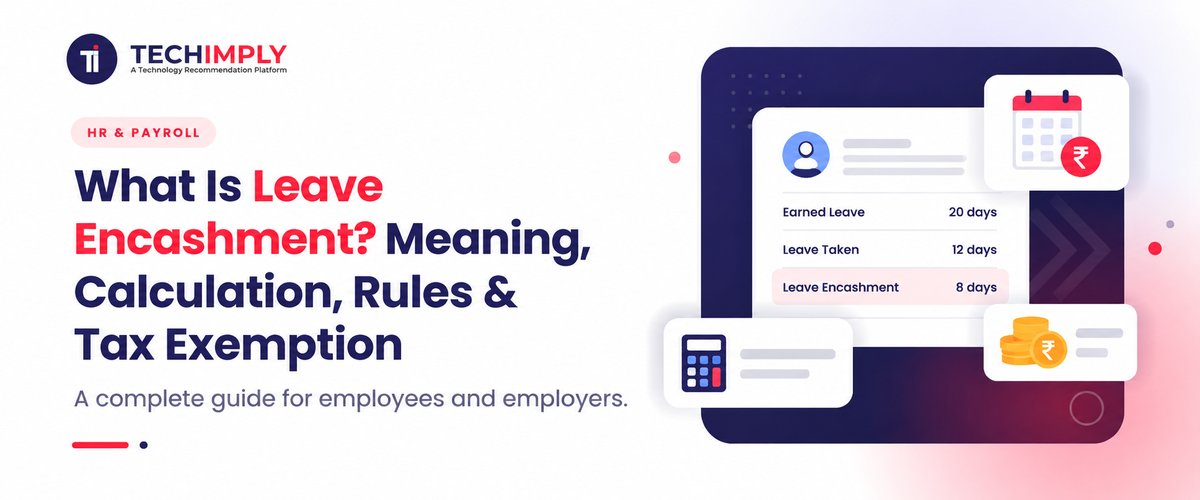
What is leave encashment? It refers to the cash payment an employer provides for earned leave days that an employee has not taken. Typically, this amount is calculated based on the employee’s basic pay and dearness allowance. The Indian government determines how to apply taxes to this payment based on the date of the transaction. The authorities have introduced new rules on how workers accrue and carry forward unused leave to the coming years with the introduction of new labor codes.
Leave Encashment Meaning: What the Payout Actually Covers
The term leave encashment describes the process where an organization converts unused paid time off into currency. The employer pays the worker a salary for those specific days instead of the worker being absent from duties. It is also called leave salary or leave payout in some companies.
Life insurance is a form of accumulation. It is an accumulation as a worker accumulates periods of employment. If the worker does not use the time, payroll management can choose to let the balance expire, roll it over to the next year, or pay it out. The method of payment is cash. Management applies this process when a worker retires, resigns, or leaves the company involuntarily. There is also a possibility of payment at the conclusion of a calendar year if the total days exceed the maximum limit for transfers.
Two points are worth keeping in mind from the start. First, encashment is a payment for leave that was earned but not taken, so it is not a bonus or an allowance. Second, whether you can encash leave at all, and how often, depends on your employer's policy and the law that applies to your workplace.
Do You Know?
Leave encashment during service is generally fully taxable, while eligible encashment received at retirement or resignation may qualify for tax exemption under applicable rules.
Which Types of Leave Can Be Encashed?
In private corporations, a worker is usually only able to convert earned leave, which is also identified as privilege leave, into cash. Casual leave and sick leave exist for sudden absences or medical conditions; those categories are generally not eligible for transfer or payment, although specific contracts sometimes allow for different outcomes.
|
Leave type |
Usually encashable? |
What to check |
|
Earned or privilege leave |
Yes, within policy limits |
Annual cap, minimum balance to retain, exit rules |
|
Casual leave |
Generally no |
Whether the policy allows carry-forward |
|
Sick leave |
Generally no |
Some employers allow limited encashment at retirement |
|
Compensatory off |
Depends on policy |
Expiry window and approval process |
For the tax exemption discussed later, the same logic applies: the relief is tied to earned leave at credit, not to casual or sick leave.
When Does Leave Encashment Happen?
There are four common triggers.
- During service: To manage leave during active employment, some organizations permit workers to convert a fraction of earned leave into money annually - this practice is governed by internal policy
- During a resignation, termination or retirement period; Employer will pay out any outstanding salary after all other employees have been paid their salaries.
- When the balance exceeds a specified limit:If the company policy or labor code sets a maximum for how much leave can be carried forward, if it exceeds that amount then any excess may need to be either paid out or forfeited, depending on the applicable rules.
- On the employee's death: Under the OSH Code, an heir or nominee can be entitled to the payment for earned leave at credit.
The timing matters for two reasons: it affects how quickly the money must be paid and, more importantly, whether any tax exemption is available.
How to Do the Leave Encashment Calculation
The Basic Formula
Most Indian employers use this structure:
Leave encashment = (Basic salary + Dearness allowance) ÷ 30 × Number of unused earned leave days
The part in brackets is the base that the policy considers monthly salary. Divide by 30 to get a per-day rate, then multiply by the days of eligible leave for the payout.
A Worked Example
If an employee earns a basic salary of ₹40,000 and receives a dearness allowance of ₹10,000 per month along with 18 unused earned leave days upon termination.
- Monthly base: ₹40,000 + ₹10,000 = ₹50,000
- Per-day rate: ₹50,000 ÷ 30 = ₹1,666.67
- Leave encashment: ₹1,666.67 × 18 = ₹30,000
House rent allowance, special allowance, bonus, and similar components are left out unless your policy says otherwise.
Why The Divisor And Salary Base Matter
The formula looks fixed, but two inputs vary from one employer to the next.
- The divisor: Many companies use 30. Some people count it as 26 workdays or the actual number of days in a month. The lower denominator increases cost per day; therefore, you should look at what is specified by this policy.
- The salary base: Some policies use basic plus DA. Others use gross pay or the definition of wages under the Code on Wages. The choice changes the payout noticeably, and it also changes the tax picture, as explained below.
The Code on Wages requires basic-type components to make up at least 50% of total remuneration. That can lift the base used in this formula for employees whose pay was earlier heavy on allowances. This is a simple example where an employee earns ₹1,00,000 per month and basic salary was ₹30,000 under the previous system. After restructuring for compliance with the 50% rule, basic is now ₹50,000. For 18 days, the payout moves from ₹18,000 (₹30,000 ÷ 30 × 18) to ₹30,000 (₹50,000 ÷ 30 × 18), even though the employee's total pay has not changed.
What the New Labour Codes Change for Leave Encashment
India's four labour codes came into force on 21 November 2025, and the leave provisions are among the parts that apply without waiting for every state to finalise its rules. These are the points that matter most for encashment, based on the OSH Code and the Code on Wages:
- Accrual of one day of leave for every 20 days worked by an adult worker, once the person has worked 180 days in a calendar year. The earlier threshold under the Factories Act was 240 days.
- Up to 30 days of earned leave is carry-forwardable. Above this amount should not be left unencashed; it must be collected instead of being lost.
- An employee who leaves, is dismissed, or dies during the year will be eligible for a leave of absence based on their 1-in-20 ratio per day worked over the course of that year, regardless of whether it reaches out to 180 days.
- Payment time is two days after the last working day as per the Code of Wages.
Two cautions apply. The encashment provisions are written around the legal category of a worker, and reports differ on how far they reach managerial and supervisory staff, so applicability depends on how your state defines the categories. Also, some states are still notifying their final rules, and a few states have their own carry-forward limits (for instance, Karnataka is reported to have a cap on carry-forward at 20 days, which is less favorable than the code, so the code’s 30 days is expected to prevail). If you are an employer, before you change anything, read the labor codes, your state’s Shops and Establishments rules, and your own policy.
Looking for Absence Management Software?
Check out Techimply's List of the Best Absence Management Software in India for your business.
Is Leave Encashment Taxable? Exemption Under Section 10(10AA)
The tax treatment is where most confusion arises, because it depends on when you receive the money and who your employer is. This is especially important to consider during tax preparation, as different rules may apply based on your specific situation.
Encashment During Service
If you encash leave while still employed, the entire amount is taxed as salary. No exemption applies, and your employer deducts TDS on it.
Encashment At Retirement Or Resignation
When the payout is for earned leave credited at the time you retire, resign, or otherwise leave service, Section 10(10AA) of the Income-tax Act, 1961 can exempt all or part of it.
- Central and state government employees: the entire amount is exempt.
- Other employees (private sector, public sector companies, most banks): the exemption is the least of these four amounts:
- The leave encashment actually received.
- The average monthly salary of the 10 months immediately before retirement or resignation, multiplied by 10.
- The cash equivalent of unused earned leave at credit, counting a maximum of 30 days for each year of service.
- ₹25 lakh.
- CBDT Notification No. 31/2023: The ₹25 lakh ceiling is for 1 April 2023 onward. It replaced the previous cap of ₹3 lakh. This is a cumulative figure: if you had encashment from more than one employer in a year, the total exemption cannot exceed ₹25 lakh, and the exemption you claimed in previous years will eat into the remaining amount. If you've previously claimed this exemption, let your new employer know. The exemption is available in both old and new tax regimes.
Worked Tax Example
Two employees resign after long service. Both have enough years of service that the 30-days-per-year cap does not restrict them.
|
Test |
Employee A |
Employee B |
|
Monthly salary (average of last 10 months) |
₹80,000 |
₹2,00,000 |
|
Unused earned leave days |
200 |
450 |
|
(1) Amount received |
₹5,33,333 |
₹30,00,000 |
|
(2) 10 months' average salary |
₹8,00,000 |
₹20,00,000 |
|
(3) Cash equivalent of leave at credit |
₹5,33,333 |
₹30,00,000 |
|
(4) Statutory limit |
₹25,00,000 |
₹25,00,000 |
|
Exempt amount (least of the four) |
₹5,33,333 |
₹20,00,000 |
|
Taxable as salary |
₹0 |
₹10,00,000 |
Employee A pays no tax on the payout. Employee B's exemption is limited by the 10-month salary test, not by the ₹25 lakh ceiling, which is a detail many people miss. The taxable amount of ₹10,00,000 is added to the income of the year, and TDS is deducted by the employer on this. In some cases, it may also be possible to claim relief under Section 89, which is worth raising with a tax professional.
Also note that if your employer calculates the payout on gross salary rather than basic plus DA, a part of it can become taxable even when the total is well below ₹ 25 lakh, because the 10-month salary test is based on a narrower definition of salary.
What Changes From April 2026
Income-tax Act, 2025 came into force on April 1st, 2026, replacing the 1961 Act, and most of its sections are numbered differently now. According to these documents, leave encashment relief falls under Section 19 of this Act, while the rules themselves- full exemption for government employees, a capped exemption for others- have been carried forward. The payroll deductions section numbers and regulations are updated now, so please check with a tax professional to get an accurate quote on them when you write policies or payslips.
Mistakes That Lead to Wrong Payouts
There are some recurring mistakes on the settlement sheets.
- Tax-free in-service encashment: Exemption is on leave at retirement/exit and not on annual encashment.
- Calculating on gross pay: When the policy says basic plus DA, it inflates the payout and pushes part of it into taxable income.
- Ignoring past exemptions: Because the ₹25 lakh limit is cumulative, an employee who has claimed relief at a previous job has a smaller amount left.
- Encashment balance is for earned leave only: The encashment balance applies only to paid time off; casual/absence days are excluded from it.
- Keeping the policy the same after the labor codes: The current state of affairs regarding accruals, carry forward limits, and settlement periods has changed; therefore, an existing agreement may not be up to date for compliance standards.
- Settlement deadlines are not met: Timely payments remain an issue of non-compliance due to their tardiness.

Pro-tip
Verify leave balance, salary components, method of calculation, applicable policy, and taxation before approving payout from leave. It helps prevent mistakes in the payslip/net payment process.
How HR Teams Can Handle Encashment Without Spreadsheet Errors
Leave encashment is often where things go wrong, with leave balances in one file, salary data in another, and policy rules somewhere in someone’s memory. Integrating a leave management system with payroll removes most of that friction.
When assessing leave management software, check these:
- Configurable accrual rules like a 1-in-20 rate, 180-day threshold, different rules for different employee groups or states.
- Carry forward limits that show balances over the cap before year-end.
- Encashment formulas that can be edited to match divisor and salary components to your policy, not a fixed template.
- Payroll integration to flow approved encashment into the salary run and full and final settlement without re-entry. This is where HR software and payroll software that have both modules save the most time.
- Tax treatment. TDS on the taxable portion. Record of exemptions already claimed.
- Record of who approved each encashment and the balance that was approved against.
If your team is small and rules for leave are simple, a stand-alone leave module can serve the purpose. A full HR and payroll suite is usually best if you have multiple states, permanent and contract staff, and regular exits.
Conclusion
If you are an employee, here are three questions to ask HR before accepting the settlement:
- What components of salary were used?
- What divisor was used?
- How many days were used?
Then compare the exempt figure to the four-part test above. If you are an employer, compare your leave policy with the labor codes and your state’s rules, decide on the salary base and divisor in writing, and do a few sample calculations before the next exit. Rules on this topic are still being notified state by state, so plan to review at least once a year.