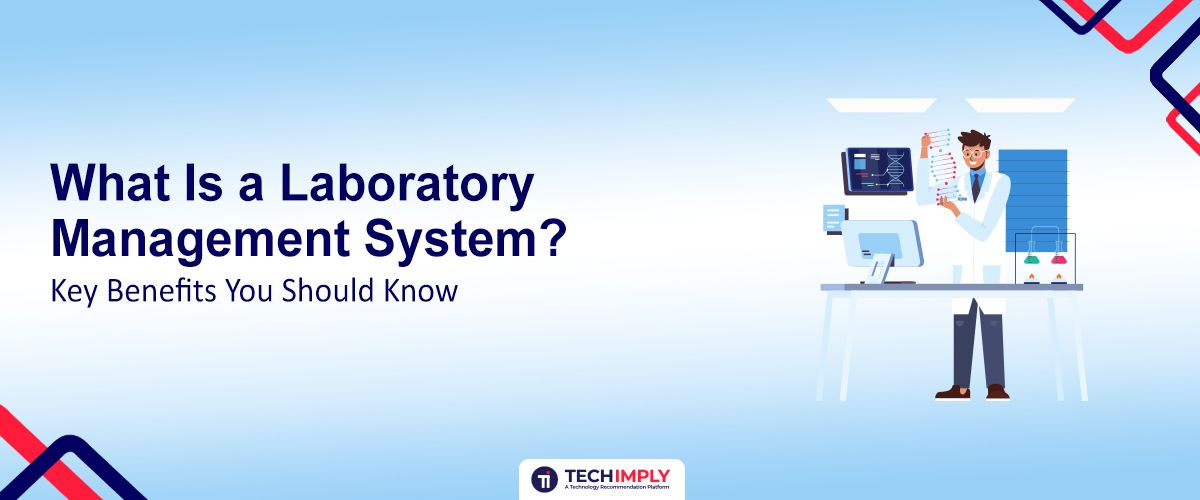
Research and medical laboratories are increasingly hit by the challenge of managing large volumes of data, compliance, and accuracy throughout operations. The necessity of effective managerial solutions has never been greater. That is where a Laboratory Management System (LMS) or so-called Laboratory Information Management System (LIMS) comes in.

Looking for Free Inventory Management Software?
Check out Techimply's Best Free Inventory Management Software for your business.
This is an innovative software that is changing how laboratories come to pass; it enables scientists, health workers, and researchers to save time, minimize errors, and be more productive. Whether wondering, what is a laboratory management system? Why is it so important? Discuss the idea behind a laboratory management system and its elements and operations, and outline the main advantages that you need to be aware of.
What Is a Laboratory Management System?
A Laboratory Management System (also known as a Laboratory Information Management System) is an online application that is used to automate and simplify laboratory processes. Managing samples and working processes as well as providing compliance and reports, an LMS provides the centralization of all the main lab operations in one simple-to-use system.
The core advantage is that a laboratory management system reduces manual operations, the possibility of making human mistakes is minimized, and data integrity is enhanced. When it is said, "What is a laboratory information management system?" The solution is that the combination of workflow automation, quality control, inventory control, and staff control can make the laboratories operate at an efficient and smooth flow.

Did You Know?
The market size of the Laboratory Information Management Systems is expected to reach over 2 billion dollars by 2028, and this indicates the significance of the systems in present-day laboratories.
Define Components of Effective Laboratory Management
A good lab management system is not merely the digitization of records, but it is more of a well-developed framework that encompasses all the important functions of a lab. These aspects guarantee the seamless functioning, increased precision, and increased adherence to the industry standards. We will examine the main pillars of effective laboratory management
1. Strategic Planning and Governance
Successful labs are those that have a clear vision as well as purpose. Strategic planning entails the establishment of performance objectives, distribution of resources in line with priorities, and establishment of governance policies that lead to the day-to-day running and the long-term growth.
2. Standard Operating Procedures (SOPs)
In the laboratory, consistency is important. Written SOPs are standard procedures in the processes, handling equipment, and safety measures. Effective SOPs decrease variability, enhance training and increase compliance.
3. Regulatory Compliance and Accreditation
Laboratories must adhere to strict regulations (such as ISO 17025, GLP, or FDA guidelines). A working compliance system ensures that the lab is operating in line with all the international standards and also the audits and accreditation of the system which instill trust and credibility.
4. Risk Management and Safety
Risk management is also important in the management of hazardous chemicals and in biosafety. Proactive risk management, safety training and incident response planning should also be included in the laboratory management because the measures will ensure the security of both the personnel and the information.
5. Resource and Infrastructure Management
Productivity is achieved through effective utilization of the laboratory space, equipment, and utilities. Infrastructure management will make sure that all the facilities are maintained in order, instruments are calibrated, and resources are put in their most required areas.
6. Financial Management and Budgeting
A laboratory has to be run with cost control. Budgeting helps to utilize funds properly to meet staffing, equipment, maintenance, and research needs. Financial management also assists labs to find cost-saving opportunities and to make the most out of an investment.
7. Human Resource Development
Any laboratory is dependent on its workforce. Management involves recruiting competent individuals, training them in order to give them ongoing training, promoting collaboration among employees, and ensuring that the workers are well-balanced. Well-trained and motivated staff directly relates to the quality of lab outcomes.
8. Continuous Improvement and Innovation
An atmosphere of continuous improvement is practiced in the best labs. It means that processes must be checked regularly, new technologies should be accepted, and innovation should be adopted to stay competitive and efficient in the constantly evolving scientific world.
Looking for Project Management Software?
Check out Techimply's Best Project Management Software for your business.
Key Functions of a Laboratory Information Management System (LIMS)
It is predicted that the laboratory information management market will grow to USD 3.9 billion in 2031, USD 4.3 billion in 2032, and USD 4.7 billion by 2033. The installation of the Laboratory Information Management System is not only about the digitalization of your lab. Here’s how:
1. Sample Management
Farewell to lost spreadsheets and handwritten notes. Using a LIMS, all data on the lab is safely stored, arranged and simple to access when required. This enhances tracing and auditing for regulatory examinations.
2. Workflow Automation
Automation eliminates routine activities, and the staff can use it to spend time on more significant activities. A laboratory information management system develops a uniform workflow that enhances the precision, effectiveness, and uniformity of all operations.
3. Data Management
Any lab is supported by data. Effective data management will provide the information to be kept at a single location. As the labs can protect delicate data and still be in line with industry standards, a LIMS can be used to ensure this.
4. Instrument Integration
Laboratory Information Management System (LIMS) maintains extensive audit records, compliance records, and processes that are conducted according to guidelines such as ISO 17025 or FDA 21 CFR Part 11. This will shield your lab against expensive non-compliance.
5. Quality Control & Assurance
In the digital world, cybersecurity and data integrity are the number one priorities. In a Laboratory Management System (LMS), sensitive lab information is secure since it has controlled access, encryption, and backup capabilities.
Quick Insights Poor inventory management contributes to nearly 20% of lab operation delays, highlighting why accurate tracking is vital.
6. Reporting & Analytics
Labs experience a radical increase in productivity by minimizing errors during the manual workflow, automating the workflow, and allowing real-time access to information. This guarantees improved results and quality outcomes.
7. Inventory Management
Lab inventory management refers to the process of tracking reagents, consumables and equipment to prevent shortages or delays. Combining inventory and workflows helps labs to decrease waste, save money, and maintain seamless work.
8. Staff Management
In addition to managing samples and data, a laboratory management system (LMS) can be used to allocate roles and performance and to keep staff training current. This brings in the extra efficiency and responsibility in the lab setup.
Looking for Lab Management Software?
Check out Techimply's Best Lab Management Software for your business.
Benefits of a Laboratory Information Management System (LIMS)
The implementation of a laboratory information management system (LIMS) is not only a question of digitization of your lab but also the release of long-time benefits. Here’s how:
1. Enhanced Data Management and Organization
Goodbye to spreadsheets in bits and pieces. Under a LIMS, all data of the lab is safely stored, arranged and simple to access when necessary. This enhances traceability as well as audits or regulatory checks.
2. Improved Workflow Automation
Automation minimizes the repetition of jobs and the staff members can undertake more of activities of high value. It also has a standard working system, thus accuracy and consistency throughout.
3. Streamlined Sample Tracking and Management
Samples are its lifeblood in a laboratory. Making the tracking process automatic will minimize chances of mislabeling or misplacing samples and improve the turnaround times. Laboratory Information Management System allows making sure that all the samples can be tracked between collection and disposal.
4. Increased Regulatory Compliance
Laboratory Information Management System maintains comprehensive audit records, a record of compliance, and processes are performed to comply with standards such as ISO 17025 or FDA 21 CFR Part 11. This will guard your lab against expensive nonconformity.
5. Data Integrity and Security
In the era of the digital world, the most important concern is cybersecurity and data integrity. A lab management system is used to assure secure storage of sensitive lab data that is controlled with access, encryption and backup.
6. Increased Productivity and Efficiency
It dramatically improves the productivity of labs through the reduction of manual errors, workflow automation and the introduction of real-time information accessibility. This will ensure quicker results and high-quality results.
7. Cost Reduction
The automation of workflows, the decrease of the numbers of human mistakes, and the real-time availability of information experience a significant increase in the work of labs. This is an indication of quicker results and more credible results.
Looking for Laboratory Information Management System (LIMS) Software?
Check out Techimply's Best Laboratory Information Management System (LIMS) for your business.
Conclusion
What then is a lab management system? In simple terms, it is an effective weapon that will enable laboratories to be smarter rather than work harder. A LIMS can help ensure that laboratories are efficient, precise, and ready to meet future needs through the unification of automation, data management, compliance, and staff administration. In such a world where data integrity, compliance and efficiency are non-negotiable, the cost of investing in a laboratory information management system is no longer a choice; it is a must. Be it samples, inventory or workflow, a LIMS provides the framework and intelligence that will succeed in the environment of modern labs.
Suggested Read:
- 6 Features to Look For In An Inventory Management Software
- 10 Ways Online Inventory Management Software Increases Sales & Profit
- Implementing Inventory Management Software to Your Inventory Strategy
- 7 Advantages of the Lab Management Software
- 10 Ways Lab Management Software Benefits Your Lab
- 8 Benefits of Using a Project Management Software
- The Role of Automation in Modern Project Management Software