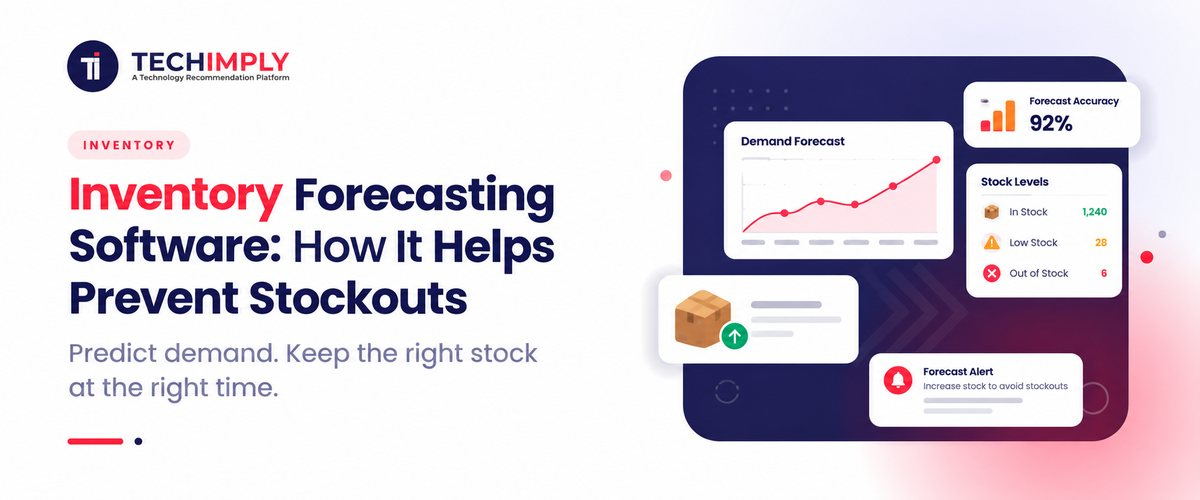
When a popular product runs out, businesses might miss sales, delay orders, upset customers, or even lose shelf space. But carrying too much stock also ties up cash in slow-moving inventory and drives up storage costs.
This is exactly where inventory forecasting software shines. It looks at sales history, current stock levels, seasonality, lead times, and other demand signals to predict what's needed and plan for replenishment.

Looking for Inventory Forecasting Software?
Check out Techimply's List of the best Inventory Forecasting Software for your business.
What Is Inventory Forecasting Software?
Inventory forecasting software is a tool that predicts future inventory requirements using historical and current business data. Its purpose is not simply to predict sales. It aids in the conversion of the anticipated demand into actual decisions on the quantity of stock to maintain, the time to place orders, and what to do first.
A typical system can analyse:
- Historical sales and order data
- Current stock levels
- Sales velocity
- Seasonal patterns
- Supplier lead times
- Purchase orders already in transit
- Promotions and planned campaigns
- Product-level demand trends
- Stockout history
- Inventory across multiple locations
The output may include a demand forecast, projected stockout date, recommended reorder point, safety stock level, or suggested purchase quantity.
This makes inventory forecasting different from simply looking at last month's sales.The software matches the forecasted demand with the inventory on hand and the lead time it takes to fill it.
How Does Inventory Forecasting Help Prevent Stockouts?
A stockout occurs when a business cannot fulfil demand because the required product is unavailable. Preventing it requires more than knowing how much sold last month.
The software generally works through a sequence like this:
Sales data → Demand forecast → Inventory position → Reorder point → Replenishment action
Suppose a retailer in India is selling 100 units of a particular accessory every week. It's typically shipped to us by our supplier in 14 days.
The business might not order enough products until the last few products are still in the warehouse, which might mean that they will no longer have any products to sell when the next batch arrives.
Reorder Point and Safety Stock
Two concepts are particularly important here: reorder point and safety stock.
The reorder point indicates when a business should place a new order. A simple approach is:
Reorder Point = Expected Demand During Lead Time + Safety Stock
Safety stock is used to cushion against uncertainty. The extra stock can buffer against a stockout if demand surges and/or if suppliers are delayed.
These can be determined by product demand, variability, lead times and business policies in modern inventory planning systems, not as one number per SKU.
What Data Does Inventory Forecasting Software Use?
The quality of a forecast depends heavily on the quality and relevance of its inputs.
Historical sales are usually the starting point, but they are not enough on their own. A good demand forecasting software setup can consider multiple signals.
1. Historical Sales
One important consideration is stockout history. If a product was out of stock for two weeks, recorded sales may be lower than actual customer demand. Forecasting systems that account for stockout periods can therefore provide a more realistic demand forecast.
2. Seasonality and Promotions
Demand rarely stays constant throughout the year.
Demand can rise or fall around festivals like Diwali, Navratri, Eid, regional festivals, wedding seasons, monsoon or the big ecommerce sale events for Indian businesses. These spikes may go undetected if the forecasts are based solely on an average monthly amount.
3. Supplier Lead Times
A forecast also needs to consider how long replenishment actually takes.
When the supplier has a consistent lead time of 7 days but during busy periods it is normally 12 to 15 days, the inventory plan should be based on this.
4. Current Inventory Position
The system should take into account what is already available, sold, and expected, based on open purchase orders.
It helps the business to predict future stock levels rather than assuming an order is made when no stock will be in the pipeline.
Key Benefits of Inventory Forecasting Software
The biggest benefit is better control over the balance between availability and excess inventory.
1. Reduce Stockouts
The system can identify products approaching their replenishment thresholds and highlight them before inventory reaches zero. This supports earlier stockout prevention and gives purchasing teams more time to act.
2. Reduce Overstock
Forecasting is not only about keeping more inventory. It can also identify products where expected demand does not justify another large purchase.
This can reduce unnecessary holding costs and free up working capital.
3. Improve Inventory Turnover
Better demand visibility can help businesses avoid holding excessive quantities of slow-moving products while keeping enough stock available for products with stronger demand. This can help improve inventory turnover and make better use of warehouse space and working capital.
4. Improve Cash Flow
Inventory represents money that has already been spent but has not necessarily generated revenue yet.
Optimized inventory, for example, can help companies avoid over investing in slow moving items, while ensuring the appropriate levels of availability are maintained for key SKUs.
5. Support Better Purchasing Decisions
Forecasts can be used to determine what to purchase, how much to purchase and when to purchase.
This is especially helpful when the supplier minimum order quantity, lead time or schedule is a factor in the purchasing decision.
Where Inventory Forecasting Software Fits Into a Business
Inventory forecasting software can support several types of businesses, but the way it is used will differ.
1. Retail and Ecommerce
Retailers can predict SKU demand and track stock levels throughout their stores, warehouses and online operations.
For an Indian D2C brand selling through its own website, Amazon, Flipkart, and offline distributors, a consolidated view can help reduce the risk of selling more units than are actually available.
2. Manufacturing
Manufacturers need to forecast not only finished goods but also raw materials and components.
If one of the low-cost components is not available, the production run may be delayed. The purchasing team can use inventory forecasting to forecast material quantities to be sourced based on material production and sales.
3. Wholesale and Distribution
Distributors often manage large product catalogues and varying supplier lead times. Forecasting can help identify which SKUs require replenishment and which products should not be reordered yet.
4. Multi-Location Businesses
A business with warehouses in Ahmedabad, Mumbai, Delhi, and Bengaluru may have enough stock overall but still experience a stockout at one location.
An effective inventory management system can combine forecasting with location-level stock visibility so that businesses can evaluate whether to reorder, transfer stock, or fulfil an order from another location.
Inventory Forecasting Software vs Inventory Management Software
Inventory forecasting software helps in predicting future needs and what inventory you may need. Unlike inventory tracking software, inventory management software extends beyond tracking inventory; it also includes the management of purchases, warehouses, orders, and inventory reports.
The two can work together. Many inventory management systems now include forecasting and replenishment features, while forecasting tools can connect with ERP, ecommerce, POS, and other inventory systems.
AI and Machine Learning in Inventory Forecasting
AI is becoming a more visible part of modern forecasting platforms, but it should not be treated as a guarantee of perfect predictions.
AI is increasingly becoming a more prominent feature of today's forecasting platforms, yet it should not be interpreted as a promise of accurate predictions every time. Depending on the platform, this may include seasonality, demand changes, promotions, customer behaviour, and other signals.
|
Traditional Forecasting |
AI/ML Forecasting |
|
Relies heavily on historical patterns |
Can analyse multiple demand signals |
|
Often uses predefined statistical methods |
Can identify more complex relationships |
|
Easier to interpret |
May require more data and monitoring |
What's critical for purchasers is the sophistication of the technology is insufficient to make up for bad data.
Even the most advanced inventory forecasting tool can give unreliable forecasts if sales are not complete, SKUs are not properly mapped, purchase orders are in arrears or supplier lead times are wrong.
How to Choose Inventory Forecasting Software
Before selecting an inventory forecasting tool, look beyond the forecasting model itself.
Check whether the platform supports:
- ERP, POS, ecommerce, or accounting integrations
- Multi-warehouse inventory
- SKU-level forecasting
- Seasonal demand forecasting
- Reorder point calculations
- Safety stock recommendations
- Purchase order management
- Supplier lead-time tracking
- Inventory alerts
- Reporting and forecast accuracy monitoring
- API or integration capabilities
- Role-based access and approval workflows
For Indian businesses, also consider whether the system fits your sales channels and operational model. A retailer selling through marketplaces may have very different requirements from a manufacturer supplying distributors.
Inventory Forecasting Software Implementation Tips
- Clean historical sales data.
- Identify stockout periods.
- Validate supplier lead times.
- Separate seasonal products from stable products.
- Start with high-value or fast-moving SKUs.
- Compare forecasted demand with actual sales.
- Review and adjust safety stock regularly.

Pro-tip
Don't test forecasting software with a trial set. Request vendors to show you how their system would cope with one of your real-life scenarios, for example if there is one week where the product is sold out or a supplier is delayed, or if there is a spike in demands during Diwali. That provides you a much better idea on whether such recommendations will be effective in actual practice.
What Are the Limitations?
No inventory forecasting software can predict the future perfectly.
Forecasts can be thrown off by unexpected events. Demand can change due to supplier shutdowns, unexpected competitor activity, new regulations, viral product trends, extreme weather, or an unexpected marketing campaign.
New products also present a challenge because there may be little or no historical data.
That's why the forecasting process should complement, not supplant, human decision-making. There remain exceptions to be considered, business plans, supplier constraints, and market information to be considered by buyers and planners.
Over time the accuracy of the forecasts should also be tracked. Instead of just raising safety stock for all products, the business should delve into the reasons for these forecasts and demand differences if they occur repeatedly.
Is Inventory Forecasting Software Worth It for Your Business?
If the business is small and has a few known, predictable stock-keeping units (SKUs), a simple spreadsheet and simple reordering rules could suffice.
The case for inventory forecasting software becomes stronger when the business has:
- Hundreds or thousands of SKUs
- Frequent stockouts or overstock
- Multiple warehouses
- Multiple sales channels
- Seasonal demand
- Long or variable supplier lead times
- Complex purchasing decisions
- A growing ecommerce operation
- Manufacturing or distribution requirements
The goal is not to buy the most sophisticated platform available. It is to select a system that delivers relevant forecasts from reliable information and links forecasts to real inventory decisions.
Conclusion
The most common cause of stockouts is the separation of demand, inventories, suppliers, and purchasing. This amalgamation of these factors is captured by inventory forecasting software that can forecast demand, plan inventory replenishment, and help prevent the occurrence of problem stockouts.
Indian retailers, manufacturers, distributors, and ecommerce companies can leverage the proper inventory forecasting software to gain better visibility of their stock, limit stockouts, and make better buying decisions. Select software that meets your SKU volume, sales channels, inventory locations, supplier lead times, and business requirements, rather than just based on the features or AI capabilities.
Related Reads-
- Retail POS System: Unified Checkout & Inventory Management
- Inventory Turnover Ratio Explained: Formula & Tips
- Predict Smarter: How Analytics Is Reinventing Inventory Management
- Smart Inventory Management with AI & QR Codes
- 7 Must-Have Features in Inventory & Stock Management Software
- 6 Features to Look For In An Inventory Management Software
- 10 Ways Online Inventory Management Software Increases Sales & Profit
- Inventory Management Software to Your Inventory Strategy