Almost every company has a version of the same conversation. A leader says, with some frustration, "We have a CRM, but nobody actually uses it." The reps log in when they have to, enter the bare minimum, and quietly run their real pipeline out of a spreadsheet or their own head. The expensive system sits half-empty, and everyone blames the software. Here's the uncomfortable truth that most CRM content won't tell you, because most of it is trying to sell you a different CRM: the software is almost never the problem.

Looking for CRM software?
Check out Techimply's List of the Best CRM Software in India for your business.
When change-management researchers dig into why these rollouts fail, they keep landing on the same finding. The failures are overwhelmingly about people and process, not technology. One widely cited analysis attributes more than 60% of CRM failures to people-related causes like resistance to change and inadequate training, roughly 30% to broken processes, and only 6 to 10% to the platform itself. Read that again.
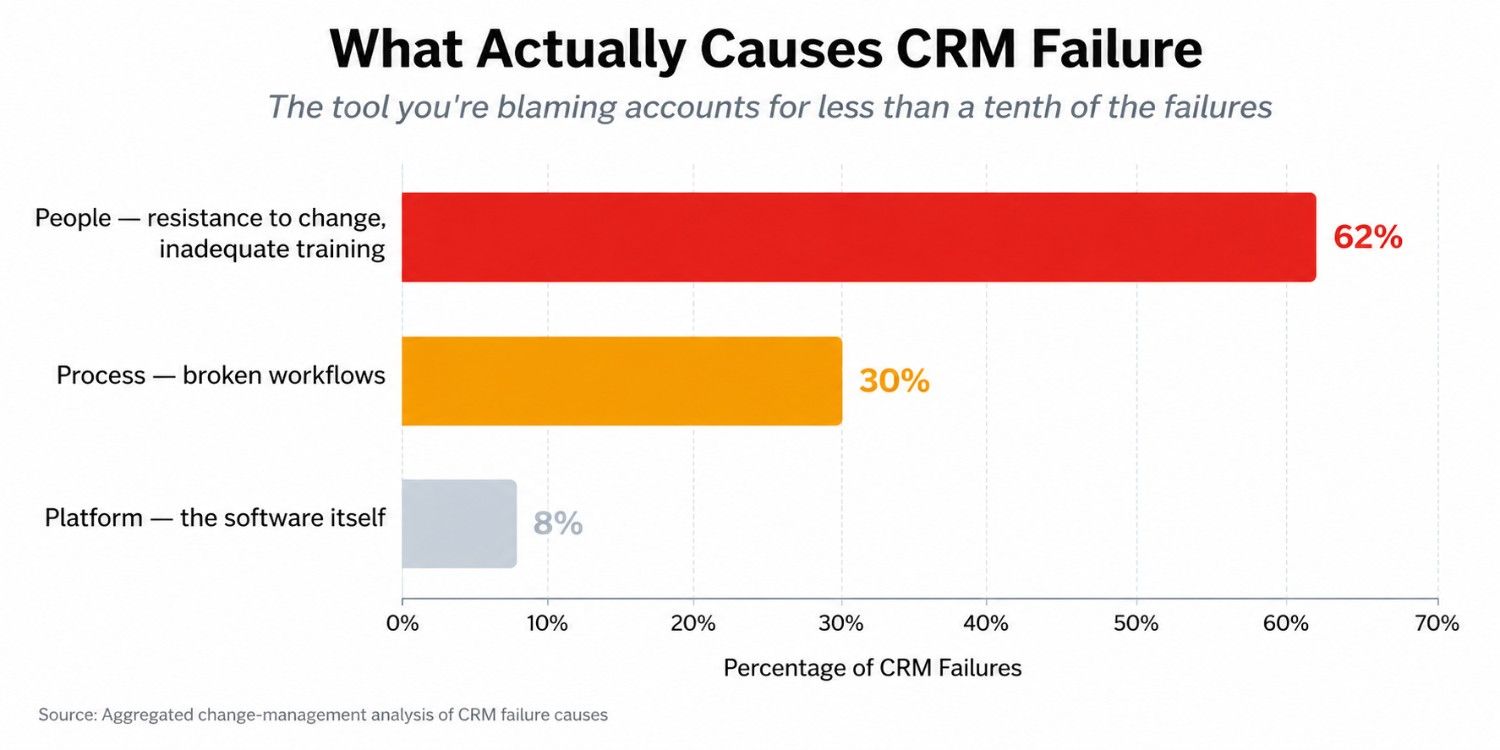
The tool you're blaming accounts for less than a tenth of the failures. Which means CRM adoption is a leadership and design problem wearing a software costume. Teams don't abandon a CRM because it lacks a feature. They abandon it because it costs them time without giving anything back, because their managers treat it as optional, and because nobody ever showed them how it fits the way they actually sell. This article is a straight diagnosis of why that happens and what genuinely fixes it, grounded in change-management evidence rather than the usual "get buy-in" hand-waving.
Why Reps Actually Stop Using It
If you want to fix adoption, you have to be honest about the reasons people quit. They're rarely mysterious, and they're almost always rational from the rep's point of view.
The CRM adds steps instead of saving reps time
This is the root of nearly everything else. A rep's job is to sell, and every minute spent feeding the CRM is a minute not spent doing that. If logging a call takes six clicks and three dropdowns, and the rep gets nothing useful in return, they'll stop. They're not lazy; they're doing the math. When the system feels like administrative tax rather than a tool that makes selling easier, people route around it, and a well-designed sales CRM software implementation is one where the fastest way to do the job is through the system, not despite it.
Managers don't use the CRM themselves
This one is fatal and often invisible to the leaders causing it. If a sales manager runs pipeline reviews off a spreadsheet the rep emailed them or asks, "What's the status on that deal?" in a hallway instead of looking it up, they've just told the entire team the CRM doesn't matter. People take their cues from what managers actually do, not what they say in a kickoff meeting. When the boss treats the CRM as optional, so does everyone else.
Onboarding and training were too generic
Most CRM training is a one-time demo where someone clicks through every feature for an hour while the team half-watches. Reps walk out with a login and no workflow. They were shown the software but never taught how it maps to their specific sales process, which means the first time they hit a real situation, they're guessing. Generic training produces generic non-use.
The CRM isn't integrated with daily tools
If the CRM doesn't talk to email, calendar, and the other tools a rep lives in all day, it becomes one more place to go, one more thing to update, disconnected from the actual flow of work. Every context switch is friction, and friction is where adoption dies. A strong lead management software setup that syncs tightly with daily tools feels like part of the workflow; a disconnected one feels like homework.
Reps see no payoff for the data they enter
People will tolerate data entry if they get something back for it: a timely reminder, a useful report, a clear next step, a deal that doesn't slip because the system flagged it. When reps pour information in and nothing comes out that helps them, the entry starts to feel pointless, and they're right. Data entry with no return is just unpaid clerical work.
What the Failure Numbers Actually Say
You'll see alarming CRM failure statistics thrown around constantly, and it's worth understanding what they do and don't mean before you quote them. The honest answer is that the numbers are real but slippery, because "failure" is measured inconsistently from one source to the next.
Industry reports commonly put the CRM project failure rate somewhere in the 20 to 70% range, which is a wide band for a reason. When Harvard Business Review aggregated a dozen analyst reports, the failure rates ranged from 18% to 69%. Johnny Grow's research landed on 55%; Forrester reported 47%. These aren't contradictions so much as different definitions measuring different things. It's also true, per widely cited figures, that around 91% of companies with ten or more employees now use a CRM, which tells you something important: adoption at the company level can look near-universal while day-to-day usage by actual reps quietly fails. Buying the software is not the same as using it.
The confusion clears up once you separate the three things people mean by "failure." There's project failure, where the rollout didn't meet its business objectives. There's adoption failure, where the system got deployed but people don't consistently use it. And there's data failure, where the CRM is used but the data quality is too poor for it to be worth anything. A company can hit one of these and not the others. You can have a technically successful implementation that no one adopts, or high adoption feeding a database so messy the reports lie.
|
Failure Type |
What It Means |
Looks Like |
Fixed By |
|
Project failure |
The rollout didn't meet business objectives |
System deployed, goals missed |
Scoping and process design |
|
Adoption failure |
Deployed, but people don't consistently use it |
Logins drop, reps run pipeline in spreadsheets |
Leadership behaviour, role training |
|
Data failure |
Used, but data quality is too poor to trust |
Reports contradict reality, forecasts miss |
Automation, record completion standards |
One frequently repeated statistic is that 43% of users tap less than half of their CRM's features, a figure attributed to DealCode AI. That's often quoted as a failure rate, but it's really a utilization number, and it makes a subtle point worth keeping: underuse is not the same as project failure, but it's the early warning sign that adoption is slipping. Across all these measures, though, one finding is remarkably consistent: poor user adoption is repeatedly named the single leading cause of CRM failure, ahead of data quality and budget problems combined. The verdict points back at people, not code.
How to Actually Fix Adoption
|
Why Reps Quit |
What Fixes It |
|
CRM adds steps instead of saving time |
Automate lead assignment, reminders, and stage updates |
|
Managers don't use it themselves |
Run every pipeline review and one-on-one inside the CRM |
|
Onboarding was generic |
Onboard by role and teach real tasks, not features |
|
Not integrated with daily tools |
Tight email and calendar sync |
|
No payoff for data entered |
Show each rep their personal gain: priorities, reminders, and fewer dropped deals |
Fixing CRM adoption isn't about squeezing reps harder or sending a sterner email about "keeping the CRM updated." It's about changing the conditions that made them quit in the first place. A few moves do most of the work.
Make managers run the business from the CRM
This is the highest-leverage change available, and it's free. When a sales manager conducts every pipeline review, every one-on-one, and every forecast conversation directly inside the CRM, refusing to accept a deal update that isn't in the system, the CRM stops being a reporting chore and becomes the operating system for sales. The rule that makes this stick is blunt: if it's not in the CRM, it didn't happen. The change-management research is emphatic here. Prosci's Best Practices studies have found for over two decades that active and visible sponsorship from leadership is the single biggest contributor to whether a change succeeds. Leadership behavior isn't one factor among many. It's the factor.
Automate the manual data entry away
Every step you can remove is a step reps don't have to resent. Automating lead assignment, follow-up reminders, and stage updates strips out the tedious data entry that made the system feel like a burden. The less clerical work the CRM demands, the less reason anyone has to avoid it, and this is where good Salesforce automation software proves its worth, quietly handling the routine updates so reps can spend their attention on selling rather than logging.
Onboard by role, not by feature
Scrap the one-size-fits-all demo. A sales rep, a sales manager, and a support user do completely different things in the CRM, and they need to be taught the exact tasks their jobs require in the context of their actual workflows. Role-based onboarding gives people a usable path through the system on day one instead of a tour of features they'll never touch, because each role abandons the system for a different reason.
Show each rep what they personally gain from it
Buy-in doesn't come from being told the CRM is good for "the business." It comes from a rep seeing that it makes their own day better: faster follow-up, clearer priorities on which deals to chase, less admin, and fewer dropped balls. When the personal payoff is obvious, adoption stops feeling mandatory and starts feeling smart. A clean sales pipeline management software view that instantly shows a rep which deals need attention today is worth more than any amount of top-down insistence.
Keep the CRM connected to daily tools
The CRM should live inside the rep's existing workflow, tightly integrated with email and calendar, so updating it isn't a separate errand. The closer it sits to where work actually happens, the less friction there is, and friction is the enemy of every adoption effort.
What Effective CRM Adoption Training Looks Like
Most companies treat training as a launch-day event: one big session, a slide deck, and then silence. That approach is precisely why adoption fades. The change-management evidence is clear that the highest-risk window is months three to six after go-live, when the initial training has worn off and old habits reassert themselves. Training that ends on launch day is training designed to fail at exactly the moment it's needed most. Here's what actually works instead.
Effective training is role-specific, teaching each group the real tasks they'll perform rather than a generic walkthrough for everyone. It comes in multiple formats, because people learn differently: live workshops, short videos, one-page cheat sheets, and a sandbox where users can practice without fear of breaking something real. It includes on-the-job support, so when someone gets stuck mid-task, they can find a searchable answer, an FAQ, or a peer to ask rather than giving up and reverting to the spreadsheet. Crucially, it's reinforced over time, with 30-day check-ins, periodic refreshers, and updates as features change, instead of being declared finished at launch.
And it leans on CRM champions. Appointing respected power users within each team, people who genuinely know the system and can coach their colleagues, does something no formal training program can: it normalizes proper CRM use as a peer behavior rather than a management mandate. When the person at the next desk uses the CRM well and can help you when you're stuck, adoption spreads horizontally. This maps directly onto how sustainable change actually happens, moving people through awareness and knowledge all the way to the ability and reinforcement stages where a new behavior finally sticks.
What to Measure
You can't manage CRM adoption if you're measuring the wrong thing, and most companies measure the wrong thing. Tracking how many people attended the training tells you nothing about whether they use the system. Attendance is not adoption.
The metrics that actually reveal adoption are behavioral. Login frequency shows whether people are even opening the system. Record completion shows whether they're entering the data that makes it useful or just the bare minimum to avoid a nag. Workflow usage, whether reps are actually running their deals and follow-ups through the CRM, shows whether it's genuinely embedded in how they work or just a place they occasionally visit. These are the signals worth watching, because they measure behavior rather than compliance theater.
The clearest sign of success isn't a number on a dashboard at all. It's when the CRM has quietly become part of the normal sales process, the default place work happens, rather than an extra reporting task bolted on at the end of the day. When updating the CRM is simply how deals move forward, you've won. Watch the behavioral metrics to catch problems early, especially through that risky three-to-six-month window, and treat any slide in the numbers as a prompt to fix a real blocker rather than to send another reminder email.
The Rule That Ties It Together
If you strip all of this down to something you can actually hold onto, it's three moves in sequence: train for tasks, reinforce habits, and manage behavior.
Training for tasks means teaching people the specific things they need to do in the system, by role, not touring them through features. Reinforcing habits means treating adoption as an ongoing effort with check-ins and champions and support, not a launch-day event that ends when the session does. Managing behavior means leadership living in the CRM, running the business from it, and measuring the behaviors that show real usage rather than the attendance that shows none. Do those three things, and the software you already own starts earning its keep.
Conclusion
Here's the quiet lesson underneath every abandoned CRM: the system was rarely the thing that failed, the rollout was. Teams stop using their CRM when it costs them more time than it gives back, when their leaders don't model using it, and when training ends before habits ever form. None of those are software problems, which is why buying a different CRM so rarely fixes them. The good news is that the fix is within your control and doesn't require a new purchase. Make managers run the business from the CRM, automate the busywork out of it, train and reinforce by role, and show every rep what they personally get back for the data they enter. Do that, and adoption follows, not because you found better software, but because you finally gave your team a reason to use what they already have.