Indian factories and manufacturing units operate in a high-pressure environment where every second on the production floor directly impacts profitability. Unlike typical corporate environments, a manufacturing business must manage two entirely different working cultures simultaneously: desk-based office executives and rostered shop floor labourers. Balancing these separate teams manually through paper registers or outdated spreadsheets creates massive operational gaps and communication silos. According to the groundbreaking NITI Aayog Industry 4.0 Report on Indian Manufacturing, accelerating digital adoption and automation across human resource workflows is now an absolute prerequisite to scaling production output nationwide.

Looking for HR Software?
Check out Techimply's List of the Best HR Software in India for your business.
This is exactly where specialized HR Software steps in to transform your daily operations. Instead of forcing your administrative team to spend weeks cross-checking punch cards and manual logs, modern systems bridge the gap between your corporate desks and your heavy assembly lines. Furthermore, data from the PwC India Workforce Tech Survey highlights that factories moving away from disconnected systems experience a sharp 30% reduction in data entry leaks. Implementing a unified platform allows your enterprise to wipe out manual mathematical mistakes, secure your data against attendance fraud, and unlock the true productivity potential of your entire industrial workforce.
Why Manufacturing Units Need Specialized HR Software
1. Large workforce
Industrial factories across India typically employ huge numbers of workers to keep their assembly lines running around the clock. Tracking the personal files, government compliance forms, and daily training logs for thousands of individuals is an absolute nightmare if done manually on paper. A basic office application simply cannot handle the extreme data scale required by a heavy industrial plant. Utilizing a robust HR management software allows your administrative managers to store, retrieve, and monitor every single worker file instantly from a secure cloud database, eliminating messy filing cabinets completely.
2. Multiple shifts
Industrial plants operate continuously, running day, night, and early morning production schedules to maximize machinery utilization. Manually planning weekly rosters for hundreds of workers across changing shift cycles leads to major scheduling gaps and costly assembly line shutdowns. An advanced Workforce Management Software solution automates this complex scheduling puzzle completely. The software monitors real-time production requirements, assigns workers to specific machines based on their skills, and flags scheduling conflicts automatically before the morning shift even begins.
3. Different employee categories
A typical Indian industrial enterprise employs a complex mix of permanent office executives, contractual assembly line technicians, and seasonal daily-wage workers. Each category operates under completely different employment rules, payment packages, and government tax structures. A standard corporate software package cannot navigate these complex legal variations. Deploying specialized HR software for manufacturing ensures your system applies the correct legal frameworks, tax deductions, and insurance rules to each distinct worker category automatically.
4. Attendance and overtime challenges
Tracking exact clock-in times across a sprawling industrial plant is incredibly difficult because workers can enter through multiple gates. Buddy punching, where one worker scans a card for an absent friend, costs Indian industrial companies millions of rupees every single year. Furthermore, manually calculating extra operational hours during sudden production rushes is highly prone to human mathematical mistakes. Implementing dedicated Time and Attendance Software connected to physical biometric scanners eliminates tracking fraud entirely and records every single working second with 1000% precision.
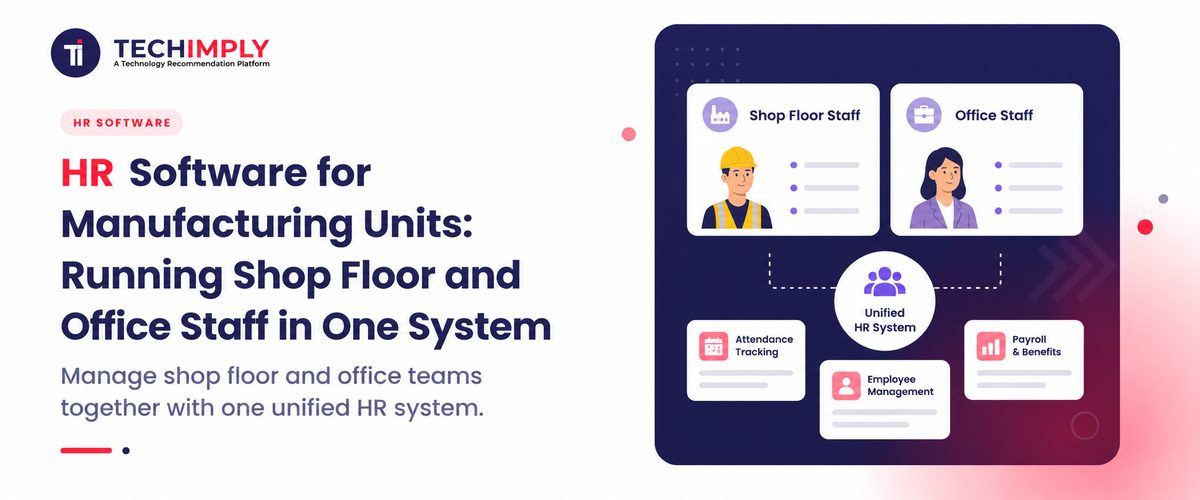
Managing Shop Floor and Office Staff in One System
1. Shift-based employees
Industrial line operators need clear, transparent tracking tools that match their dynamic work environments. A good Manufacturing HRMS will enable team leaders to configure rotational shift patterns, late penalties, and night-shift incentives and utilize them fully. Using advanced biometric scanners, floor staff attendance is captured accurately and without the need for old-style handwritten or even digital attendance sheets.
2. Office employees
Corporate office teams like sales, finance, and design operate under a completely different corporate culture with fixed daytime hours and remote work needs. A centralized HRMS software accommodates these staff members perfectly by offering web-based logins and mobile geo-fencing tracking. This ensures your corporate staff can request leave, log business trips, and view appraisal structures using the exact same database engine that tracks your industrial plant machinery operators.
3. Contract and permanent workers
Indian employment laws are very strict when it comes to distinguishing between agency and direct employees. Failing to do so in day-to-day operations may result in adverse legal and union consequences. Utilizing specialized HR software for factories keeps these databases securely partitioned yet operationally aligned. The system tracks contractor agency invoices separately while managing your permanent internal staff records on a completely different core ledger.
4. Centralized employee records
When your administrative data is split across multiple separate software systems, finding a single piece of worker information takes hours of frustrating searching. A comprehensive HR management system unifies your entire business intelligence into a single, clean dashboard. “Whether you need to review an office manager’s academic degrees or verify a machine operator’s safety certification, Learning Management Software can help maintain employee training and certification records in one place.
Key HR Features for Manufacturing Units
1. Attendance and shift management
A heavy-duty Shop floor HR software must be capable of processing thousands of complex biometric check-ins simultaneously during intense shift changeovers. The platform manages multiple complex attendance-related parameters automatically and in real-time such as grace periods for late arrivals, number of shifts cut short in half-days automatically and rules for extending shifts. This means that plant managers can immediately identify any shortage in the workforce and move workers to different production lines before there is a disruption in production.
2. Leave management
Managing time-off requests manually using paper forms causes major operational chaos on the factory floor. A modern employee management software digitizes this entire request pipeline. Workers may apply for leave using Employee Management Software through mobile applications or automated digital kiosks. The software is designed to automatically route the request to the appropriate supervisor. In turn, the latter can ensure that production line coverage is maintained before approving.
3.Overtime
Extra hours are an absolute reality in the industrial sector to meet sudden client delivery deadlines. However, tracking extra hours manually leads to massive financial leaks and frequent worker disputes over unpaid time. A specialized Manufacturing HR software calculates extra hours automatically by comparing real-time biometric checkout data against the master shift roster. The system applies the correct double-wage modifiers automatically, keeping your business fully compliant with Indian labour laws.
4. Payroll
Calculating final monthly salaries for a split workforce involves navigating an incredibly complex web of variables, including basic pay, dearness allowance, provident fund deductions, and employee state insurance contributions. Utilizing dedicated Payroll Software automates this massive mathematical challenge completely. The engine processes thousands of distinct salary structures in seconds, generating accurate bank transfer files and compliant digital payslips automatically without requiring human calculation.
5. Employee records and reports
To maintain strict quality and safety standards, industrial units must maintain up-to-date health checkup records, accident logs, and machinery operation certifications. A sophisticated HRMS made for manufacturing will remind you when an operator’s safety license is up for renewal to help you avoid any mishaps and huge penalties that come along with them.
How HR Software Simplifies Attendance, Shifts & Payroll
Attendance → Shifts → Overtime → Leave → Payroll
In an outdated administrative setup, processing the monthly payroll requires days of stressful manual data matching. The human resource team has to gather paper attendance books, cross-check them with the rotating shift roster, calculate the extra hours manually, deduct unauthorized leaves, and finally type these figures in a different spreadsheet for payment purposes. It is a very tedious process involving multiple steps that are costly and highly prone to errors.
A modern workforce management software transforms this entire workflow into a single, automated digital pipeline. The process flows seamlessly: Employee attendance software captures a worker's biometric thumbprint at the factory gate. The central engine matches that timestamp against the assigned shift schedule to see if they arrived on time. If the worker stays late to complete a production run, the system calculates the extra hours instantly. Simultaneously, the platform checks if any missed days were covered by approved digital leaves. Finally comes the turn of the Factory payroll software, which is used to take the thoroughly validated data package and produce the final pay to the very penny. By tying the entire process together, a company can eliminate the need for data entry, slash the time taken to process payroll, and ensure that every worker is paid accurately and on time every month.
How to Choose HR Software for Your Manufacturing Unit
1. Multi-shift support
When evaluating potential software platforms for your industrial unit, your top priority must be the platform's ability to handle highly complex scheduling rules. The software has to be able to handle rotating shifts, night shifts, 24-hour production cycles, and ad hoc shift swaps. It has to be more than just your regular vanilla corporate software meant to handle only 9-to-5 type of work, because it will not survive the harsh realities of the factory floor.
2. Attendance integration
The system you select must be native to the heavy-duty equipment. It should effortlessly communicate with biometric fingerprint scanners and facial recognition cameras at the factory entrance and RFID card gated access points. Advanced Factory HR software can extract tracking data from these devices in real-time to prevent tampering and ensure that managers can see precisely who is on the floor at any given moment.
3. Payroll capabilities
Your chosen platform must be an excellent financial calculations engine capable of handling unique industrial compensation models. The POS billing system equivalent for human resources, your core payroll software module must automatically calculate complex structures like piece-rate wages, production bonuses, and statutory deductions like PF, ESI, and Professional Tax. Automated compliance reporting ensures your business passes government inspections without a single hitch.
4. Employee self-service
Because industrial floor workers do not sit at office desks with corporate computers, your software must provide alternative digital touchpoints. Look for a Manufacturing employee management platform that offers a highly intuitive, multilingual mobile app or support for standalone touch-screen kiosks placed directly on the shop floor.
5. Reporting and scalability
As your manufacturing business expands by adding new production lines and opening new factory units across India, your data requirements will scale up massively.
Conclusion
In summary, running a modern industrial facility with separate spreadsheets for your corporate office and your production floor is a recipe for operational chaos. By investing in a high-quality, comprehensive Manufacturing HRMS, you give your industrial brand a solid digital foundation to optimize labour costs, keep your production lines moving perfectly, and successfully scale your manufacturing business across India’s competitive industrial landscape.


.jpg "8 Reasons Why Employee Engagement Software is Important for Your Business")