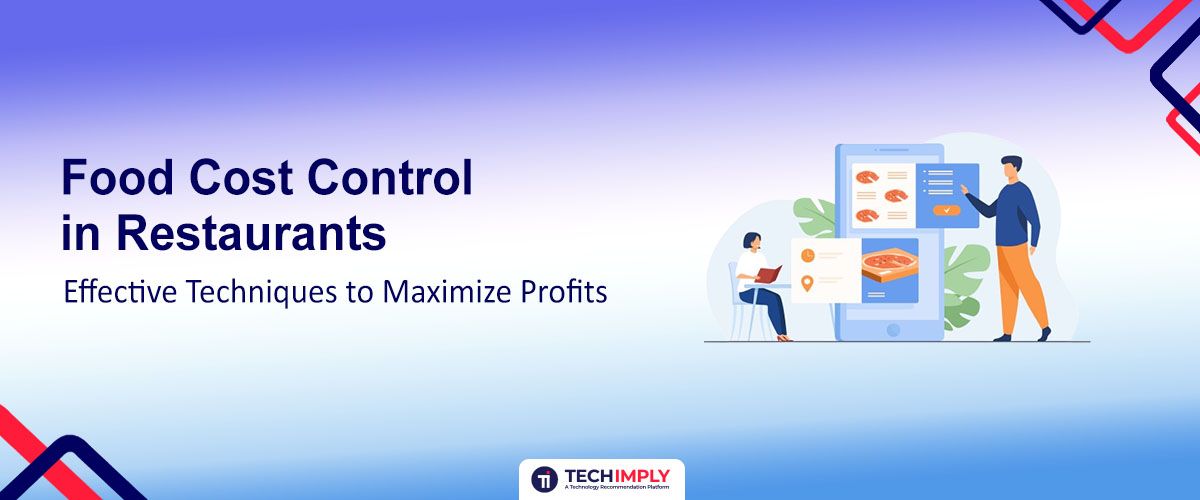
Managing a successful kitchen requires more than just culinary talent; it demands a rigorous approach to financial oversight. Implementing Cost Control in Restaurants ensures that your passion for food translates into a sustainable business model. In 2026, the ability to balance high-quality ingredients with smart spending is what separates thriving establishments from those that struggle to stay afloat.

Looking for Restaurant POS Software?
Check out Techimply's List of the Best Restaurant POS Software in India for your business.
To achieve long-term growth, you must treat Food Cost Control as a daily discipline rather than a monthly chore. Effective Cost Control in Restaurants involves analyzing every plate that leaves the kitchen and every shipment that enters the loading dock. When you master your food cost percentage, you gain the clarity needed to make informed decisions about pricing, staffing, and expansion.
The Foundation: Master Your Food Cost Percentage
The most crucial one of your financial tools is the percentage of your Food cost. It is a percentage of your sales revenue that is spent on buying the ingredients. Although there is a general rule of thumb that the target should be somewhere between 28% and 35%, the actual ideal number would rely on your particular concept and style of service.
The Standard Formula for Success
In order to come up with this figure, it is very important to have a standard formula. The Cost of Goods Sold (COGS) is the number you can get by tracking your inventory at the beginning and the end of a certain time. The standard calculation is.
Food Cost Percentage = (Beginning Inventory + Purchases - Ending Inventory) / Total Food Sales x 100
Using the following formula on a weekly basis, it is possible to detect price spikes of suppliers or internal problems such as theft and over-portioning.
Understanding Actual vs. Theoretical (AvT) Food Cost
The difference between your Theoretical Cost (that you should have spent according to your recipes) and your Actual Cost (what you actually spent) is the key to profit secrets. This variance makes out the inefficiencies. When you think your cost is 30% but you actually incur 34%, then you are losing 4% of your revenue to waste, shrinkage, or bad preparations. The best method of improving your bottom line is by reducing this variance.
Setting Realistic Targets for 2026
In 2026, your overhead will be affected by external influences such as climate-based supply chains and changing labor legislation. You must have goals that take note of the seasonality. A target should not be too hard but rather flexible and based on facts, and this enables your team to adjust to the market changes without losing rigorous Control over Cost.

Do You Know?
Any 2% decrease in your food cost percentage can increase your net profit of a restaurant by up to 20%, depending on your volume.
Strategic Menu Engineering: Psychology Meets Profit
Menu engineering is the deliberate design of your menu to encourage guests to buy the items you want them to buy, specifically, the high-profit ones. It is an ongoing process of evaluating the profitability and popularity of every dish.
Categorizing Your Menu: Stars, Plowhorses, Puzzles, and Dogs
Using the Boston Consulting Group Matrix adapted for restaurants, you can categorize items into four groups:
Stars: High popularity and high profitability. These are your champions; keep them consistent.
Plowhorses: High popularity but low profitability. You should consider slight price increases or reducing portion sizes for these items.
Puzzles: Low popularity but high profitability. These need better placement on the menu or a descriptive rewrite to entice more orders.
Dogs: Low population and low profitability. Remove these from the menu to simplify your inventory.
The Anchor Strategy
The Anchor strategy involves placing a high-priced item at the top of a menu section. When guests see a premium steak for $65, the $38 salmon underneath it feels like a bargain. This psychological framing guides the guest toward items that provide excellent margins for the house.
Cross-Utilization of Ingredients
One of the most effective Cost Control techniques is limiting your pantry. If an ingredient only appears in one dish, it is a liability. For example, if you use kale for a specific salad, try incorporating it into a breakfast smoothie or a sautéed side dish. Cross-utilization reduces the risk of spoilage and allows you to buy in larger quantities at better prices.
Modern Inventory Management & Waste Reduction
Inventory is simply a form of cash that is on your shelves and in an edible state. Otherwise, that money will be in the garbage bin. The process of cutting waste in restaurants begins with a well-organized perspective on the processing of products.
The FIFO Method and Storage Optimization
One of the main principles of Food Cost Control is the so-called First In, First Out (FIFO) approach. Make your team mark all the things with the date of receiving and the date of expiry. The older stock should always be behind the newer stock. Moreover, the correct storage, including placing the proteins on a lower shelf and calibration of thermometers, prevents the untimely spoilage.
Implementing Daily Flash Counts
You simply do not have to count all of the spices in the house daily, but you must conduct what are called flash counts in high-value products such as steaks, seafood, and costly cheeses. It is immediate accountability since you can compare the number of steaks that were sold using your POS and the number that were missing when they were walking in.
Waste Logs and Spoilage Tracking
You will not be able to control what you do not measure. A Waste Log is used to track all the burnt burgers, the dropped plates, or the carton of expired cream. The staff will be more mindful when they are required to document their errors. The analysis of these logs can help you know whether a particular cook requires additional training or whether your level of ordering is always too high.
Looking for Restaurant Management Software?
Check out Techimply's List of the Best Restaurant Management Software in India for your business.
Advanced Technology: Using Your POS for Cost Control
The restaurant POS market was estimated to be valued at USD 18.5 billion in 2025 and is projected to reach USD 56.9 billion by 2035, registering a compound annual growth rate (CAGR) of 11.9% over the forecast period. This rapid growth highlights how essential digital integration has become for maintaining Cost Control in Restaurants.
Real-Time Stock Depletion
Modern POS systems automatically deduct ingredients from your inventory as items are sold. This real-time tracking allows you to see your stock levels at a glance without stepping into the dry storage area. It provides a level of Cost Control that manual spreadsheets simply cannot match.
Integrated Supplier Management
When you integrate your POS with your suppliers, you can track price fluctuations instantly. If the price of chicken rises by 15%, your system can alert you, allowing you to adjust your menu prices or find an alternative vendor before your margins erode.
Data-Driven Demand Forecasting
Smart systems analyze historical sales data to predict future needs. If your POS knows that you typically sell 40% more pasta on rainy Tuesday nights, it can suggest more accurate ordering quantities. This precision is the ultimate weapon for restaurant waste reduction.
Pro-tip
Set up Low Stock Alerts in your POS system for your top 10 most expensive ingredients to prevent emergency runs to the local grocery store, which often cost 30% more than wholesale
Staff Training: The Human Element of Cost Control
The best software money can buy will not work unless your Food Cost Control initiative includes having your line cook rely on his or her eyeball to gauge the size of the portions of the cheese. It is your team members who will, in actuality, implement your cost-saving strategies.
Standardized Recipes and Portioning Tools
A standard recipe is an elaborate plan of all dishes. It has uniformity in taste and price. All the stations must have these recipes and measuring instruments, such as scales, leveled scoops, and certain ladles. When a recipe requires 4 ounces of protein, it will cost this plate 25% more to have 5 ounces of protein.
Creating a Culture of Awareness
Disclose the cost of doing business to your staff. The employees feel a greater sense of responsibility when they realize that a damaged dish or a lost steak affects the capacity of the restaurant to provide them with a raise or new machinery. Incentivization of Food Cost Control: This will reward the kitchen team when they reach their monthly targets.
Training on Receiving Protocols
The cost Control is at the back door. Develop your reception personnel to verify all the invoices with the physical delivery. They are expected to weigh, make sure that the temperature of the chilled products is correct, and ensure that the quality corresponds to your standards. One should not buy a bag of 50lb of onions when it only weighs 45 lbs.
Conclusion
Mastering Cost Control in Restaurants is a continuous journey of refinement and observation. By focusing on your Food cost percentage, utilizing a standardized recipe for every dish, and leveraging the power of a modern POS, you can protect your profits from the common pitfalls of the industry. Remember that Food Cost Control is not about being cheap; it is about being efficient. When you eliminate waste and optimize your menu through clever menu engineering, you create a more resilient business that can provide better value to your customers and a better environment for your staff. Start implementing these techniques today, and watch your margins grow in 2026.